





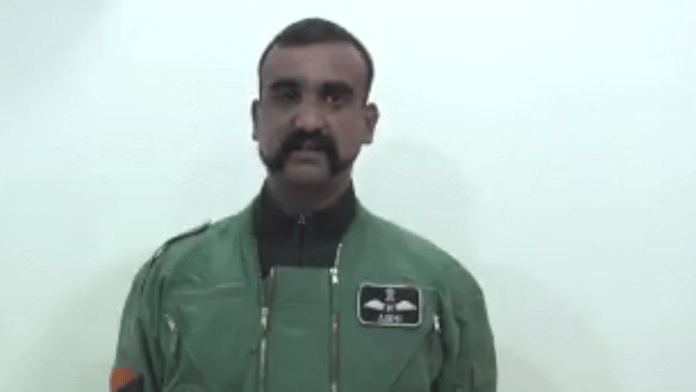



Trump and his team proudly detailed on Monday the success of a dramatic combat-search-and-rescue mission that extracted two US airmen from behind enemy lines. Seven years ago, India had also secured the release of an airman from behind enemy lines. But India achieved its objective by deploying coercive diplomacy, not military power. When Wing Commander Abhinandan Varthaman dropped into Pakistan after his plane was shot down on 27 February 2019, India used smart diplomacy to bring him back. India activated multiple diplomatic channels, backed by a credible threat of escalation with missile strikes, if the pilot was not returned. Pakistan reacted quickly, releasing the pilot as a ‘peace gesture’, after just two nights in captivity. Abhinandan was back home barely 60 hours after he parachuted into enemy territory. The then High Commissioner of India in Pakistan, Ajay Bisaria, who was closely involved with the negotiations on the release of the Indian pilot, describes the events in fascinating detail in his book, Anger Management.
Wing Commander Abhinandan Varthaman flew the MiG-21 bison that was part of the air defence sortie scrambled to intercept Pakistani aircraft on the morning of 27 February. In the ensuing aerial dogfight, his aircraft was struck by a missile and crashed, but Varthaman safely ejected, to descend into a village in Pakistan-occupied Kashmir, some 7 kilometres from the LoC. Varthaman was initially captured and assaulted by locals before army soldiers took him into custody. Soon, Varthaman became for the Indian public both a symbol of heroism—having engaged an enemy aircraft—and the human cost of the skirmish. He also became the lightning rod for the diplomatic action of the next few days and its primary focus.
India’s demands for Pakistan were clear. Pakistan had retaliated against India’s pre-emptive counterterrorism action. It had responded by attacking military targets. It had captured an Indian pilot and violated the Geneva Conventions. India would expect the pilot not to come to any harm. Pakistan should exercise restraint and responsibility; any provocation along the LoC would not be tolerated.
India had activated multiple diplomatic channels to deal with the crisis. Pakistan on its part was trying to drag the matter to the UN, as an issue that threatened regional peace and stability. Foreign Secretary Vijay Gokhale in Delhi had emphasized to the US and UK that any attempt by Pakistan to escalate the situation further or to cause harm to Varthaman would lead to an escalation by India; raising this issue at the UNSC instead of resolving the issue of terror could also lead to an escalated response from India. Other channels were in play to send similar messages to countries with influence over Pakistan, particularly the UAE and Saudi Arabia.
The US ambassador to India, Ken Juster, and UK envoy, Dominic Asquith, worked with their counterparts in Islamabad, Paul Jones, and Tom Drew, to impress upon Pakistani interlocutors that India was serious. Frenetic diplomatic action was unfolding in Pakistan. India’s hard messages were being conveyed both in the diplomatic bubble of Islamabad and at general headquarters, Rawalpindi. The diplomats of the P5 in particular had been called in by the foreign office ‘thrice in rapid succession’ after 26 February, most of the time separately. To the diplomats, Pakistan appeared genuinely spooked by the prospects of an escalation in the conflict. At the same time, Pakistani officials, as also ISI officers, were insisting that they had no direct role in the Pulwama attack. It had been claimed by the JeM, which was based in Pakistan, but had no connection with the army or with Bajwa personally.
Pakistan’s public and private talking points included the default position that the Pulwama attacker was a local Kashmiri, the video of the JeM owning responsibility was suspect, the weapons shown in the video were not Pakistani, and that the flag displayed in the video did not belong to the JeM. There was ‘considerable pushback’ by the US, UK, and France to the Pakistani narrative, in their discussions with the DG ISI Asim Munir and Foreign Secretary Tehmina Janjua. They pointed out to Pakistan that its narrative was weak. One, the JeM had already undeniably claimed responsibility for Pulwama. Two, the Jaish chief Masood Azhar was undeniably in Pakistani territory. Three, the video of the claim may have been edited, but did not suggest the Jaish did not claim the attack. Four, the markings on the weapons did not matter, since any sort of weapons could be bought, even within the arms markets of Pakistan. Five, the flag of Jaish may not be the original one but could have belonged to some splinter group.
The Western diplomats were pointing out in private conversations that the connection between Pakistan and the terror attack was obvious. Pakistan also tried to make the argument that this may have been a ‘false flag operation’ connected to Indian elections. The British high commissioner and the US ambassador both advised their interlocutors to not even go down that route. This was a familiar denial practiced by Pakistan through this century, whether it was for 9/11 or Mumbai or Pathankot or Uri, and was no longer credible.
At 4 p.m. on 27 February, the day after India’s air strikes at Balakot, the US, UK, and French ambassadors were closeted at the US embassy in Islamabad to discuss the crisis. During their consultations, their offices called to say that the foreign office was requesting them to show up for yet another meeting with the Pakistan foreign secretary at 5 p.m. While the conference was in progress, and they were discussing India’s asks, Foreign Secretary Janjua paused the conversation at 5.45 p.m. to read out a message she had just received from the army, saying that nine missiles from India had been pointed towards Pakistan, to be launched any time that day. Also, India’s navy had taken on an aggressive, threatening posture. The foreign secretary requested the envoys to report this intelligence to their capitals and ask India not to escalate the situation. The diplomats promptly reported these developments, leading to a flurry of diplomatic activity in Islamabad, P5 capitals, and in New Delhi that night. One of them recommended to her that Pakistan should convey its concerns directly to India. (A P5 diplomat later reconstructed these events for my benefit.)
Later in the evening, the DG for South Asia, Mohammad Faisal, summoned India’s acting high commissioner, Ahluwalia, for a démarche. After condemning the ‘unprovoked ceasefire violations by the Indian occupation forces along the Line of Control’ a ruffled Faisal said that Pakistan had credible information on nine missiles India had prepared to launch into Pakistani territory. India was asked to desist, since this was an unprecedented act of aggression and an action tantamount to open war. While Pakistan’s media reported the démarche on ceasefire violations by India, the story of the potential missile launch was held back that night but released in a background briefing by ISPR on 4 March, with some embellishments. Several media reports appeared in March, detailing the conversations around the missiles between India and Pakistan and through global interlocutors.
At around midnight I got a call in Delhi from Pakistani high commissioner Sohail Mahmood, now in Islamabad, who said that PM Imran Khan was keen to talk to Prime Minister Modi. I checked upstairs and responded that our prime minister was not available at this hour but in case Imran Khan had any urgent message to convey he could, of course, convey it to me. I got no call back that night.
The US and UK envoys in Delhi got back overnight to India’s foreign secretary to claim that Pakistan was now ready to de-escalate the situation, to act on India’s dossier, and to seriously address the issue of terrorism. Pakistan’s PM would himself make these announcements and the pilot would be returned to India the next day. India’s coercive diplomacy had been effective, India’s expectations of Pakistan and of the world had been clear, backed by a credible resolve to escalate the crisis. Prime Minister Modi would later say in a campaign speech that, ‘Fortunately, Pakistan announced that the pilot would be sent back to India. Else, it would have been qatal ki raat, a night of bloodshed.’
The US secretary of state Mike Pompeo later made a dramatic claim in his memoirs that ‘the Indian minister’ had told him that Pakistan might escalate the conflict into a nuclear one. He wrote he was awakened to speak with his Indian counterpart who ‘believed the Pakistanis had begun to prepare their nuclear weapons for a strike.’ He said the Indian side informed him that New Delhi ‘was contemplating its own escalation.’ After the call, Pompeo and NSA John Bolton contacted the Pakistani side. ‘I reached the actual leader of Pakistan, General [Qamar] Bajwa, with whom I had engaged many times. I told him what the Indians had told me. He said it wasn’t true…he [Bajwa] believed the Indians were preparing their nuclear weapons for deployment. It took us a few hours—and remarkably good work by our teams on the ground in New Delhi and Islamabad—to convince each side that the other was not preparing for nuclear war.’ But Pompeo seemed to have overstated the case, both of fears of escalation of the conflict and of the US role in defusing it.
In Pakistan, the Indian threat of action was taken seriously. Foreign Minister Qureshi spoke at a closed-door session of parliament to explain Pakistan’s decision to release the Indian pilot. A Pakistani MP later revealed in parliament: ‘In the case of Abhinandan, I remember Shah Mahmood Qureshi was in that meeting which the prime minister [Imran Khan] refused to attend and the chief of army staff joined us—his [Qureshi’s] legs were shaking and there was sweat on his brow.’
Imran Khan’s promised ‘peace speech’ started hesitatingly. The address in Pakistan’s parliament was telecast live in India on the afternoon of 28 February. Khan apparently spoke extempore, as Foreign Secretary Gokhale and I sat in front of a TV in his chamber, making notes. Khan referred to the ‘tragedy of Pulwama’ and said that Pakistan was ready to investigate this incident. He did assure the world that the soil of Pakistan would not be used by terrorists to launch an attack against any other country. This promise checked a box, but it was a familiar refrain that had been sung, also under pressure, by Musharraf in 2002. Khan also said that Pakistan was ready for dialogue. Pakistan, he complained, had received the Pulwama dossier only after India had taken action in Balakot. Instead, India should have given the dossier first and waited for Pakistan to take action before attacking.
Pakistan had shown restraint, Khan insisted. When India’s planes attacked Pakistan at 3.30 a.m., the Pakistan leadership waited to assess the damage and then decided to attack India, which they did successfully, without causing any damage. Khan said he had tried to call Modi on the night of 27 February in the interest of peace, ‘not out of weakness’. Foreign Minister Qureshi had also tried to call his counterpart to discuss the issue. Khan ended with a flourish. Pakistan, he said, did not want to share the fate of Bahadur Shah Zafar, the last Mughal, who capitulated before the British, but its hero was Tipu Sultan, who defied them till the death. His message to the Indian PM was that India should not force Pakistan into war. Pakistan would then be forced to respond to Indian missiles and the situation could escalate to dangerous levels.
As Imran Khan sat down in parliament, Gokhale and I looked at each other in disappointment. Pakistan’s prime minister had said nothing about the pilot, or about specific action against Jaish terrorists. Before we could start making calls to confer on this speech, we got the breaking news that Khan had said that he would return Abhinandan Varthaman, the IAF pilot, as a peace gesture. Khan had in fact resumed his speech after sitting down when he was prompted to deliver a part of his speech that he had forgotten—that the pilot would be released as a ‘peace gesture’. I later learnt from a source in Islamabad that the army brass had been exasperated that day because Khan had forgotten his lines and spoken extempore on this crucial issue. He had to be nudged by Qureshi into making the key announcement.
Meanwhile, Foreign Minister Qureshi said publicly that Pakistan was ready to talk about terrorism and was prepared to examine India’s dossier. He told CNN and BBC that the JeM head Masood Azhar was in Pakistan but very sick. This fact, well known to India and shared with the world, had to be roundly denied by the military spokesman soon after, because of the official Pakistani line that (just as in the case of al-Qaeda leader Osama bin Laden) Pakistan had no clue where the Jaish chief was.
But India was not assuming the situation had been completely defused until Abhinandan Varthaman actually returned home. On 1 March, India’s Cabinet Committee on Security met again, to make public some firm decisions. India’s approach was focused—press for the return of the pilot, continue the pressure on Pakistan on dismantling the terror network, and work on the listing of Masood Azhar as a terrorist by the Security Council before mid-March.
We got working on the modalities of the return of Varthaman the next day. We decided to ask Pakistan not to make a media spectacle of the return of the pilot. We said that he could be returned through the international Red Cross like other pilots before him, most recently Flight Lieutenant Nachiketa, who was downed, as we saw, during the Kargil operations in 1999 and repatriated after eight days in Pakistani custody. Varthaman would need to be returned following prisoner of war protocol. We were willing to send an Indian Air Force aircraft to pick him up but Pakistan refused permission; the optics of an Indian Air Force plane landing in Islamabad after all that had happened over the previous three days, was, of course, not acceptable to Pakistan.
Pakistan agreed to hand over Varthaman at Wagah between 2 p.m. and 5 p.m. on 1 March. We activated a team in Islamabad, led by the air attaché, Group Captain Joy Kurien, to go to Wagah to pick up the pilot who, we heard, would be transported from Islamabad to Lahore. For Kurien, who had been stationed in Islamabad for three years and was about to return to India, it was a special joy for his last official task to be one to escort his colleague from Pakistan to India.
India decided to call off the border ceremony at Wagah on that day and said that the prisoner should be returned in compliance with Geneva Conventions. A representative of the Indian Air Force would receive the wing commander according to protocol norms. India issued a statement expressing satisfaction that a worthy son of India was returning.
I was continuously on the phone with colleagues in Islamabad monitoring Varthaman’s release, as was the entire Indian media. We had word that the pilot had been taken to Lahore. I told Defence Minister Nirmala Sitharaman when she called me that the ISI was possibly making multiple propaganda videos in some Lahore studio starring the Indian pilot, and would release Varthaman before the day was over. But only when they had the perfect take. As it turned out, the pilot was finally produced at Wagah at around 9 p.m. and was handed over to the Indian side.
Our overall approach had been to go by standard global protocols on these matters and to avoid a media circus. But the public narrative had been frenzied on Pulwama, Balakot, and Varthaman. What was missing was a deeper analysis of Indo–Pak relations and India’s shifting security paradigms. Pakistan maintained the line that it had returned the pilot ‘as a goodwill gesture aimed at de-escalating rising tensions with India.’ The IAF simply said it was ‘happy to have Abhinandan back’.
 This excerpt from Ajay Basaria’s book ‘Anger Management: The Troubled Diplomatic Relationship between India and Pakistan’ has been published with permission from Rupa Publications.