





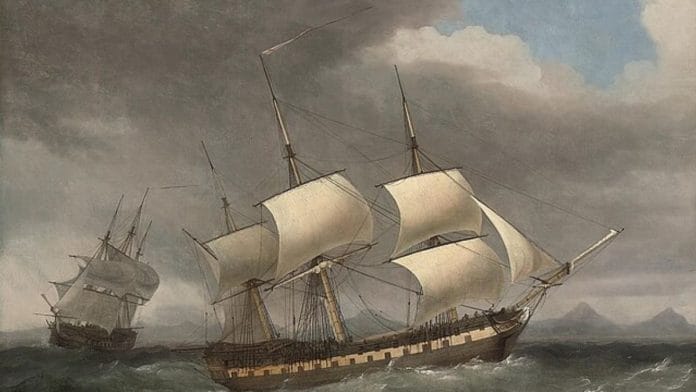



Among the diverse tasks that personnel aboard the EIC’s ships (these ships came to be referred to as ‘East Indiamen’) had to perform were diplomatic, political, and military functions. This was especially true in the seventeenth century when the Company was still developing its commercial networks. The ship’s captain was expected to combine maritime expertise with business acumen, military abilities, and a basic grasp of politics and diplomacy. Experienced captains would already have acquired mercantile knowledge through earlier seafaring ventures. This would be augmented by relevant Company records. These records accumulated with time as the voyages proceeded, making the archive richer and the information more precise. Trade, however, involved negotiating with authorities of Asian states, which in this period were in a position to withhold consent for commercial dealings or special privileges and to enforce discipline if there was any attempt to disregard their injunctions.
Consequently, the success of an expedition depended to a large extent on the captain’s talent for diplomacy. Lancaster’s account of his visit to Acheh (present-day Aceh, Indonesia) in the journal for the first voyage describes in minute detail the courtly ceremonial amidst which Elizabeth’s letter addressed to the sultan of Acheh was delivered. The account demonstrates familiarity with the main aspects of the sultanate’s diplomatic protocol. Lancaster’s audience with the sultan was preceded by lengthy deliberations with court officials, during which the credentials of Lancaster and his associates were verified; the purpose for seeking audience with the sultan was ascertained, and some of the initial formalities were taken care of. Incidentally, the English were assisted in their preliminary dealings with the court by two Dutch merchants who were temporarily residing in the town to purchase goods. A representative of the English delegation was then sent to the sultan to request permission for Elizabeth’s letter to be presented to him by the captain: ‘This messenger was very kindly entertained by the king who when he had deli[v]ered his message gladly granted his request, and communed with him about many questions: and after caused a royall [sic.] banquet to be made him.’
A robe of honour was conferred on him before he was dismissed. Subsequently, an official of the court had a meeting with Lancaster and demanded to see the superscription of the letter. He seems to have been satisfied after examining the superscription, ‘he read the same, and looked very earnestly upon the seale, tooke a note of the superscription, and did likewise write her ma[j]esties [sic.] name.’ The official had initially suggested that the letter be handed over to him to be transmitted to the sultan. The suggestion was unacceptable as, according to Lancaster, he was authorized only to deliver it himself directly to the ruler.
The commander had convinced the court that he was the emissary of an eminent royal personage and was therefore eligible for an audience with the sultan, and entitled to ceremonial which accorded with his status. An important device for expressing the high status of the bearer of the royal letter was the design and style of the letter itself. Miles Ogborn has drawn attention to the care that was taken to produce such letters. The object itself had to be impressive:
This was a matter of creating a particular sort of valued and valuable object through the combination of a heraldic writing style, decoration with colourful illuminated borders, elaborate capitals and gold lettering, and the appropriate parchment fixed with the authenticating and authorizing armoury of the royal signature and seals. These letters were objects whose materiality was meant to display their political valence and economic value.
According to Lancaster’s journal, the court sent six elephants to convey him and the letter to the palace. The letter was ceremonially carried on the biggest of these elephants, placed in a basin of gold, and covered by a silk cloth. Following consultations spread over several days, the English were granted permission to trade on a recurring basis.
Also read: Indian middle class is the most indebted group worldwide. Taking loans for phones, holidays
The inaugural contact with Surat during the third EIC voyage in 1608, mentioned at the beginning of this chapter, was essentially of a diplomatic nature. Shortly after the Hector arrived at the port, the commander of the ship, William Hawkins, proceeded to Agra to deliver the letter sent for the Mughal emperor by Elizabeth’s successor, James I (r. 1603–1625). The letter was addressed to Akbar, ‘Kinge of Cambaya or Suratt’, the EIC’s officials not having learnt of Akbar’s death (in 1605) at the time of drafting it. Meanwhile, the Hector sailed onwards to Bantam. Hawkins’s antecedents are obscure, and nothing is known of his experience as a navigator or merchant.
The EIC’s records suggest that he was chosen primarily for his supposed diplomatic capabilities, including his familiarity with the Turkish language and court protocol. Hawkins reached Agra in April 1609 and stayed in the Mughal dominions for about two and a half years, during which he repeatedly petitioned emperor Jahangir (r. 1605–1627) for the grant of a farman (royal decree) that would allow the Company to regularly trade at Surat. The permission was withheld, and the request for a reply to James’s letter was declined. On the whole, however, he was treated courteously and with considerable generosity at the court. Hawkins left Agra towards the end of 1611, departed from Surat in January 1612, and travelled to England via Bantam, but was not destined to return home. He died in 1613, shortly before the ship carrying him from Bantam to England reached its final destination.
It would take the Company another five years to acquire a stable presence in Surat. A factory was initially established there in 1613, which made some headway in trade largely due to the efforts of Thomas Aldworth, the agent who held charge of it. Aldworth was modestly successful despite complications created by the violent actions of English ships in the Arabian Sea mainly directed against the Portuguese. This was a show of strength intended to threaten the Portuguese and impress the Mughals. Several Indian vessels were caught in the crossfire between the EIC and the Portuguese, including a prestigious Mughal ship belonging to a leading member of the royal family.
The dislocation caused by the Company’s intrusion made local Mughal authorities wary of dealing with the English. This would have been at the cost of their largely cordial relationship with the Portuguese, a relationship marked by ups and downs since the Mughal annexation of Gujarat in 1573. At the same time, the English were able to demonstrate their superior naval strength in confrontations with the Portuguese. This made a section of Mughal officials receptive to the EIC’s request for permission to trade at Surat. It is worth emphasizing that Portuguese power in the Indian Ocean was beginning to decline in the last quarter of the sixteenth century.
In 1614, the EIC decided to organize what its directors hoped would be seen as a high-powered diplomatic mission to the Mughal court. It was felt that sending a ‘mere merchant’ might not be the best way to negotiate an agreement with the Mughals for trading privileges. Following a lengthy debate among key functionaries of the EIC, it was resolved to request James I to extend his support to the project. The Company was to bear the expenses and pay the salary of the emissary deputed for the purpose. Some of the directors had expressed their reservations over involving the king in the matter as they feared this might open the way for royal intervention in the Company’s affairs. Eventually, a consensus was reached on the issue, and the search began for a suitable person.
Thomas Roe, the person finally chosen as envoy, came from a background quite different from that of the navigators and merchants employed by the Company for its routine diplomatic and political dealings in Asia. Roe had been linked to the royal court since the time of Elizabeth, and the association continued under her successor. He was well educated and had recently entered Parliament as a member of the House of Commons. He had some experience of seafaring and travel, having sailed to South America and explored its coast. Roe was facing financial problems when the EIC approached him for the undertaking, and he readily agreed to its request. James I approved of the choice made by the directors, and the court provided the necessary diplomatic documents of state, including the letter of credence and, most importantly, James’s letter addressed to the Mughal emperor.
 This excerpt from ‘Governors of Empire’ by Amar Farooqui has been published with permission from Aleph Book Company.