









In 2007, my girlfriend got pregnant, and I witnessed the profoundly disturbing miracle of birth as my son rotated out of her. I felt pretty much none of the things you’re supposed to feel: love, gratitude, wonder. I could barely stand. Mostly I felt nausea and panic at the science experiment we were embarking on to keep this thing alive. However, as it often does, instinct kicked in, and the experiment became less awful, even likable. Unconditional love took over.
With procreation out of the way, the need to protect and provide grew increasingly intense when I became a father. When the financial crisis that year hit, it hit me hard. I went from sort of wealthy to most definitely not. The previous financial crisis had registered the same economic effect, but it had rolled right off me, as I was in my early thirties and knew I could take care of myself. But this was different. I had made a lot of money, but I’d invested most of it in RedEnvelope.
I followed the advice of the venture capital community: if you’re talented and a baller, you need to go all in. In a three-week period in 2008, the stock went from $7 to Chapter 11. My net worth went from $10 million to $12 million to negative $2 million, since I was one of those idiots who’d borrowed against their stock to buy even more stock. Then my oldest son had the poor judgment to come marching out of my girlfriend. My first emotion was that I’d failed to live up to my responsibility as a man; i.e., to take care of my child.
Not being able to provide for the needs of a kid in Manhattan the way I had envisioned for my son seriously fucked with my sense of why I was here (as in, on earth) and my worth as a man. I was shaping up to fail on a cosmic level, and the flame of hunger burned brighter. The pressure many men put on themselves to be good providers is irrational. The instinct to protect and nurture your offspring is core to the success of our species. However, believing your kid must have Manhattan private schools and a loft in Tribeca is your ego, not paternal instincts. You can be a good, even great dad on a lot less than I thought I needed to earn.
Nonetheless, some of my insecurities I hadn’t fully faced arose and I felt deficient as a provider right away. Whenever I didn’t have money as a single, childless person, I could always figure out ways to make it back. There was always enough to eat brunch at cool places or own a luxe TV and speaker system. I never worried. But once my kid came, life felt scarier and more tenuous. This was coupled with the realization it wasn’t about me anymore.
The fairly selfish person who enjoyed his freedom—maybe a bit too much—was gone. If you plan on being a reasonable dad, the life you were leading and the person you were before kids come dies. It’s a mercy killing—don’t sweat it. I was used to lots of people around me, and doing what I wanted when I wanted to, and suddenly those were gone. Also, I hadn’t been good at relationships. I worried that if I fucked up this one, it would have an exponentially bigger impact.
Specifically, I was now responsible for a kid, and it freaked me out. This is probably natural. I didn’t have a role model and knew I wanted to do differently than how my father had raised me. In many ways this fear was motivating and productive—my economic security has grown exponentially since the birth of my oldest. Was this a function of newfound focus or a raging bull market? Yes. If I wasn’t instantly in love, I fell in love over time. At first my only job was to keep the thing alive, and the upside wasn’t readily apparent. If you hear angels singing and see bright lights, great. If not, don’t worry, it comes.
Note: New fathers almost always feel unprepared for being dads, and that’s normal.
Also read: Ambedkar and RSS had the same stand on many issues—UCC, Article 370, gram panchayat elections
In the beginning
We pretend parenthood is immediately fun. It’s not. A dad’s job is to show up, do night feedings, change diapers, make sure his wife gets some sleep and keeps her sanity, and do what he can do to make the home feel secure, her loved, and the new baby comforted. Be a ballast—a steadying force, focused, and disciplined about money to avoid that stress infecting the household. Also, just be there.
New dads’ testosterone levels drop by a third, beginning during their partners’ pregnancies. Their balls shrink, too. An evolutionary logic is at work here—testosterone works great if you’re competing for mates, but it’s incompatible with caring for and bonding with babies. There’s a quietude, a relaxation, in thinking about someone else; it’s probably a function of lower T.
I enjoyed my weekends as a single guy, but they were stressful, too. How could I optimize them to take advantage of my single, successful, fabulous self? When you’re a dad, brunch is exposed as the dumb, made-up thing it is. It’s not about what cool people you’re hanging with; it’s about Johnny’s birthday party. Yes, for the first couple of years, being a dad could be frustrating and boring at times, but then it became strangely relaxing to know exactly what I was going to do on the weekends—soccer matches, rewatching Despicable Me, picking up after messes. There’s a comfort in having the same answer to most of life’s questions: whatever is best for the kids. People without kids bask in the same light when they’re kind and caring to others.
If you have the flexibility and resources, I would have a second one sooner rather than later. Having two felt three or four times better than one. One is too much pressure and focus—on you and the kid. I was an only child and believe I missed a lot. The negotiation, arguments, balance, positive tension that happens between siblings or even between parents and kids—the joy, stress, noise, and motion that two kids bring to a household feels like the difference between having a cool accessory and having a family. I’m glad we have two. I wish we’d had another, but I was worried about money and felt we were pushing our luck. It’s a challenging world for kids, and I felt we should cash out with two wonderful boys. Looking back, I wish we’d had a daughter, too, but it wasn’t in the cards.
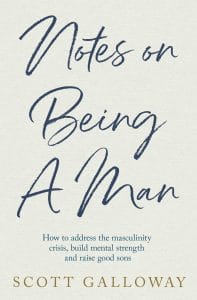
This excerpt from ‘Notes on Being a Man’ by Scott Galloway has been published with permission from Simon and Schuster Publication.