








With the Shah having managed to alienate not only the intellectuals and religious groups but also the leftists, nationalists and majority of the rural masses, the late 1970s saw a growing resentment towards the revived autocracy backed by the United States. Further, secular intellectuals who had been wary of the orthodox perspectives of the Shi’a ulama (religious scholars) until then, sat up to reconsider their stance. Aligning themselves with the ulama seemed an attractive option if it resulted in overthrowing the Shah. And so, in 1978, the country came together to bring about a revolution.
What started out as a protest by students in Qom, the seat of Iran’s largest seminaries, against slanderous remarks made by a newspaper about the exiled Ruhollah Khomeini, snowballed into an anti-regime agitation joined by thousands of unemployed Iranian youth. The streets of Iranian towns and cities filled up with demonstrators carrying pictures of Khomeini, portrayed in his signature black robe with a white beard and piercing black eyes. The anger of the masses took Mohammed Reza, then fighting a debilitating cancer, by surprise.
His government immediately imposed martial law and ordered the killing of protesters, setting into motion a vicious cycle of protesting, dying and mourning by demonstrators who returned to the streets to commemorate the seventh and the fortieth days of mourning for the ‘martyrs’ as per Shi’a tradition. By the end of the year, strikes by disenchanted staff at government offices and industrial units alike became a common sight in Tehran. Sensing trouble, the Shah abdicated in early 1979 and went into exile, leaving behind him a country that eagerly awaited the return of his nemesis—Ayatollah Khomeini.
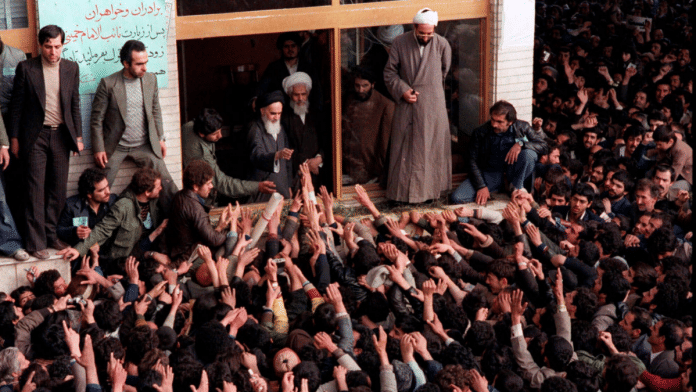
Two weeks after the Shah’s abdication, Khomeini, who had by now attained the status of a high-ranking spiritual leader or ‘Grand Ayatollah’, arrived in Tehran to a rousing welcome by a million-strong crowd. The populist revolution to obliterate the 2,500-year-old monarchy had been a success. However, that wasn’t the end game the 77-year-old Shi’a scholar had envisaged. No doubt the revolution could not have been possible without the support of the seculars, leftists and nationalists, but they did not figure in his vision for the future of the country.
In the early 1970s, Khomeini had given a series of lectures in Najaf, Iraq—where he lived in exile—that were later compiled into a book titled Hokumat-e Islami: Velayat-e Faqih (Islamic Government: Guardianship of the Jurist). The book, which went on to become his most influential work, laid out his thoughts on the strict implementation of Sharia (laws of God) through an Islamic government that would be headed by a faqih (an expert in the knowledge of Islamic law and justice).
Emphasizing that both monarchy and democracy were ‘wrong’ according to Islam, Khomeini argued that since no one knew Islam better than the clergy, it was only natural to allow them to rule as guardians of the state until the return of the Hidden Imam. He also propagated the idea that clerical rule was required not only to prevent corruption, injustice and oppression of the downtrodden but also to destroy anti-Islamic foreign influences. While Velayat-e faqih had existed in Shi’a Islam for centuries as a system of limited clerical guardianship to support those incapable of protecting their own interests, such as orphans and the destitute, Khomeini’s interpretation recast the doctrine into a mould that encompassed the entire nation.
Also read: Lawrence Bishnoi regrets that his younger brother followed his footsteps in crime
During his exile in Najaf, Khomeini had also made several speeches—some mollifying, some motivational and some fiery calls for action—whose cassette recordings found their way into Iran and were listened to with adoration and anticipation by frustrated Iranians. Although the allusion to Islamic law in these speeches should have raised eyebrows of secular intellectuals, they went almost unnoticed or were misinterpreted.
For instance, in the same breath as he promised a return to the traditional Iranian identity—that the masses culturally lost between the East and West during the Shah’s reign could connect to—he also talked about the divine ordinances of the Sharia and the need to use Islam as an organizing force to form the future government. Similarly, he mixed aspects of religion and governance to convince the people that just as following Islamic faith would lead to happiness and a philosophically perfect human, implementing the tenets of Islam at the national level would lead to a perfect society. His careful choice of words gave the masses a sense of pride in being Iranians and in being followers of Islam.
And so, when he returned to Tehran after 15 years in exile on 1 February 1979 and turned what had essentially been a secular revolution into an Islamic one, his appropriation of the symbolic leadership of the country by acknowledging the ‘religious and legal right the people of Iran had bestowed upon us through their demonstrations’ went uncontested. The ambiguity of his use of the word ‘us’ worked in his favour with the nationalists and intellectuals interpreting it as an allusion to the larger collective that had led the revolution and not just Khomeini and his disciples.
Further, Khomeini veiled his distaste for democracy with statements that sounded pro-democratic such as in his avowal that ‘in Muslim countries, Islamic law is of the people, so essentially Muslim countries are democracies.’ His denunciation, ‘I must tell you that Mohammad Reza Pahlavi, that evil traitor, has gone… We are saying this man, his government, his Majlis are all illegal… I shall appoint my own government. I shall slap this government in the mouth. I shall determine the government with the backing of this nation, because this nation accepts me,’ was met with rousing cheer from the crowds of common men and intellectuals alike. And no one stepped forward to question his decree—when appointing Mehdi Bazargan as the interim prime minister of Iran—that since this was not an ordinary government but a government based on the Sharia, those opposing it were effectively opposing the Sharia of Islam, and any revolt against God’s government was a revolt against God.
There was one group, however, that remained wary of Khomeini’s doctrine of Islamic Governance. Paradoxically, it comprised Shi’a scholars from Qom who opposed the Islamization of Iran and rejected the idea of the clergy’s involvement in matters of governance. Several of them even abstained from travelling to Tehran to acknowledge Khomeini’s leadership.
In a scenario where spiritual leaders such as Ayatollah Shariyatmadari and Ayatollah Mahallati presented a moderate face that he feared would be better liked by nationalists, Khomeini realized the need for scholars to publicly endorse his religious authority if he were to implement his vision of Velayat-e faqih. And so, in his choice of Bazargan as Prime Minister, he shrewdly played down the ‘Islamic’ component of his rhetoric and presented Iran with an engineer and a nationalist who had led the Freedom Movement against the Shah’s regime—a man with spotless democratic credentials who was acceptable to all, including the Americans.
Further, well aware that a US-backed military coup could destroy all that he had achieved, appeasing the Americans and placating the Shah’s armed forces was a crucial next step. In this direction too, the choice of Bazargan worked its magic. Within a week, the SAVAK had declared its neutrality on the advice of the US and acquiesced to support the interim government. Little did the Americans, or indeed Bazargan and the larger Iranian population, know then that everything Khomeini said in those early days about a pro-people democratic government was a deception. And although a glimpse of what lay in store for Iran was apparent in the months that followed, the excitement of overthrowing the Shah seemed to have inhibited the reasoning power of the entire country.
No sooner had Bazargan’s government been sworn in, than Khomeini put into action his plans to turn Iran into an Islamic state.
 This excerpt from ‘Dictators’ by Priya Narayanan has been published with permission from Rupa Publications.
The usual story of Islamists executing Leftists en masse wherever they come to power.