





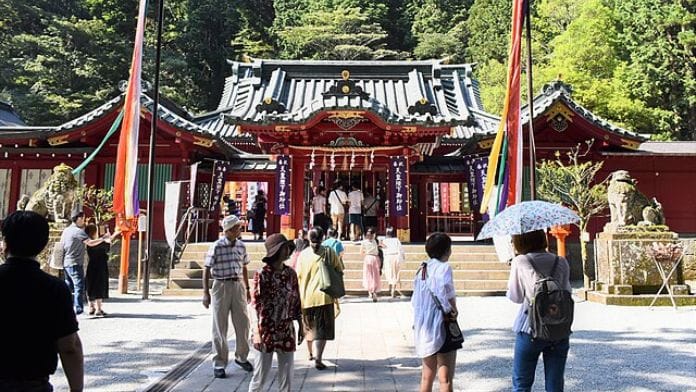



Shinto isn’t the only spiritual tradition in Japan, of course. It is joined by many other beliefs. But its oldest companion is Buddhism. Note I didn’t say “rival.” The deities of Shinto are known as kami. Those of Buddhism, hotoke. That’s the official distinction, anyway. In colloquial speech, people are just as likely to use kami to refer to either or both.
Today the kami and hotoke coexist harmoniously at shrines and temples throughout Japan. But that harmony was hard-won, the product of a holy war fought over a millennium ago. The effects of that conflict can still be felt today. One of the biggest is that Shinto and Buddhist traditions have been so thoroughly integrated that it can often be hard to tell kami and hotoke apart. And as a result, it can be hard for many of us to explain if we are Shinto or Buddhist.
The idea that a person must identify with one or the other is not something that comes naturally to Japanese people. Traditionally, Shinto and Buddhism do not proselytize or strive for converts. To be honest, I don’t even know what “convert” would mean in this context. I’ve never heard of a conversion ceremony, like the baptisms of Christian faith—you simply do things in one tradition or another, or don’t. Even broad terms like Shinto or Buddhism fail to serve as boundaries. My Shinto Cultural Examinations textbook made that abundantly clear, explaining that there are kami out there being venerated in Shinto shrines that are clearly influenced by Buddhism, Taoism, and other foreign religions. Really, you could say the same about Japanese society as a whole. Professor D. T. Suzuki, who transmitted Zen philosophy to American tastemakers in the fifties, called Buddhism in Japan “an influence so pervasive, indeed, that those who are living in its midst are not at all conscious of it.”
As I’ve said, I don’t consider myself a religious person. And Buddhism is most definitely a religion with a capital R, an organized one, with believers all over the world. I have no background in Buddhist worship or studies. Yet I needed to grapple with the impact of Buddhist thinking on my society to understand myself. I studied Shinto through the cultural examinations, but Buddhism? I didn’t have a clue as to how to approach it. There isn’t any equivalent of those exams for Buddhism, because there are 156 sects and schools of faith registered in Japan. Which to pick? I had no idea. And, besides, choosing any given school wouldn’t give me the big picture I was looking for. Because I wasn’t interested in religion per se. I was interested in how faith can become culture, transforming from divine writ for believers into spiritual traditions for everyone—where it is practiced with neither belief nor disbelief but a sort of instinctive balance between the two.
Also read: Ambedkar and RSS had the same stand on many issues—UCC, Article 370, gram panchayat elections
How could I have this religious influence coursing through me, through my cultural DNA, without being conscious of it? Can one be culturally religious without being religiously religious? What does that even mean?
Resolving that question would take me to a great many places across many years and through many cultures. And it would end with a boat—a boat carrying gods from around the world, sailing merrily under the same flag, their enduring popularity in my country proof positive that harmony equals happiness. But not the kind of harmony you might think.
It all began with a meeting, back when I was still in high school. The occasion was my enrolling in an international exchange program run by an organization named Youth for Understanding.
There was an orientation. The organizers handed out sheets of paper titled “Useful Information for Your Stay in America.” It described various dos and don’ts: “Don’t take off your shoes when entering a home unless asked” and “Don’t bow when you meet someone; just say ‘hi’” and “Don’t reflexively apologize; say ‘excuse me’ instead.”
Another section covered “common questions Americans may ask,” with a list of suggested responses. There were many, but today I remember only one: “What religion are the Japanese?” The suggested response was “I am a Buddhist.”
Buddhist? I clearly remember the wave of puzzlement that washed over the attendees, including myself. One quizzical parent raised a hand and asked for clarification. The orientation leader replied, “I know it isn’t necessarily the right answer, but it’s the easiest, and least problematic. America is a religious country. We need to give them some kind of response.”
This suggestion did more than confuse. It made me downright uncomfortable. I’d always pay my respects when I went to one of our many Buddhist temples, dropping a coin in the collection box and praying at the main altar. But I’d never seen those visits as specifically religious acts. Did putting up Christmas decorations make me a Christian? I didn’t think so. I also prayed at Shinto shrines from time to time, like everyone else I knew. So the more I thought about it, the less confident I felt declaring I was Buddhist to anyone. This wasn’t out of any aversion to Buddhism. I just feared getting asked anything about it, for I wouldn’t have had a clue about how to answer.
 This excerpt from ‘Eight Million Ways to Happiness’ by Hiroko Yoda has been published with permission from Bloomsbury Publishing.