








A section of the intellectual elite in India has just not been able to decode Narendra Modi. Even after he became Chief Minister of Gujarat for a fourth time, they believed that his political fortunes were limited to being a strong regional leader. In early 2013, despite the rapid emergence of Modi as a national leader, they were confident that he would not be named as the prime ministerial candidate of the BJP. It was only when the momentum generated by him during the 2014 campaign looked unstoppable that the elite became distinctly nervous. Some declared that they would migrate if Narendra Modi became the prime minister. None did.
The 2014 victory of the NDA (BJP) was regarded by them as an aberration, a one-time mandate due to anger against the non-performance of the UPA during its second term. The elite were skeptical that the NDA was unlikely to win again. Hence, in 2019, they were rejuvenated by their belief that the BJP would lose. Instead, the BJP secured a record majority and required no coalition. In 2024, due to a setback to the BJP on the results day, their hopes were enlivened momentarily, only to subside.
What the elite fails to appreciate is that Modi has triggered a structural change in the dynamics of the political landscape of India, which ensures that, in the medium term, the probability of dislodging a highly disciplined party promoting a nationalist agenda, is minimal.
To use a rather insensitive analogy, Modi is like an atomic bomb that has fallen on the elite’s cherished notions and ideas. Ivory towers and cocoons rudely disturbed, they cannot digest that a tea vendor’s seemingly unsophisticated son, an RSS pracharak, from the backwaters of Gujarat, has become the Prime Minister of India for a third successive term. The elite, which claims to be dispassionate, actually bristles with prejudice against Modi. The reasons for the allergy are many. However, prior to dissecting their mindset, let us first define what is meant by the expression, the Indian intellectual elite, in the present context.
Political or religious propagandists of any hue, having an agenda, are obviously to be excluded. The elite, referred to here, comprises mostly highly accomplished individuals, usually with integrity and ethics in personal life, with no overt connections to any political party or organization. It comprises of academicians, historians, biographers, lawyers, and media persons. Of course, not all of them nurse such prejudice.
A typical profile of a ‘Modi allergic’ is a person educated in the English medium (mostly in acclaimed boarding schools in the hill stations or famed schools in the metropolis, with a foreign degree in the liberal arts thrown in) from an upper middle-class professional family, with centre-of-left liberal leanings and atheistic agnostic views on religion. Dry rationalists, whose ability to intuitively grasp issues is often blunted. They wear what they incorrectly term as secularism on their sleeve. Many of them are secretly condescending about those tutored in the vernacular medium who cannot speak King’s English.
The elite have been brought up on a staple diet of historical narratives of post-Independence India, which skilfully gloss over all the acts of commission and omission of the so-called secular leaders while highlighting the sins of those they dub as Hindu communalists.
***
The last prime minister before Modi, Dr Manmohan Singh, so appropriately called the accidental Prime Minister, was in stark contrast to Narendra Modi. A soft-spoken Oxbridge-educated economist and bureaucrat, he was unabashedly the proxy for the Italian-origin Sonia Gandhi, who prudently chose not to be the prime minister. Competent, honest, learned, apolitical and gentlemanly, Dr Singh was the first PM who displayed not the slightest emotional fervour for the job. In the closing stages of his second five-year term in office, he was tired, listless, speechless and appeared lost. It must be said to his credit, though, that he refused to sanction or be a party to any trumped-up prosecution or legal action, which his aggressive and increasingly desperate party men encouraged him to take against Modi, to prevent the latter from becoming the prime minister. During a parliamentary debate in 2021, Modi acknowledged the decency and work ethic of Dr Singh.
For long in a state of denial, when Narendra Modi finally did become a fait accompli, the elite was confident that New Delhi was no Gandhinagar, and Modi, a first-time member of Parliament ever to straight-away become Prime Minister, may have lorded over his native Gujarat, but would soon discover that governing India was altogether a different cup of tea. Finding his way through the maze of bureaucracy in North Block or dealing with other countries would prove to be beyond Modi’s competence. His administrative experience as the chief minister of Gujarat for thirteen years would prove inadequate for running the Central government. Neither Western powers nor Islamic countries approved of him. He did not speak good English and was unsophisticated. His radicalism will terribly backfire on him. Narendra Modi’s prime ministership was a disaster in the making. The elite waited with bated breath for Modi to fail.
Ironically, some of Modi’s committed supporters too were apprehensive as to how he would perform. A few of the BJP’s own senior leaders, fuming at being bypassed for the top job, were secretly hoping that he did not succeed. The Western media was not far behind during the 2014 campaign, and even after he was elected, there were highly critical editorials and articles about him. TIME magazine headlined: Modi means business, but can he lead India? The Economist of London, on the eve of the election, ran an editorial titled: Can anyone stop Narendra Modi?17
However, Bharat Bhagya Vidhata and Modi’s Jagat Janani apparently had other plans. Each apprehension proved incorrect. After the very first hundred days in office, the wind had gone out of the sails of the elite.
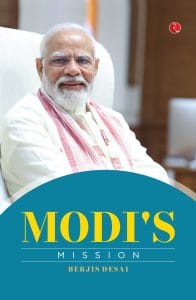 This excerpt from ‘Modi’s Mission’ by Berjis Desai has been published with permission from Rupa Publications India.
So it was the indian elite that defeated BJP in UP and Maharashtra Lok sabha elections 🧐