









Unlike the Spanish conquistadors, or even the Portuguese, the British colonialists in India did not use brute force to save the millions of Hindus passing into eternity without salvation. An overt or direct collaboration between the church and the empire was discouraged ‘because it was feared’ that it ‘would give rise to the suspicion that the British intended to impose Christianity by force or stealth.’ The cautious approach of the East India company, and later the British Government, was dictated less by any purity of conscience and more by the realization that the British were too few in India, and their security depended on the collaboration of mainly Hindu native soldiers, which rested on the promise that their religious and social beliefs would not be trampled upon.
Instead, the British adopted a benign approach. They felt that if the Indian elites were educated in Western-style institutions with ‘a strong dose of Western science and philosophy,’ it would expose ‘the falsity of the superstitions on which Hinduism rested,’ and make them more amenable to Christianity. Once the high castes among the Hindus fell for the Gospel, the conquest of Hindu India would be far easier than imagined. Seen in this light, the policy of state funding of missionary schools during the British Raj ‘wherein the teaching of the Bible formed an integral part of the curriculum’ makes perfect sense. The only problem was that the upper castes wholeheartedly accepted the missionary education but solely for material advancement by way of securing government employment—the message of the Gospel was completely lost on them. Worse still, Western-style education made the Indians aware of their rights and privileges, so much so that ‘[b]y the 1870s, the Raj was bemoaning the way English education had turned elements of the Indian middle class into seditious critics of the British Rule.’
As I have argued earlier, it is hard for anyone to give up their ancestral faith and the Hindus were no exception; they clung to their old ways with tenacity during five hundred years of Muslim rule despite the coercion and the brute force of the state. Christianity had little chance of success in persuading them to abandon their faith; not surprisingly, it proved even less successful than Islam. On the eve of India’s independence, the Christians in India comprised a meagre, less than 2 per cent of the population, and the Muslims, roughly a quarter. The Hindu polytheists survived, and survived in good proportion. Considering the fact that the Islamic invasion wiped out almost all religions, including polytheism in a vast stretch of land from Andalusia to Central Asia, and Christianity firmly implanted itself in New Spain and Africa on the back of colonial conquest, not to speak of the destruction of paganism in the Roman Empire in the Late Antiquity, the survival of polytheism in India is a remarkable feat. And this happened, as we shall shortly see, because the Hindus, though defeated, never ever gave up the fight.
Also read: Indians and their cultural inferiority complex, explains Romila Thapar
Dahir’s Son Hullishah Apostatizes
The first successful Muslim invasion of India commenced in 711 when Muhammad bin Qasim laid siege to the city of Debal in Southern Sindh. We have the details of his expedition in Sindh from the Chachnama of Kufi Ali and Kitab Futuh al-Buldan of al-Baladhuri. We know from these texts that towns like Nerun and Siwistan capitulated as the Samanis persuaded the largely Buddhist population not to fight but Debal, Raor, Brahamanabad and Multan put up a fierce resistance. Raja Dahir himself led the army against Qasim near Raor, and just before the commencement of the crucial battle, he is said to have remarked:
My plan is to meet the Arabs in open battle, and fight with them with all possible vigour. If I overpower them, I shall crush them to death and my kingdom will then be put on a firm footing. But if I am killed honourably, the event will be recorded in the books of Arabia and Hind, and will be talked of by great men, and will be heard of by other kings in the world, and it will be said that such and such a king sacrificed his precious life for the sake of his country, in fighting with the enemy.
Dahir was killed after his elephant was hit with a naphtha arrow. When the news of his death reached his son, Jaisiah vowed: ‘[W]e will face the enemy and smite him with our swords to win fame and honour. Even if we are killed, we shall not have lost our lives in vain.’ He kept the flame of resistance burning; he wrote to the neighbouring kings and moved from place to place, canvassing their support in order to organize resistance against the Arabs.
The mighty Arab army under Qasim took almost four years to subdue the area and establish their rule. The siege of Brahamanabad alone lasted six months. Umar al-Aziz became the Caliph in 717 and ‘he wrote to the kings [of Hind], inviting them to become Moslems and be subject to him, agreeing to let them continue on their thrones, and have the same privileges and obligations as the Moslems.’ Jaisiah, who meanwhile had reclaimed Brahamanabad, embraced Islam and took the Arabic name Hullishah in the hope of keeping the Arabs at bay. During the reign of Caliph Hisham al-Malik (c. 724–43), al-Junaid became the governor of the Sindhian frontier; he wanted to reassert his control over Sindh, but was rebuffed by Hullishah, who prevented al-Junaid from crossing the Indus. Hullishah reminded al-Junaid that since he was appointed by none other than the caliph, he was a legitimate ruler. As conflict became inevitable, Hullishah refused to pay tribute, apostatized and declared war. Like Julian’s counter-revolution against Christianity, Jaisiah was waiting for an opportune moment to re-establish polytheism, but unfortunately, he lost the battle against al-Junaid, was taken prisoner and killed.
But the resistance did not die with Jaisiah for Baladhuri informs us that during the rule of Tamim al-Utbi, the successor of al-Junaid, ‘the Moslems withdrew from the land of al-Hind, and abandoned their headquarters, and they have not returned so far as that since […] Afterwards, while al-Hakam ibn-Awanah al-Kalbi was ruler, the people of al-Hind apostatized, with the exception of the inhabitants of Kassah.’ Evidently, by the latter half of the ninth century, when Baladhuri was travelling through Sindh, the Muslim influence had waned significantly.
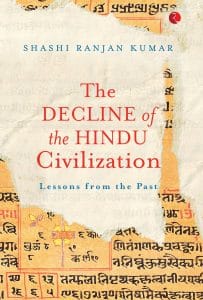 This excerpt from ‘The Decline of the Hindu Civilization’ by Shashi Ranjan Kumar has been published with permission from Rupa Publications.