





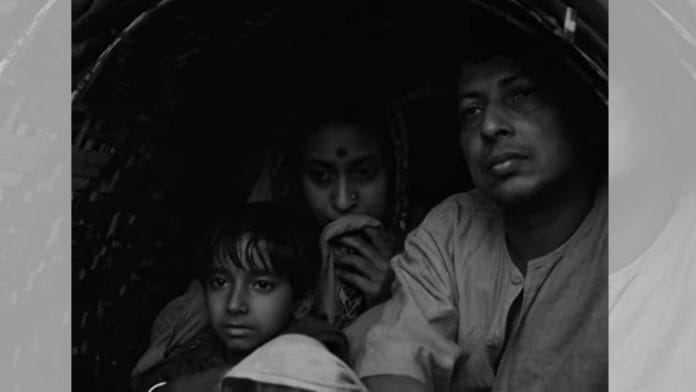



The first review of Satyajit Ray’s first film, Pather Panchali, was published in Desh magazine on 3 September 1955, one week after its release.
ONE OF THE FINEST CINEMATIC CREATIONS IN THE WORLD
Not hesitantly, dotted with ‘perhaps’, ‘but’, or ‘maybe’—the opportunity has been presented to assert unequivocally and unhesitatingly that our country is capable of making films that are worthy of being counted, not just numerically but also in terms of quality, among the finest in the world. Today we can declare this with pride after viewing the film Pather Panchali.
The novel is an impeccable literary creation of Bibhutibhushan Bandyopadhyay’s, but with his exceptional screenplay and the facility of his direction, Satyajit Ray has presented something that does not bring to mind any Indian or foreign film ever screened in our country which is worthy of comparison. If anyone is still in doubt about this after watching the film, they must either be given to modestly denying the accomplishment of their own country, or are utterly supercilious or plain jealous.
Even after watching thousands of films made in India and elsewhere over nearly twenty-five long years, one can aver that none of them has been the source of such delight; nor has one been desirous of adorning any of these other films with several strings of adjectives. Indeed, the moment has come to shake the entire world awake and announce that in terms of overall excellence, an Indian film has reached the ranks of the best in the world. And when one considers the circumstances in which the film was made, one can only be stupefied into silence.
The screenplay-writer and director of the film, Satyajit Ray, was not connected with cinema earlier; cinematographer Subrata Mitra had only worked as an assistant on the film The River; and art director Bansi Chandragupta’s association with films was not a long one either. These three individuals had access to equipment that would not only be rejected in other countries but was also available in meagre numbers. But the magic they have wrought with these cannot be created even with the best equipment in the world.
The exemplary patience, perseverance, and fortitude with which they painstakingly imagined and sought the best artistic and dramatic elements day after day, month after month, knitting them into a rhythm of sequences, can themselves be the subject of history. We have seen how sensitive and thoughtful artists can achieve flawless brilliance in their creations even with equipment dulled with age. As the leader of the team, the life that Satyajit Ray has breathed into every aspect of filmmaking illuminates everything in a new light.
There has not been another instance of each of the different aspects of a film blossoming in its distinctive manner and yet maintaining perfect coordination with one another. Each of these plays its own unique role, but they come together in a beautiful completeness. Bhupendra Ghosh and Satyen Chattopadhyay have been responsible for sound recording and re-recording for other films too, but the director of Pather Panchali has applied their work here so elegantly and innovatively that it has made the excellence of their efforts clearly evident. Music has been used in films in various ways before, but not only is the originality of a talent like Ravi Shankar palpable in the music direction, but director Satyajit Ray has also exhibited how this music can be used to meet the requirements of the narrative in a way that makes it part of the uniqueness of this film.
The genius of direction demonstrates that while we are fully aware of the individual role of every aspect of the techniques applied here, we also perceive them as a beautiful interlinked and collective whole that constantly makes us want to cry out, ‘Marvellous, marvellous!’
Also read: 17th-century India was an Eldorado for the French—Taj Mahal, jewel mines, unimaginable wealth
The originality of Pather Panchali is so spectacular that the commercial mind may well wonder how much space it can occupy in the emotional chambers of the heart. Because of the lack of song and dance sequences and cheap humour, none of the distribution companies came forward to finance the completion of the film. Moreover, most of the filmmakers and actors were new to the field, and the one or two veterans had no market appeal. But still, the director did not abandon his commitment to art for the sake of money.
This is where the assistance of the West Bengal government and, in particular, of Chief Minister Bidhan Chandra Roy must be mentioned. Dr Roy did what no government in India has ever done, being the first to offer financial support for a film. Without this assistance, the world of cinema would undoubtedly have been deprived of one of its greatest creations. Satyajit Ray has not only honoured the contribution made by the government, it can even be said that he has ensured a pioneering position for the state government as a patron of the arts.
The signs of the deep thinking that has been invested in order to manifest originality in every segment of the film are palpable. No description will do justice to the number of small touches that captivate the viewer. The human appeal of the narrative has been presented with such ease and simplicity that it is bound to overwhelm any human being. There is nothing redundant in the entire film, nothing incapable of playing on the strings of human emotions, not a moment that does not cause wonder. A film like this, where everything is to be commended, may even appear to be an illusion.
 This excerpt from ‘The Bengal Reader’, edited and translated by Arunava Sinha, has been published with permission from Aleph Book Company.