






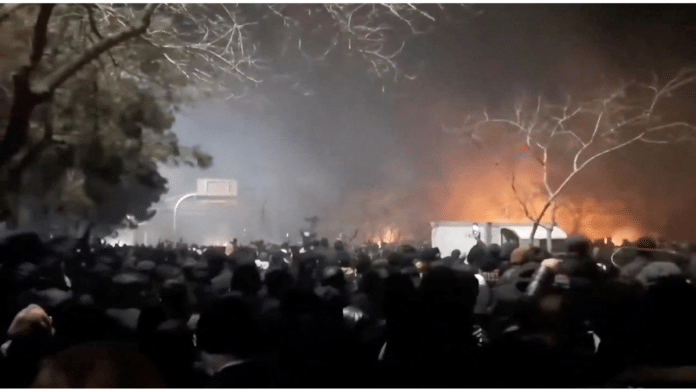



After the brutal death of 22-year-old Mahsa Amini in the custody of Iran’s morality police in 2022, “Woman, Life, Freedom” stopped being just a slogan. It became a breaking point. Nearly four years later, that moment has not been forgotten. The streets of Tehran, Ilam, Mashhad, Lorestan, Kermanshah, and hundreds of other cities in the country are once again filled with chants of revolution—“Death to the Dictator,” “Death to Khamenei.”
This is no longer only about a headscarf or one woman’s death. It is about a society that has run out of patience. Women’s oppression lit the fire, but what we are seeing now in Iran is the release of years of fear, anger, and suffocation, an open challenge to a regime that has tried to control bodies, silence voices, and rule through intimidation.
While recent unrest — which some media reports claim has cost as many as 12,000 Iranian lives — was triggered by the Islamic Republic’s collapsing economy and a rapidly devaluing currency, it has long moved beyond questions of bread and prices. What began as anger over rising food costs and staggering inflation has now turned into a full-blown revolt against the state itself. Years of sanctions, diplomatic isolation, and a failing foreign policy have slowly seeped into everyday life, and domestic politics is finally facing the cost of those choices.
Women-led revolution
Of course, no uprising has a single cause. Iran’s turmoil is the result of many forces colliding — geopolitics, ideology, economic mismanagement, and international pressure. But one factor stands out more than the rest. For me, it is impossible to look at this movement and not see how women’s fight for equality has moved to its centre. Women have reshaped the protests. Their resistance exposed the deeper rot of the regime, and in doing so, turned a crisis of governance into a moral confrontation the state can no longer easily contain.
For more than four decades, the Islamic Republic has governed by controlling women. Their rights were not chipped away gradually; they were deliberately fenced in—marriage, divorce, inheritance, child custody, work, the courts, political participation, travel, lifestyle, even what they wear. Women’s bodies became tools of domination, symbols through which the state asserted power, while at the same time failing—repeatedly and openly—to protect women from gender-based violence. This is not a marginal flaw in Iran’s system; it is one of its pillars.
What is often forgotten is that resistance to this control began immediately. The fight against theocratic rule in Iran did not emerge decades later—it started the moment mandatory veiling was imposed, and women realised what kind of future was being built over their lives. Anyone who understands Iran’s history knows how central women’s bodies and “honour” have been to its political symbolism.
During the revolution, Ayatollah Khomeini actively encouraged women to join the movement, offering reassurance and leaving many to believe that their freedoms would not be rolled back. There was little public indication that compulsory veiling or systematic restrictions on women were inevitable. But once power was secured, the tone shifted. The veil became law, rights were withdrawn, and women took to the streets on 8 March 1979, chanting words that still feel painfully current: “We didn’t have a revolution to go backwards.”
That sentence captures the heart of today’s unrest. What we are witnessing now is the continuation of a long, unfinished struggle. Women recognised its true nature early on. And by placing their bodies, their lives, and their dignity at the centre of this movement, they have exposed the deeper truth of the Islamic Republic itself: a system that cannot survive without control, and a society that is finally refusing to live under it any longer.
Iranian women’s resistance has also forced the world to look—really look—at the human rights reality inside Iran. It is impossible not to feel awestruck by their courage. These women, along with their families and supporters, are fighting for their lives against a system that has taught them fear since birth. They know the cost of defiance, prison, torture, exile, even death. And yet they step forward, again and again, refusing to retreat. This is not reckless bravery. It is a conscious choice—to pay the price of freedom so that the next generation might breathe safely.
Also read: Iran protests — why India cannot be a mute spectator
Challenging the regime’s moral authority
In a world where comfort often silences conscience, Iranian women are reminding us what resistance truly looks like, and how deeply the desire for dignity can run, even when everything is at stake.
Additionally, Iranian women’s defiance is what makes this movement especially powerful—and deeply dangerous for the Iranian state. Authoritarian systems can survive economic anger, foreign pressure, and even protests over bread and prices. What they struggle to survive is a direct challenge to their moral authority. When women reject state control over their bodies, they expose the regime’s deepest insecurity that its power does not rest on faith or consent, but on fear. Every woman who walks unveiled, every girl who refuses to stay silent, weakens the carefully constructed myth that this system is divinely ordained. That is precisely why the response has been so brutal. The state knows that the moment women stop obeying, the entire structure begins to crack.
What is unfolding in Iran is a mirror held up to every society that believes control over women can be dressed up as tradition, sanctified as religion, or justified as order. When women are reduced to symbols instead of recognised as citizens, resistance becomes destiny. And history tells us that when such demands are ignored long enough, the cost of suppression always exceeds the cost of reform.
Amana Begam Ansari is a columnist and writer. She runs a weekly YouTube show called ‘India This Week by Amana and Khalid’. She tweets @Amana_Ansari. Views are personal.
(Edited by Ratan Priya)