









South Korea built its premier policy institution, Korea Development Institute, on a founding conviction: You cannot reform a system using only minds formed within it. India built its equivalent, NITI Aayog, on the opposite instinct. Fifty years later, the results speak for themselves.
During the last week of February in Seoul, I sat across from the recently retired president of the Korea Development Institute (KDI) and asked him to explain his country’s transformation. There was one thread that ran through the conversation: To imitate and then innovate, you have to tap into the best practices of the world. Since its founding in 1971, KDI made that conviction institutional. Recruit from abroad; measure against global standards; bring outside thinking into the centre of policy; and do not let the institution become a mirror of the system it was built to improve.
It struck me that this single founding conviction—modest in its statement, radical in its implications—is precisely what India’s equivalent institution, NITI Aayog, has never had. And that absence, more than any policy difference, may explain the gap between where the two countries stand today.
The founding contrast
KDI was South Korea’s first government-supported think tank. When it was established, the country was still poor, still building, and still measuring itself against a future it had not yet earned. Its founding mandate was explicit: Provide rigorous, evidence-based policy analysis tied to measurable development outcomes. And crucially, recruit internationally at every level.
Korea’s president at the time took the international recruitment mandate personally. He wrote to Korean economists and researchers studying and working in the United States, inviting them to return and build KDI. They were offered compensation above local university professor salaries, a deliberate signal that external intellectual formation was valued. Korea’s leadership understood something that is easy to state but hard to act on: That a country cannot generate the thinking needed to escape its institutional constraints using only the thinkers those constraints have produced.
This philosophy was not unique to KDI and was applied consistently across Korea’s major knowledge institutions for half a century, including the Korea Institute for International Economic Policy (KIEP), the country’s premier trade and international economics research institution.
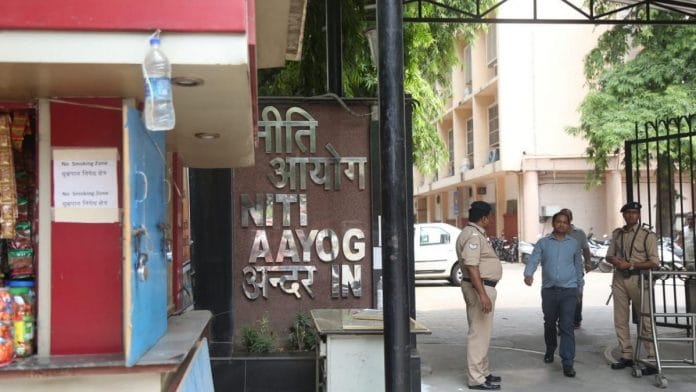
NITI Aayog was established in 2015, replaced the Planning Commission, with an ambitious mandate to serve as India’s apex policy think tank, a hub of innovative thinking and a bridge between government and knowledge. Its founding instinct was different. Leadership would come from the Indian Administrative Service. The intellectual ecosystem would be domestic. The institution would be staffed and led by the same administrative class that had run Indian institutions for decades.
Also read: Indian think tank releases Responsible Nations Index. It measures ethical choices
Who leads them
The leadership profiles of the two institutions make the contrast concrete in a way that statistics alone cannot.
KDI’s most recent president held a PhD in Economics from the University of Wisconsin-Madison, taught at Texas A&M University, served as KDI’s Chief Economist, sat on the Bank of Korea’s Monetary Policy Board for four years, and published extensively in peer-reviewed international journals alongside co-authors at the IMF and leading global universities. A researcher of international standing leading a research institution, the fit is exact and deliberate.
His successor, appointed as KDI’s 18th president in February 2026, is a Professor Emeritus of Economics at Seoul National University, a former senior economist in the IMF’s research department, and a former member of the Financial Services Commission’s Financial Development Review Committee. Again: An economist shaped by global institutions, leading a knowledge-generation organisation. The pattern has held for over 50 years.
Now consider NITI Aayog’s leadership over the same period. Its most recent CEO was a 1987-batch IAS officer whose career spanned administrative roles in Chhattisgarh, Jammu & Kashmir, and the Ministry of Commerce. The CEO before him led the institution for six years—a 1980-batch IAS officer with an economics degree from St Stephen’s College and an MA from Jawaharlal Nehru University, and whose career was built entirely within the domestic administrative machinery. Career bureaucrats, one after another, running India’s premier policy think tank.
A think tank should be led by thinkers, not administrators. That sentence need not be said. And yet, for NITI Aayog, it describes a standard that has never been applied.
This is not a criticism of individual capability. IAS officers are often extraordinarily talented administrators. The point is structural. A think tank led by career generalists embeds a fundamentally different intellectual culture than one led by researchers who have spent careers competing at the global frontier. The questions asked are different. The standards of evidence are different. The tolerance for honest findings that challenge official policy is different. And the signal sent to the institution about what is valued — administration or knowledge — is entirely different.
The contrast doesn’t stop at the leadership level. KDI’s researchers, fellows, and economists across the organisation hold doctoral degrees from universities across North America and Europe: Wisconsin, Columbia, Georgia Tech, University College London, Brown, and Minnesota. Institutional culture is not set by a single leader; it is shaped by the collective intellectual formation of the people in the room.
At KDI, that formation is genuinely global throughout. At NITI Aayog, the economists and fellows are drawn overwhelmingly from the same domestic academic and administrative ecosystem that produces its leadership. Appointing a different CEO would not change that. The insularity is institutional, not individual.
The consequences extend well beyond NITI Aayog itself. The people who lead it do not quietly retire. They become the faces of India’s policy conversation—keynote speakers at Davos and AI summits, panellists at global forums, G20 Sherpas, the voices international audiences hear when they want to understand India’s economic thinking. When those voices have been formed entirely within a domestic administrative ecosystem, insulated from genuine external intellectual challenge, the ideas they carry into those rooms reflect that formation. The insularity does not stay inside the institution. It radiates outward, shaping how India’s challenges are framed, which questions get asked, and which uncomfortable answers never get spoken aloud. The cumulative damage—measured in missed diagnoses, delayed transitions, and policies that tell governments what they want to hear—is far larger than any single leadership appointment suggests.
Also read: India’s think tanks double up as lobbyists, give no disclosures. Hurt policymaking
The numbers India would rather not discuss
India has more than 500 think tanks, second only to the United States. And yet quantity is precisely the problem. It substitutes for quality in the same way that announcing bold visions substitutes for executing them.
NITI Aayog produces reports, coordinates between ministries, and publishes indices and vision documents with ambitious titles. What it does not produce, in any meaningful volume, is internationally peer-reviewed economic research, the kind that gets cited, challenged, revised, and built upon by the global community of economists and policy researchers. That absence reflects what the institution was designed to be: A coordination mechanism, not a knowledge engine.
The consequences of that design failure are measurable. Indian private corporations invest less than 1 per cent of their revenue in research and development. South Korean corporations invest 4 to 6 per cent.
Decades of corporate culture has never been seriously challenged to shift toward knowledge investment. Nudging Indian industry from services and assembly toward genuine innovation is precisely the kind of long-horizon, analytically demanding policy challenge that a rigorous, independent think tank exists to address. It requires honest diagnosis, uncomfortable recommendations, and the institutional credibility to be taken seriously. NITI Aayog, as currently constituted, has been unable to provide any of those three things.
The failure is perhaps most visible and consequential in the Indian IT services industry. India built one of the world’s largest technology workforces on a model of labour arbitrage: Delivering cheaper what Western companies needed done. It was a genuine achievement, but also a trap. The transition to higher-value business models—SaaS, cloud platforms, proprietary IP, innovation-driven growth—required exactly the kind of structural economic analysis and policy pressure that a serious think tank should have been generating for the past two decades. That analysis never arrived with any force. Indian IT services companies remained overwhelmingly dependent on the same model, the same clients, the same logic.
Now AI agents are beginning to automate precisely the work that model depends on—threatening to do to Indian IT services what Indian IT services did to Western back-office work. The window for transition is narrowing. The institutional thinking that might have accelerated it arrived too late, too softly, and from an institution too close to the government to deliver the uncomfortable truth at the necessary volume.
KDI, by contrast, has functioned as a genuine research institution since its founding. Its work is read, cited, and debated internationally because it was built by researchers trained abroad and held to international standards.
Also read: Indian think tanks are growing in big numbers under Modi. But impact, influence questionable
A pattern across Asia
The recently retired KDI president did not describe his institution’s success as the product of exceptional individuals or fortunate timing. He described it as the product of a sustained institutional commitment to a simple but demanding idea: That rigorous, honest, externally benchmarked analysis is the foundation of good policy, and that building the capacity for such analysis requires deliberately importing intellectual standards from outside the system.
Last week, in Shanghai, I met with Dr Xiaohuan Lan, author of How China Works and a professor at the China Europe International Business School (CEIBS)—a high-ranking executive MBA programme in Asia. His observation about CEIBS was striking in its directness: Almost every faculty member is educated abroad. The institution was co-founded by the Chinese government and the European Union, with international intellectual formation as a founding requirement. The same conviction that animated KDI’s founding in 1971 animated CEIBS’s design decades later.
India has never made that commitment at the institutional level. NITI Aayog was designed to be useful to the government, which is a different and more limited ambition than being useful to the country. Institutions that exist to serve the government tend to tell governments what they want to hear. Institutions with genuine intellectual independence and global accountability tend to tell governments what they need to know.
The comparison between KDI and NITI Aayog is about two theories of how knowledge relates to national development. One theory holds that policy institutions should be staffed by the administrative class, oriented toward coordination, and measured by their usefulness to the current government. The other holds that policy institutions should be staffed by researchers, oriented toward truth, and measured by whether their analysis holds up against the best thinking in the world.
South Korea chose the second theory. China made the same choice. India has effectively chosen the first approach and then wondered why its institutions keep producing more strategy documents than results. It protected existing hierarchies and treated external challenges as a threat.
The choice was made at the moment of founding. And it has compounded, quietly and relentlessly, ever since.
Vasu Eda is the author of Get Job Ready and founder of Eda Institute. He divides his time between the United States and India and is currently researching his next book, Innovation and the Future of India. He tweets @VasuEda. Views are personal.
(Edited by Theres Sudeep)
A very thought proving idea.
Talk and no action defines Indian think tanks. They are only good at arm chair philosophy. The practical execution, implementation and feedback is never considered because they they might loose their positions.
This is stupid. The Planning Commission had plenty of phoren PhDs. But they did stupid shit. Korea imitated Japan. India imitated the anus of Holy Cow which produces Holy Shit.
Niti Ayog is where you park the most useless & stupid IAS officers.
Socialist India is beyond anybody’s help.