






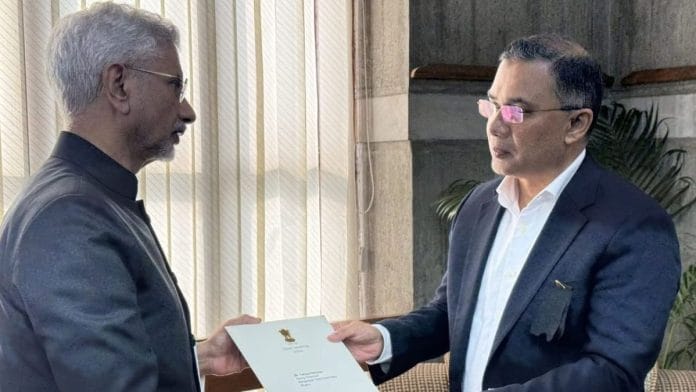



After roughly a year and a half of strained ties between India and Bangladesh following the fall of the Sheikh Hasina government on 5 August 2024, New Delhi and Dhaka are trying to do business again.
Bangladesh Foreign Minister Khalilur Rahman’s two-day visit to New Delhi this week, along with a high-powered delegation, is being hailed as a “major diplomatic breakthrough that signals a rapid formalisation of ties between New Delhi and the newly elected government in Dhaka”.
“There is a sense of relief in New Delhi that the Bangladesh Nationalist Party (BNP) has come to power in the neighbouring country and not the largest Islamist political party—the Bangladesh Jamaat-e-Islami. Relations between the two countries got seriously strained during the tenure of the interim government under former chief advisor Muhammad Yunus,” Veena Sikri, Indian High Commissioner to Bangladesh from 2003 to 2006, told ThePrint.
There is optimism in strategic circles in both New Delhi and Dhaka around Rahman’s visit, but a sense of caution as well. And then there is the Sheikh Hasina question.
The talking points
The priority for Dhaka right now seems to be ‘reset’ — in energy, water, trade and visas. A source in the Bangladesh foreign ministry told ThePrint that the top items in Dhaka’s agenda are both practical and economic. At the top of the list is the Ganges water-sharing treaty, signed in 1996, which is set to expire in December this year.
Even when relations between Dhaka and New Delhi remained far from cordial during the Yunus regime, officials from the two countries interacted on common issues, including water sharing. “In February 2025, during a meeting with India’s External Affairs Minister S Jaishankar on the sidelines of the eighth Indian Ocean Conference in Muscat, Oman, Bangladesh’s Foreign Affairs Advisor Touhid Hossain sought to initiate discussions for the renewal of the Ganges Water Treaty signed in 1996,” The Daily Star had reported.
The two sides met again in March and later in September last year.
The political future of the treaty hinges on the nature of bilateral ties between India and Bangladesh, and assent from the West Bengal government, the Daily Star report stated. “At the physical level, the widening supply-demand gap in water flow in the Ganga River Basin region will highly influence the provisions in any draft that the two countries prepare to renew the treaty or negotiate the provisions on water sharing,” the report reads.
The source in the Bangladesh foreign ministry said that another crucial point in Dhaka’s agenda for the talks would be Bangladesh’s worsening energy situation. “The proposal of regular supply of diesel, LNG and crude oil from India will surely come up during the talks,” the source said.
Visa issuance for Bangladeshis is also expected to come up during the talks. “Dhaka feels it has ‘opened up’ to Indians seeking Bangladeshi visas but sees New Delhi’s reciprocation in giving visas to Bangladeshis as insufficient,” he said.
A major talking point for Bangladesh would be the nomination of Khalilur for the presidency of the United Nations General Assembly for 2026-27. Rahman may seek India’s support for his candidacy during his meetings in New Delhi.
Tariff and non-tariff measures imposed over the Yunus period have hurt bilateral trade. Seeking a joint review mechanism, Rahman’s team may propose an early meeting of the India-Bangladesh Joint Economic Commission to unlock trade, investment, and connectivity projects.
Ranjan Sen, former First Secretary (Press) at the Bangladesh Deputy High Commission, Kolkata, told ThePrint that Rahman will seek to understand the Indian government’s stance regarding the renewal of the Ganga water treaty. “He will most certainly discuss Bangladesh’s energy needs, how much diesel, LNG and crude oil can be purchased in the immediate future,” Sen said.
On its part, Delhi would also welcome closer engagement with Dhaka. Pinak Ranjan Chakravarty, High Commissioner of India to Bangladesh from 2007 to 2009, told ThePrint that dialogue is the sine qua non for constructive relations.
“India seeks mutually beneficial ties. Contested issues must be addressed and not ignored. Security and economic growth will remain crucial components from India’s point of view,” he said, adding that both sides should attempt to normalise visas and connectivity.
Sikri said that during the talks, India should focus on its security red lines. Sikri, who was the Indian High Commissioner to Bangladesh the last time the BNP was in power, though in alliance with the Jamaat, added that India’s security concerns were not paid heed to during that time.
“The 2001-2006 period, when the BNP was in power, saw the rise of fundamentalism and support for insurgent groups that want to create trouble in India’s Northeast. More recently, during the Yunus administration, several references to India’s Northeast were made by Dhaka, which raised alarm bells in Delhi,” Sikri said.
Sikri added that there were some reports about Paresh Baruah, leader of the insurgent group United Liberation Front of Asom, which is fighting for the separation of Assam from India, being in Bangladesh during the Yunus period. “India should firmly underline its security red lines,” she said.
Also read: Dhaka is resetting ties with New Delhi. Modi govt must open up
The uncomfortable Hasina equation
The Hasina question may come up in the talks, but is unlikely to be a deal breaker. The source at the Bangladesh foreign ministry claimed that the Tarique Rahman government has stated that it supports Hasina’s extradition through legal channels. “The Hasina topic will not turn into a matter of confrontation,” he said.
On 17 November last year, Bangladesh’s International Crimes Tribunal sentenced Hasina to death in absentia for crimes against humanity during the July-August 2024 student-led uprising. The former Bangladesh prime minister is currently in exile in India.
Sikri said that India should stress the lifting of the ban on political parties, like the Bangladesh Awami League. Reports stated that the new government in Bangladesh is planning to formalise the ban on rival Awami League’s political activities, shutting all legal doors for its return to the country’s electoral politics.
“For Bangladesh’s return to democracy, the ban on the party which led Bangladesh’s struggle for autonomy as well as the Liberation War against Pakistan is absolutely necessary,” Sikri said.
Geopolitical analyst Sagorika Sinha told ThePrint that the Hasina question is unlikely to be brought up by the new administration in Dhaka. “There is a definite understanding of Bangladeshi dependencies on its immediate neighbourhood, and back-channel outreach has ensured that the current administration is likely to be intent on stability rather than on causing diplomatic waves,” Sinha added.
Deep Halder is an author and a contributing editor at ThePrint. He tweets @deepscribble. Views are personal.
(Edited by Saptak Datta)