






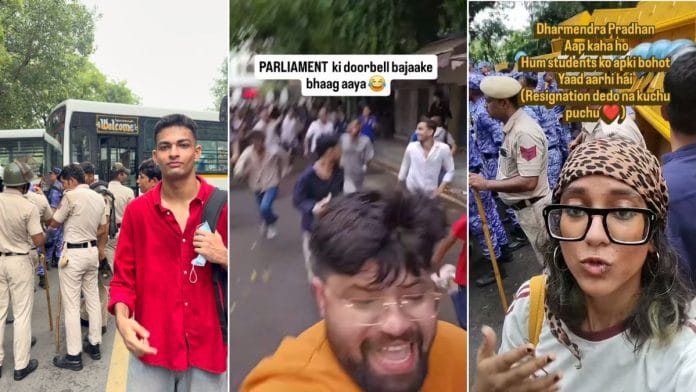

The generation that grew up playing Subway Surfers is now living out the game. Protesters filmed themselves running from lathi-wielding Delhi Police and later posted reels with the chase music.
“Aaja pakadle (Come catch me),” read the caption of a reel posted by Saiyed Faizan and Ashish Choudhary set to the game’s chase music.
Whether it’s the “get ready with me to get lathi-charged” videos or clips of young people swinging left and right to dodge water cannons, Gen Z laughed in the face of the baton.
The Viral Spiral this week is the Gen Z movement, and yes, it will be memefied.
On 20 July, police crackdown on protestors featured lathi charge, tear gas, and allegedly, even pellet guns. It led to several injuries, and some protesters were hospitalised.
It didn’t take long for the meme generation to find the joke in it. The protesters turned their own pain into the punchline, and there was power in that decision. If the police dominated the day’s headlines, the students would write its captions.
“PARLIAMENT ki doorbell baja ke bhaag aaya (rang the doorbell at Parliament and bolted),” read the text on a reel posted by Mahak Bhayana on 21 July, set to the title track for Chak De! India.
The video showed him running frantically with others, some grinning as they ran.
“Bro abhi tk mood kharab tha teri video dekh ke hasi aa gyi (I was upset until now, but your video made me laugh),” read a comment under the video.
Some posted stats from Strava—a fitness app—logging their own sprint away from the police as though it were just another Tuesday run. Here, too, the Subway Surfers music was a frequent presence.
Others made fun of the tear gas shells fired at the protestors.
“Ittna sutta phook lia k ab to tear gas ka asar bhi nhi hota (smoked so many cigarettes, even the tear gas doesn’t affect me anymore),” read a reel featuring three young men wearing masks.
Content creator Nishan took a shot at open drains. “Someone tell the police I am from Jamnapar; we have worse gas in our open sewers,” read the Hindi text over footage from the tear-gas shelling in Central Delhi.
Another reel showed a man with a handkerchief over his eyes, his friend pouring water over it.
“Isko yaad aa rahi hai,” the friend said. He paused for effect before adding, “swatantrata ki (he misses freedom).”
From detentions to the scale of the police presence at Jantar Mantar to ‘kuchu puchu’ requests for Pradhan’s resignation, the youth have found something funny in every aspect of the protest.
Also read: Alankar Mishra is India’s newest rural gyani influencer. People compare him to Shakespeare
One must dance
My first encounter with the memefication of the Jantar Mantar protest was a reel captioned, “Feeling FOMO for not being lathi-charged by the Delhi Police.” I was repulsed. I was incensed. It felt wrong to make light of something that had left people hospitalised, as the reelsters watched from a screen.
But a lot of the memes come from people who were actually there—on the street, in the smoke, among the crowd. And when they made fun of the ordeal, the joke wasn’t on them. It was on the police, the State, and the system.
Scholar and activist Umar Khalid, who has been in jail for nearly six years, once said, “Fascism se ladai ka ek pehlu ye bhi hai ki khush raho (one of the facets of the fight against fascism is also that you should learn to be happy), because that is exactly what they don’t want you to be.”
Gen Z’s jokes about lathi charge and tear gas are its own kind of revolt—they refused to be curtailed by brute force. I’m not sure how many of the people making the memes think of it as a political act. But then again, what about a protest isn’t political?
Writer and activist Dan Savage said that during the darkest days of the AIDS crisis, they buried their friends in the morning, protested in the afternoon, and danced all night.
“It was the dance that kept us in the fight because it was the dance we were fighting for.”
Views are personal.
(Edited by Prasanna Bachchhav)