









What happens when a flagship rights-based social law gets recast in a new bill with a new name?
The BJP-led central government’s proposed Viksit Bharat-Guarantee for Rozgar and Ajeevika Mission (Gramin) Bill — VB-GRAMG — which seeks to replace the Mahatma Gandhi National Rural Employment Guarantee Act, or MGNREGA, promises more workdays and strategic interventions in rural areas. But as we read closely and listen to voices on the ground, a whole new narrative emerges: this is not merely a name change, but a structural shift with consequences for rural labourers, states’ finances, and the political economy of welfare.
The BJP does not seek only electoral consent; it seeks control over collective memory and historical meaning. Renaming a policy long associated with MK Gandhi, a figure it routinely criticises and whose assassin has been publicly glorified by some within its ecosystem, is not incidental. It is a political strategy, written into policy.
The move raises a question: is this modernisation glorified, or a rushed rewrite that risks weakening the very guarantee it claims to strengthen?
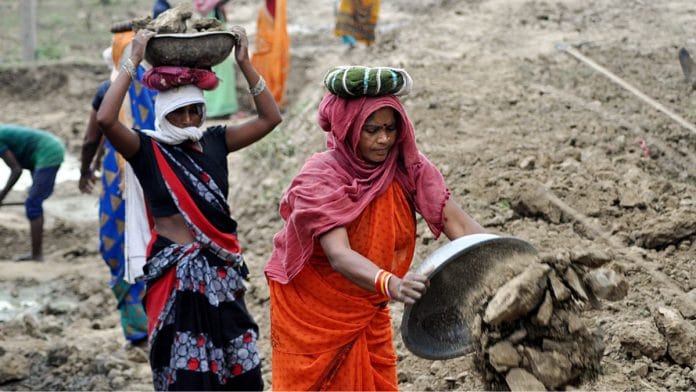
First, let’s consider the numbers. MGNREGA has historically been India’s largest employment programme, designed to be demand-driven, with 100 days of guaranteed unskilled work per rural household whose members volunteer to work. It was born from decades of struggle by rural activists and multiple movements — as a legal right to work.
As per government data, in FY 2025-26, 15.99 crore rural households registered under the scheme. With this around 290.6 crore person-days of employment was generated, with nearly Rs 38,000 crore allocated to wages. In Uttar Pradesh alone, for FY 2025–26, more than 48 lakh families obtained employment under the scheme, where over 97 per cent of the workers got timely payments.
But these impressive figures conceal uneven realities: studies drawing on rural insights derived from the Project on Agrarian Relations in India (PARI) show that workers in some villages receive as little as 32 days of paid work per year on average, far below the statutory 100 days, hinting at underutilisation and access constraints.
Promise of new jobs, with caveats
At first glance, the proposed VB-GRAMG Bill appears attractive with its claims. It increases the guaranteed annual work from 100 to 125 days. Moreover, it emphasises rural infrastructure, climate resilience, and livelihood-linked assets. But scratch beneath the surface, and structural changes loom large, especially in funding architecture, regulatory design, and states’ responsibilities.
The contrast between MGNREGA and the proposed VB-GRAMG reveals not an upgrade, but a quiet reworking of the idea of a guarantee itself.
Under MGNREGA, rural employment was demand-driven: households could seek up to 100 days of work when they needed it, with the Centre bearing the full wage cost and Gram Panchayats shaping projects around local priorities.
VB-GRAMG, on the other hand, raises the headline figure to 125 days while inserting a 60-day annual pause during peak agricultural seasons, effectively rationing access when distress may be highest. More significantly, it shifts the funding burden, transforming a centrally funded rights-based law into a centrally sponsored scheme where states must now finance a substantial share of wages and absorb costs beyond centrally approved allocations.
The job provision model also moves away from open-ended demand toward normative, Centre-defined planning quotas, making employment contingent not on need but on budget ceilings and administrative approval. Project choices are narrowed and aligned to national priorities — water, roads, climate resilience — diluting the autonomy of local governments. While social audits and grievance mechanisms formally remain, they now operate within thicker layers of governance and conditional funding flows.
In effect, what was once a legal guarantee anchored in local demand and central responsibility is now being reshaped into a managed programme where risk is devolved downward and control pulled upward.
Also read: The long arc of rural employment—from welfare to rights to rationing
So, what really changes?
MGNREGA’s core strength was its demand-driven nature: if you needed work, you got work. VB-GRAMG’s funding model, however, hinges on normative allocations. That means rural households may apply, but work will only be available if a state has the budget and the Centre has approved the corresponding allocation.
Scholars like Jene Drèze have flagged that if work availability is tied to allocations rather than genuine rural demand, people will not get jobs just by asking for them. This strikes at the heart of the original scheme’s promise.
It is equally important to know that the new funding pattern places a significant fiscal burden on states like Tamil Nadu. Officials have estimated that the state may need to spend an additional Rs 4,300 crore annually just to maintain existing employment levels under the new cost-sharing model. This creates a paradox: states now are disincentivised from meeting rural labour demand, especially when budgets are tight. Yes, 125 days sound generous. But that figure includes a potential 60-day non-work window tied to peak agricultural periods, when labourers arguably need alternative work most. What appears to be greater protection could in fact offer less, when workers are excluded not only by budgets but by rigid schedules.
PARI-style rural documentation shows that rural livelihoods are scattered, seasonal, and fragile. In many areas, households receive only a few dozen days of MNREGA work. Under VB-GRAMG, however, an emphasis on national priorities may divert employment toward asset construction rather than the immediate wage support families rely on to survive.
Such a shift would also shape the kinds of assets built and at what social cost. Research by the India Council of Agricultural Research (ICAR) finds that MNREGA assets, such as land development and water structures, do improve agricultural performance, especially during droughts and lean seasons, but these gains are gradual and unfold over several years.
It would be naive to ignore the political context, and even more naive to reduce this to a debate over names. With the Punjab Assembly elections scheduled for 2027, farmers’ distress remains unresolved even after years of disputed farm reforms and mass protests that continue to unsettle the BJP leadership. Many view VB-GRAMG as a rural freebie, offering more funds and central visibility without addressing core demands such as employment guarantees, debt relief, or irrigation. Instead, it appears to tie rural voters to short-term wage work while sidestepping deeper, long-term agricultural policy reform. And where do we go from here?
VB-GRAMG’s promise of extra days and bigger projects is attractive. But without guaranteed demand, predictable financing, and genuine rural participation in planning, the new scheme feels more like hype than hope. If the Modi government is serious about rural resilience, any “upgrade” it brings must preserve the core, the guaranteed right to work. Moreover, it must also strengthen asset quality, gender equality, and climate resilience. Drèze’s legacy reminds us: a guarantee without enforceability is a promise unfulfilled. Let us hope policymakers listen more to rural realities and less to quick electoral optics.
The author is a political researcher and independent writer on Indian democracy, welfare, and identity. Views are personal.
(Edited by Aamaan Alam Khan)
If this reform, saves money, and govt cuts petrol taxes as a result, then the poor will benefit more.