






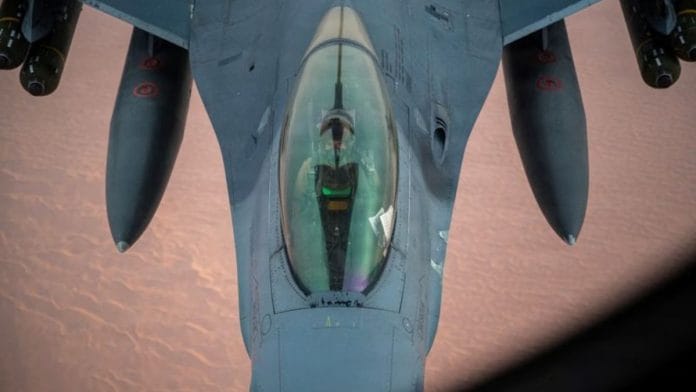



In the early hours of 3 April 2026, an American F-15E Strike Eagle was shot down over Iranian territory. The aircraft was likely engaged in an interdiction mission. It belonged to the 494th Fighter Squadron, known as the Black Panthers, which is part of the 48th Fighter Wing (Liberty Wing). The Wing is permanently based at RAF Lakenheath in Suffolk, England.
The squadron operates the two-seater F-15E (Mudhen) for long-range strike, interdiction, and close air support missions. Its aircraft are easily identifiable by a distinctive red stripe/band on the vertical stabiliser (tail fin), often accompanied by “LN” tail code and “Europe” markings. These visual identifiers were also observed on the photos/videos of the wreckage shared on social media.
The two-man crew, comprising the pilot and weapon systems officer (WSO), ejected safely but landed in hostile terrain. It appeared, at first glance, to be a significant setback for US forces. The pilot was rescued within a few hours, but the fate of the WSO remained uncertain for a long time. Eventually, the WSO was safely recovered in a daring Combat Search and Rescue (CSAR) operation that involved multiple aircraft, elite special operations teams, and extraordinary risk.
The WSO (reportedly a USAF Colonel) used SERE (Survival, Evasion, Resistance, Escape) training to great effect, improving his chances of rescue. US President Donald Trump hailed it as “one of the most daring search and rescue operations in history”.
A large number of assets were devoted toward this mission and by some (as yet unverified) accounts, a significant number of losses were incurred. Potential damage includes: one F 15E, two A10 aircraft, two MQ-9 UAVs, two HH-60W Pave Hawk (Rescue Helicopters) were attacked by small arms fire, one HC-130 was damaged in the air, two C-130 were damaged on the ground. The list is astounding and awaits formal confirmation from the United States Central Command (CENTCOM). However, the extent of (possible) losses has led to a spirited debate on the subject.
A large number of commentators are fixated on the narrow ledger: resources committed versus potential gain. The central argument being the US risked too many lives and lost far too many assets in saving one life. Fuel, ammunition, flight hours, and manpower were expended at considerable cost. Critics ask whether it was worth it.
This line of argument is literally ‘missing the woods for the trees’. This reasoning misses the far larger strategic truth: a captured USAF pilot would have been catastrophic at the strategic level. This was a “no price too high” mission, and the successful rescue delivered a force-multiplying boost to the morale at precisely the time it was needed the most. The rescued airmen is a senior pilot in the rank of Colonel. His return to the flight line would raise spirits in his squadron, wing, and the entire force. They would probably be ready to run through a brick wall at this time.
The rescue force
Combat Search and Rescue is always a complex mission involving a lot of moving parts. The F-15E CSAR package that unfolded over Southern Iran (reportedly in Khuzestan province) followed standard USAF doctrine and the SOP. The crew was backed by the state-of-the-art equipment, extensive training and the trust of their leadership. Primary recovery assets were two HH-60G Pave Hawk helicopters, specialised for personnel recovery. Each Pave Hawk carries a crew of four (pilot, co-pilot, flight engineer, and gunner) plus up to two Pararescue Jumpers (PJs). The PJs are the elite special operators trained in combat medicine, survival, and extraction under fire. These aircraft are equipped with advanced terrain-following radar, infrared sensors, defensive countermeasures, and miniguns or .50-caliber machine guns.
Supporting them was at least one HC-130J Combat King II, a modified Hercules tanker and command platform that provides in-flight refueling for the helicopters while serving as an airborne coordination hub. These tankers enable the Pave Hawks to loiter or penetrate deep without running out of fuel mid-mission. Low-altitude footage verified by multiple sources showed the HC-130J operating at ultra-low level over the Iranian countryside alongside the helicopters.
Close air support came from A-10 Warthogs. Their ability to fly low and slow makes them an ideal platform for proving firepower during CSAR missions. One A-10 was hit during the operation, forcing its pilot to eject over the Persian Gulf; he was recovered safely, but the incident underscored the risk. Additional assets included electronic warfare aircraft for jamming Iranian radars and communications, plus intelligence, surveillance, and reconnaissance (ISR) platforms feeding real-time data to the rescue force.
Manpower was equally significant. A typical CSAR package draws from Air Force Special Operations Command and Air Combat Command units. Pararescuemen (PJs) are specially trained troops and are available only in a handful. These are not interchangeable troops; PJs undergo some of the most grueling training in the military, with washout rates exceeding 80 per cent. Each PJ represents years of investment and irreplaceable expertise. They were supported by other elements of JSOC, including Rangers, Delta and Green Berets. Off-site support providing real-time intelligence and situational awareness was executed by a large number of people spread across multiple bases and ships.
The catastrophic alternative
A live American pilot paraded on Iranian state television would have been an intelligence windfall and a propaganda coup of historic proportions. F-15E aircrew, in the rank of Colonel, would possess classified knowledge of current US tactics, techniques, procedures, rules of engagement, electronic warfare countermeasures, and ongoing operational plans in the theater. In an era of precision-guided munitions and networked warfare, that information is worth far more than the aircraft itself. Iran has already circulated claims and imagery of wreckage; a captured airman would have provided a human trophy to amplify every narrative of American vulnerability.
History offers grim precedents. During the Vietnam War, downed pilots became central to North Vietnamese retaliation. The “Hanoi Hilton” prison system held hundreds of American airmen whose public confessions—often extracted under torture—were weaponised to erode U.S. domestic support and international legitimacy. The political and psychological costs dwarfed the material ones. In the 1991 Gulf War, captured US pilots were displayed on Iraqi television, their battered faces broadcast globally to signal defiance.
More recently, the 1995 shoot-down of Air Force Captain Scott O’Grady over Bosnia demonstrated the near-miss: had Serbian forces captured him during his six-day evasion, NATO’s air campaign would have faced a severe morale and diplomatic crisis. In India’s case, the capture of Wg Cdr Abhinandan by Pakistani forces in the 2019 crisis severely restricted our operational options.
In the current Iran conflict, the stakes are arguably higher. Tehran had reportedly offered bounties for capturing US pilots alive and devoted enormous resources to locating the pilot and damaging the CSAR aircraft. A successful capture would have handed Iran leverage in any future negotiations, a rallying cry for its proxies across the region, and a humiliating image to broadcast across social media and global news. It would have severely dented Trump’s political capital. A successful rescue, on the other hand, with no loss of life, is a tactical success and strategic victory. The daring rescue sent the message: America will penetrate defended airspace, accept fire, and extract its own at any cost.
Historical lessons
The US military has long internalised this calculus. One of the most infamous examples remains “Bat 21” during the Vietnam War. In April 1972, an EB-66 electronic warfare aircraft was shot down near the demilitarised zone. Only navigator Lieutenant Colonel Iceal “Gene” Hambleton survived. The ensuing 11-day rescue effort became the largest CSAR operation of the war: 284 aircraft sorties, multiple helicopters lost, several A-1 Skyraiders shot down, and more than a dozen Americans killed or wounded. Yet the mission continued. Hambleton and another airman were eventually recovered by a Navy SEAL team. The operation’s cost was staggering, but its message to every American aircrew was clear: you will not be abandoned.
The 1995 O’Grady rescue offers a more recent parallel. After his F-16 was downed, O’Grady evaded Bosnian Serb forces for six days with only a 29-pound survival kit. Marine CH-53E Super Stallions, escorted by AH-1W Cobras, AV-8B Harriers, and a massive supporting package including AWACS, EA-6B Prowlers, and A-10s, extracted him under fire. The mission involved dozens of aircraft and hundreds of personnel. No one questioned the resources; the return of a pilot alive and defiant provided an incalculable morale surge. Each successful CSAR reinforces the doctrine that trained aircrew are national assets whose preservation justifies extraordinary measures.
The force multiplier
At a time when questions about the utility and futility of the Iran conflict circulate among troops—long deployments, high operational tempo, uncertain strategic end-states—the rescue lands like a thunderclap. A rescued pilot does more than return one highly trained aviator to the fight. It reaffirms the sacred covenant between the nation and its warriors: we will risk everything to bring you home. That covenant is a force multiplier. It sustains willingness to fly into contested airspace, to press attacks knowing that if the worst happens, the full might the military would be rallied to recover you.
The rescued airmen themselves become living testaments. They can debrief, share survival lessons, and—most importantly-inspire. His return inspires every squadron mate, every maintainer, every young lieutenant worried about the consequences of flying into harm’s way. In an era of volunteer forces and all-volunteer recruitment challenges, such signals matter. Retention, reenlistment, and even public support hinge on visible proof that the institution values its people above all else.
Psychologically, the effect ripples outward. Enemy forces witness the lengths to which you will go, forcing them to recalibrate options. Allies see resolve—incentivising them to take part. Domestic audiences, often skeptical of distant wars, register that. American lives are not expended lightly. In the broader narrative of this conflict, the rescue undercuts narratives of American vulnerability or indifference.
Also read: Rafale dilemma sums up India’s defence paradox—security vs self-reliance
Beyond the balance sheet
Critics who reduce the F-15E rescue to a simple input-output equation overlook the irreducible human and strategic dimensions of war. Yes, the mission consumed expensive flight hours, exposed high-value aircraft to ground fire, and placed elite operators in harm’s way.
Multiple assets were lost or damaged, too. But the alternative—a captured pilot paraded as a trophy–-would have inflicted strategic damage measurable not in dollars but in eroded credibility, compromised intelligence, shattered morale, and prolonged diplomatic entanglement. In the final analysis, the US did not just rescue two airmen. It rescued something far more vital: the conviction that in the American way of war, the human element still commands the highest price tag of all.
Group Captain Ajay Ahlawat is a retired IAF fighter pilot. He tweets @Ahlawat2012. Views are personal.
(Edited by Ratan Priya)
A matter of prestige. For both USA and more so, President Trump personally. So the cost, including aircraft and helicopters lost in the rescue effort, would not have been grudged. 2. A larger point. Combat involves service personnel being killed, the grim visuals leading upto Dignified transfer. Also some being taken prisoner. So one pilot being captured and shown on state TV should not be seen as so catastrophic. All these factors should be considered while taking the fateful decision to go to war. A war of choice in this case, with no imminent threat to USA, as per the professional assessment of the intelligence community.