






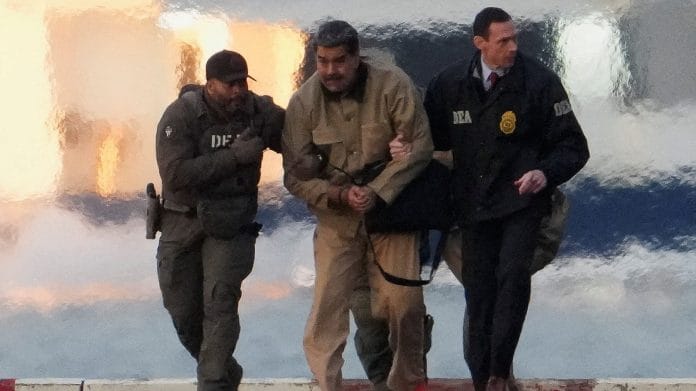



We will miss the liberal international order. Yes, it was neither entirely liberal, nor truly international nor very orderly. But despite all that, it was a regime in which the world’s most powerful country at least sought to live by and enforce some basic rules, even if it was because these rules disproportionately benefited the US. President Donald Trump’s foolish invasion of Venezuela means that we are likely well past any kind of orderliness in international politics. It is the relatively weaker parties, India included, which are likely to be worse off.
For all the failures of the liberal international order, a part of it was useful to India because it also involved keeping in check — ‘containment’, if you will — China from seeking to dominate Asia and the Indo-Pacific. But a US that is run on the moronic strategic idea of spheres of influence and on the willing acceptance that its interests are limited to the Western Hemisphere rather than be a global power, will sound the death knell for any idea of an Asian balance. In all likelihood, Asia and the Indo-Pacific will need to get comfortable with living under China’s hegemony. Expect more inane Indian declarations about the “need” for a multipolar Asia, which will be about as successful as the calls for a multipolar world.
For India, another lesson is not to let ideology get in the way of the cold calculations of foreign policy. There was considerable satisfaction and even some schadenfreude among some sections of the Indian political opinion about Donald Trump’s election because of their supposed common ideological sympathies. But nativism carries within it hatefulness and nastiness, whether in India or the US or anywhere else.
That is the domestic corollary of the narrowmindedness and foolishness that Trump exhibits in foreign policy. Both are damaging to America’s self-interest, but there is little that the rest of the world can do about it because that is the choice that Americans have made. Whether they will realise it and attempt to undo the damage remains to be seen. In another three years, the earliest that the Trump-Vance administration will leave the White House, the damage done may already be too great to repair.
A fake narrative
Part of the justification for the US action in Venezuela appears to be some notion of the spheres of influence — the idea that great powers control their immediate neighbourhood. This was reflected in the recently released US National Security Strategy document, which emphasised US interest in the Western Hemisphere. The US military action in Venezuela further underlines this interest. But the US dominance in the region is overwhelming and unquestioned, which is why the emphasis on the region was so unnecessary and limiting to US interest. To claim that the US reasserted control over the Western Hemisphere is akin to claiming that Americans can once again celebrate Christmas: a narrative that is as fake as the make-up on Trump’s hands.
The other aspect of the US emphasis on such spheres of influence is that the US is, in effect, conceding that it has no interest in contesting great powers in other regions. Spheres of influence are not legal mechanisms but simply reflections of power realities. If Europeans largely stayed out of the Western Hemisphere in the 19th century, it was just a reflection of their growing weakness relative to the rising US. That is why the Trump administration’s concession to other powers is so foolish, because other powers do not have the kind of dominance in their regions that the US has in the Western Hemisphere. Russia is relatively weak, and outside of nuclear weapons, it has little claim to being a great power.
China, of course, has a much greater claim to being the dominant power in its region, but US prosperity is deeply integrated with East Asia, which means that any rational US policy would not abandon the region without a fight. But rationality is not the adjective that anyone would link with the Trump administration.
Also read: What the world gets wrong about Venezuela’s Left–Right divide
Options for US allies
There are also additional consequences of the US action in Venezuela and Trump’s ‘strategy’ in general. Most critically, it is likely to raise questions about the choices that US allies and partners face today, putting even greater stress on the international order. If they can no longer depend on the US, the need to seek alternatives will become stronger, except that there are not particularly good alternatives.
One alternative choice is regional partnerships without the US. But these are largely unviable. The first question is of capacity, but even where there is capacity, political problems come in the way of such security partnerships. Europe does not lack capacity, given that several European powers are wealthier than Russia — the regional threat. Collectively, they are about ten times wealthier. But they are divided, and those who are the wealthiest are also the farthest from Russia. They find it easier to work their jaws than build their military muscles. In Asia, regional partnerships are unlikely to work because China is already richer and stronger than the other major powers.
The other response is nuclear weapons. Many US partners are technologically capable enough and have the material resources needed to build them. But two reasons may hold them back.
One reason is the norm of non-possession, though this may break if any one ally decides to jump across the nuclear divide. This is the easiest way to counter at least overt military pressures from regional hegemons, though they are generally useless for anything less serious than existential threats. Nevertheless, they are better than nothing.
The other reason is hope: hope that the US will return to its senses after the Trump administration departs. This itself rests on two other assumptions: first, that Americans elect either a Democrat or a non-MAGA and non-isolationist Republican. This is by no means certain. Though Democrats did well in several recent off-cycle elections, the party itself is deeply divided and held together mainly by their common and deep dislike of Trump. Whether they can pull together and reiterate more traditional American strategic values is uncertain.
Of course, this also assumes that the US strategic culture hasn’t been fundamentally altered in unhelpful directions. This is by no means assured.
Rajesh Rajagopalan is a professor of International Politics at Jawaharlal Nehru University, New Delhi. He tweets @RRajagopalanJNU. Views are personal.
(Edited by Aamaan Alam Khan)
The point advanced here that somehow Trump is a rupture with traditional US foreign policy is a fallacy. The US has in its 250 year existence engineered over 70 regime change operations through all and any means. Much of it was covert. With Trump, it’s all being overtly owned as a badge of honor. Suddenly an arrest warrant in the US has become a global warrant that the Us will enforce by any means. The US has become a law unto itself. Spheres of influence is also a falsity that seeks to actually indirectly tell China, in the geopolitical language that Chinese foreign affairs specialists often have used, that the US will only be concerned about the western hemisphere. Interestingly however has rebuffed it already in their global times paper with a statement that such an approach limits a nation’s choices and growth trajectory. It’s also no secret that the US is actively meddling in South Asia. Whether thats the “democratic” intervening in the case of Umar Khalid by Congressman Jamie Raskin and the letter written directly to him by Mamdani or the chaos and bloodshed that reigns in Bangladesh. The fact that while Venezuelans sovereignty was being breached with impunity, China was welcome the South Korean president shows that really the US is working with and against China to both contain it and expand its eastern sphere of influence. South Korea a close US ally would never visit Beijing without Washington’s assent. In an interview to NDTV, Jeffrey Sach’s words were interesting. While he said all the right things about US actions, he suddenly seemed to forget that India was a founding BRICS member and leads its presidency in 2026, saying instead that India should be more a part of BRICS rather than the QUAD. Sachs is a pro-China and pro-Russia foreign policy analyst. While the control and militarization of shipping routes by the US and its desire to control oil production and shipment suggests the desire to control every nation on earth especially those that want to pursue a truly independent foreign policy like India. India’s uncompromising multi polarity is what the US is really pushing back against.
Let the “best President ever” of USA grab Greenland. All the leftover charade will be done for and people across the globe will realise the extreme duplicity and hypocrisy of the USA and how it is not worthy of being turned to for leadership. It has become too cliched to use words like Nazism but the mindset of current Trump administration is showing early signs of pushing future of America in deep peril.