






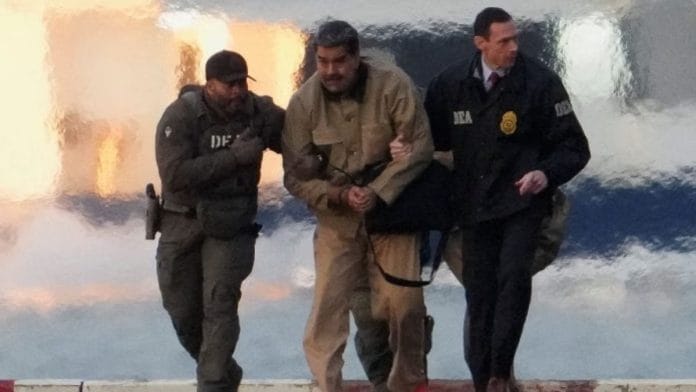



The early-morning raid on 3 January 2026 by United States forces—Operation Absolute Resolve —culminated in the capture of Venezuelan President Nicolás Maduro and his wife, Cilia Flores. The operation has generated global attention for its intelligence penetration, audacity, speed, multi-domain integration, air, electronic and cyber domination, and application of elite Special Forces.
Much of the commentary on the operation has focused on its legality, morality and geopolitical fallout. For India, however, the real value lies not in emulating its objectives or political context, but in understanding the military capabilities and joint war-fighting constructs that made such an operation possible. Operation Absolute Resolve showcased a range of capabilities that are foundational to 21st-century conflict.
Separating intent from capability
The US employed its military power to capture a foreign head of state and impose compellence on the successor political leadership without a permanent commitment of boots on the ground. India’s strategic culture, respect for international laws, and long-term interests argue against such adventurism.
Yet, Operation Absolute Resolve must not be dismissed as irrelevant. It offers important lessons on how modern militaries build, integrate and employ capabilities to achieve political objectives swiftly, decisively and with controlled escalation. The operation’s success rested on capabilities increasingly central to all serious militaries: intelligence dominance, joint planning, superiority in air, electronic and cyber warfare, precision strikes, elite Special Forces, and compressed decision-making cycles.
India’s security challenges—whether counter-terrorism, limited war under a nuclear overhang with Pakistan, or deterrence against China—will be shaped by these technological and doctrinal realities. The lessons of Operation Absolute Resolve, therefore, must be imbibed to build the capabilities India will need.
Intelligence dominance: the foundation of 21st-century warfare
The most decisive element in Operation Absolute Resolve was neither airpower nor special forces, but intelligence preparation of the battlefield to bring about certainty. The operation was preceded by persistent intelligence gathering since August 2025 across human, electronic, cyber, space and geospatial domains. Effective use was also made of platforms such as the RQ-170 Sentinel stealth drone, and the MV Ocean Trader, a special warfare support vessel, for intelligence collection. The US knew where Maduro would be, when, with whom, and under what protection. Similarly, data on all military elements that could threaten the Special Forces mission were identified and mapped.
For India, this underscores a hard truth: precision operations are impossible without intelligence dominance. India’s intelligence ecosystem remains fragmented. Service intelligence, national agencies and technical collectors still operate in parallel rather than through real-time fusion. Human and technical penetration of the adversaries is also below par. If the Operation Absolure Resolve model or Israel’s approach during Operation Rising Lion had been followed, then the terrorist leadership in Pakistan could have been decapitated with precision strikes during Operation Sindoor, rather than killing 100-odd (as claimed) terrorist foot soldiers and destroying the terrorist infrastructure, which can be rebuilt in a short time.
Capability development must prioritise persistent intelligence, surveillance and reconnaissance across land, maritime and space domains; deeper human intelligence penetration integrated with technical intelligence; AI-enabled fusion and predictive analysis; direct intelligence-to-shooter linkages; and the exploitation of drones deep inside adversary territory through agents or proxies. Without these enablers, even the most advanced modern weapons platforms will underperform.
Continuous intelligence preparation enables faster political and military decision-making to execute contingency plans. If this had been done, Operation Sindoor could have been launched within 24 to 48 hours rather than after 15 days. Its absence also led to China achieving strategic surprise in April-May 2020, which is an unpardonable political and military sin.
Jointness—from aspiration to operational necessity
Operation Absolute Resolve was a textbook example of jointness in execution, not merely coordination. Air, land, maritime, cyber, space and Special Forces operations were planned and executed under a single operational framework by the US Southern Theatre Command with unity of command and effort. During the Venezuelan raid, the operations of 150 aircraft and drones from the US Air Force and Navy—operating from 20 bases and an aircraft carrier—were synchronised with special operations aviation and ground teams that executed the assault with precision. A US Navy armada provided the launch pad for both air operations and Special Forces. All of this was achieved in just two hours and 28 minutes over Venezuela.
India has been debating tri-service integration and jointness for decades, and a political decision to create integrated theatre commands was taken six years ago. Yet very limited progress has been made. The absence of fully empowered theatre commands continues to impose structural limitations on planning and execution. Service-centric doctrines, duplicated assets and sequential decision-making slow response times and dilute combat power. Service Chiefs can not exercise direct command and control at the operational level of War. I say it with full responsibility that the present system cannot execute an operation similar to Absolute Resolve.
Capability development must therefore be aligned with integrated theatre-level planning, joint command-and-control architecture, a common operational picture across services, and joint training as the norm rather than the exception. Modern operations reward speed and integration, not mass alone.
Air, electromagnetic and cyber dominance
A key lesson from Operation Absolute Resolve was the use of electronic and cyber warfare. A near-nationwide blackout was reportedly achieved through cyber attacks on the power grid. The entire military and civilian command control system was disrupted by electronic and cyber operations before ground forces moved. Electronic warfare attacks using aircraft and drones neutralised Venezuelan radars and control and guidance systems of air defence weapon platforms. The blinded air defence systems were then targeted by aircraft using precision-guided munitions from stand-off ranges. There is also speculation about the use of a mysterious sonic weapon.
It is pertinent to mention that the Russian air defence systems—the S-300 and Buk-M2E— failed to engage any aircraft, drone or helicopter during the operation. All were either neutralised by electronic warfare from aerial platforms or destroyed by kinetic strikes. The fabled anti-stealth Chinese radar, JY 27, also failed. The stealth features and surface designs of US fifth-generation aircraft reduced radar detection ranges of radars by 10 per cent or 20-30 km, which set them up for destruction.
India must therefore carefully evaluate the capabilities of the S-400 air defence system against Chinese J-35 fifth-generation fighters with advanced stealth feature, which Pakistan may get as early as 2026. India will have to seriously consider inducting at least three squadrons of fifth-generation fighter aircraft to exploit the stealth features.
For India, particularly in the context of Pakistan, these lessons have direct relevance. Any future crisis will unfold under intense time pressure and escalation risks. The side that gains early air, electromagnetic and cyber superiority will shape the conflict’s trajectory.
Capability priorities should include robust suppression and destruction of enemy air-defence capabilities; integrated electronic-warfare units across services; resilient networks and counter-electronic and cyber-warfare measures; redundant space-based intelligence, surveillance, reconnaissance, and communications; and a penetrative cyber-warfare capability.
Airpower, when integrated with cyber and electronic warfare, becomes a tool not just of destruction but of strategic signalling and escalation management.
Precision over mass
Operation Absolute Resolve reaffirmed a broader trend in modern warfare—precision has replaced mass as the primary ingredient of combat power. The operation relied on small, highly trained forces supported by precise fires rather than large troop deployments.
India’s force planning still reflects legacy assumptions about numbers, platforms and territorial control. While geography and scale impose certain realities, capability development must increasingly prioritise stand-off precision weapons, loitering munitions and unmanned systems, networked Special Forces operations, and long-range fires integrated with intelligence, surveillance and reconnaissance.
Precision reduces collateral damage, political risk and escalation while increasing deterrent credibility.
Decision cycles and political-military integration
One of the least discussed but most important aspects of Operation Absolute Resolve was the compression of political and military decision-making cycles. Intelligence, planning, authorisation, and execution occurred within a tightly controlled loop. Apart from intelligence gathering and force positioning since August 2025, the final decision was conveyed to the military by President Donald Trump at 1046 hours (EST). Preceded by 150 aircraft that created a safe pathway, the Delta Force was on target by 0100 hours. In 30 minutes, it captured Maduro and was back over the sea by 0329 hours in approximately 150 minutes. Maduro landed on USS Iwo Jima at 0429 hrs.
India’s civil–military decision-making remains cautious and sequential. While this reflects democratic accountability, capability development must focus on reducing friction through pre-authorised contingency plans, standing joint task forces, and secure, real-time political–military communications. Speed in decision-making is itself a capability in modern conflict.
Also read: India isn’t ready for drone terrorism. It’s central to proxy warfare
Special Forces
India’s Special Forces have mostly been used for tactical missions or to execute difficult regular Infantry missions. It is time to use them primarily for strategic missions. The Special Forces Division needs to be converted into a Special Forces Command for strategic missions. The three services can retain or create separate forces for complex tactical missions.
Imagine the psychological impact of capturing and killing the top rung of terrorist leadership in Operation Sindoor 2.
Narrative management
US political and military leadership proactively shared the details of Operation Absolute Resolve hours after the operation. Investigative reporters have dug out the rest. Even the Indian media has given more coverage to Operation Absolute Resolve than Operation Sindoor. As a result of credible details being available in public domain the world is in awe of the US military capabilities.
This should be an important lesson for India. Despite the stupendous strategic success of Operation Sindoor, India inexplicably failed to sell its success story due to the perceived stigma of early tactical losses. Pakistan ran away with the narrative, cashing in on early tactical successes, whitewashing its strategic defeat.
Conclusion
Operation Absolute Resolve was a demonstration of what a modern, integrated military can achieve when intelligence, air, electronic and cyber dominance, jointness and precision are brought together under decisive political direction.
For India, its value lies not in the operation’s objective, but in the capability ecosystem that enabled it.
Lt Gen H S Panag PVSM, AVSM (R) served in the Indian Army for 40 years. He was GOC in C Northern Command and Central Command. Post retirement, he was Member of Armed Forces Tribunal. Views are personal.
(Edited by Ratan Priya)