






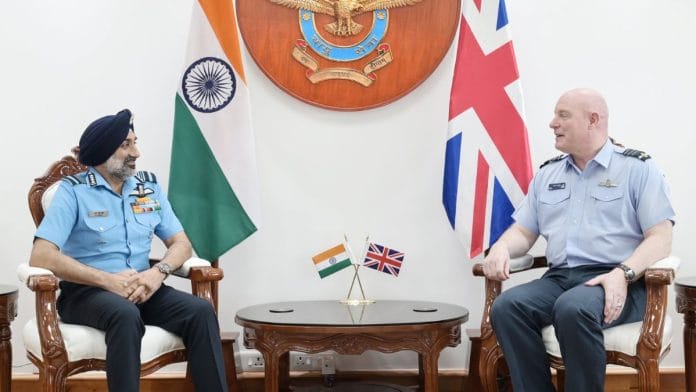



My visit to India as the UK’s Chief of the Air Staff has been exceptionally useful, covering a wide range of topics, from strategic to tactical. Of course, the matter of the regional war in the Middle East has been a common discussion point: It will undoubtedly reshape the region for decades.
As Prime Minister Keir Starmer said, the UK will not be drawn into the wider war. We will keep working toward a swift resolution that brings security and stability back to the region, which is a shared priority of the UK and India.
The UK is clearly demonstrating reliability as a security partner at a moment of acute need. Ever since the hostilities broke out in the Middle East, the Royal Air Force (RAF) has been in defensive action to protect British lives and UK interests.
That’s why we have deployed significant defensive capabilities to the region since January, including radar systems, RAF Regiment-controlled counter-drone systems, F-35B jets, ground-based air defence, and 500 extra UK personnel.
Over the past weeks, we’ve also bolstered these capabilities, deploying further counter-drone specialists, additional Wildcat and Merlin helicopters, and four more Typhoon jets to Qatar.
As of now, RAF is conducting defensive air sorties in support of allies in the Middle East, and recently, British Typhoon jets successfully took out two drones, one over Jordan and one heading to Bahrain. RAF pilots have already racked up over 1,200 flying hours in defensive operations across the region, which is home to not only British nationals but also a significant Indian diaspora.
Because of conflict, the security ties and cooperation of the Indo-Pacific and the Euro-Atlantic are increasingly vital. Navigating today’s complex security scene as partners with shared values will be pivotal. The growing UK-India defence relationship, through closer people-to-people ties, training, education, and joint exercises, showcases how the UK remains committed as a defence and security partner for the long term.
Also read: India’s oil and gas vulnerability runs on diesel trucks
Complementary strengths
When it comes to collaboration, our two Air Forces share a unique bond since inception, and this historic relationship has grown across multiple domains of air warfare. Just last year, the UK Carrier Strike Group exercised with their Indian counterparts, and our two countries took part in a complex air defence exercise. Additionally, each nation has now participated in each other’s multilateral air combat exercises, with the Indian Air Force debuting at the UK’s Exercise Cobra Warrior in 2023, and the RAF being privileged to rank among the participating forces for the first edition of India’s Exercise Tarang Shakti in 2024.
This ability to perform and participate in complex environments also translates to the realm of military training, which has grown much stronger in recent times. We are honoured to host Indian liaison officers as instructors at our world-renowned military institutions, including the Royal Air Force College Cranwell, the Royal Military Academy Sandhurst, and Britannia Royal Naval College. The recent agreement between our Air Forces has seen the first Indian Flight Commander arrive at RAF College Cranwell in January. We also look forward to Indian fast jet flying instructors joining Number 4 Flying Training School (4 FTS) later this year at RAF Valley in Wales.
Additionally, the shared commitment to strategic cooperation between our two nations is perfectly demonstrated by the Defence and Security Pillar of the India-UK Vision 2035, announced during PM Modi’s visit to the UK last year. This references our recently published 10-year Defence Industrial Roadmap, in which the UK is one of only a handful of close, trusted partners to adopt such an approach with India. India and the UK bring complementary strengths to a deeper partnership in defence innovation and industrial collaboration, notably in areas such as jet engine design and complex weapons.
During my visit and senior engagements, I have emphasised that all these commitments attest to a core principle that the UK and India share: The pledge to maintain a free and open Indo-Pacific, which connects our countries through trade and an intimate people-to-people connection. As two Air Forces with a shared history and relevant operational experiences, it is our shared responsibility to learn from each other for the wider benefit. I am grateful for all my interactions during my visit and for the generous hosting by my friend, Indian Chief of the Air Staff, Air Chief Marshal Amar Preet Singh. The warm friendship I have been shown has been second-to-none, and I look forward to continuing a strong collaboration between our two Air Forces and our nations.
Air Chief Marshal Harv Smyth is the UK’s Chief of Air Staff. Views are personal.
(Edited by Prasanna Bachchhav)