






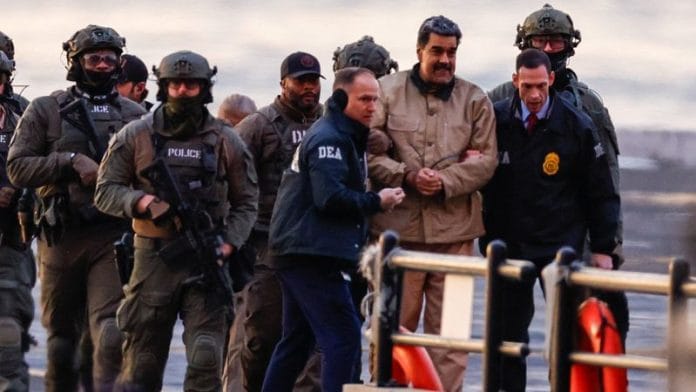



As I write this, Venezuelan President Nicolas Maduro is ousted and the Iranian regime is rocked by mass protests. The year 2026 opened with a simultaneity of crises — Latin America is destabilised, Middle East is on the edge, Russia-Ukraine war still looms into destruction, and uncertainty and global markets keep oscillating under the weight of political risk.
Some of Donald Trump’s rhetoric, first dismissed as bluster, has translated into policy. And as those policies take shape, analysts are left grappling with a question that sums up the strategic anxieties of our era: how far does this go?
A dominant explanation has emerged among policy circles — a revival of hemisphere-based thinking. According to this view, the Trump administration, through an updated Monroe Doctrine (with a “Trump Corollary”) articulated in the 2025 National Security Strategy, is primarily concerned with controlling the Western Hemisphere and by extension, leaving Indo–Pacific to China and Eastern Europe to Russia. Under this logic, Washington has turned inward, relinquishing the role of global security guarantor and policeman, securing instead its immediate neighbourhood.
At first glance, this framing appears persuasive because it is articulated as an official document. Yet it is also misleading.
Upon closer perusal, recent events reveal a more complex and entwined pattern — one that resists clean lines separating spheres of influence, and by logical conclusion, any siloed analysis. What we are witnessing is not a simple retreat into regionalism, but the emergence of an entwined form of power politics, where actions in one theatre produce ripple effects across several others resisting silos whether in operation or analysis.
In this piece, I will analyse the convergent dynamics of Latin America and the Middle East. But first, let’s de-construct the ‘sphere of influence’ theory.
Re-think hemispheres
At its core, the hemisphere theory rests on three assumptions.
First, it assumes that the United States no longer wishes, and neither has the capabilities, to play the global policeman. That is true. Uncle Sam is wary of expending blood and greenback to democratise faraway societies, with its liberal experiments failing grandly over the last few decades. The unipolar moment has passed, and the American strategy under Trump no longer rests on the presumption of global dominance.
Second, it imagines a world divided between three great powers: the US in the Western Hemisphere, China in the Indo-Pacific, and Russia in Eastern Europe — each managing its own “backyard.” Yet this analogy doesn’t hold under scrutiny. Great power status is not a static metric. Military power, economic leverage, technological dominance and institutional reach do not distribute evenly. Only China meaningfully rivals the US across multiple domains. Russia’s influence is asymmetric and brittle as its strongholds across the world have suffered blows from Syria, Iran, Latin America, and in its own backyard — the Caucuses.
Third — and most critically — the hemisphere theory assumes that events and their triggers in one region remain contained within it and that crises can be geographically isolated.
This assumption is not merely half-baked. It is also misleading and perilous.
Intersecting pathways of power and proxies
The US’ actions in Venezuela cannot be understood independently of tensions in Iran. Neither can Israeli strikes on Hezbollah be separated from developments in Latin America. These are not parallel developments, but ones that interlock.
Let’s take Venezuela first. The capture of Nicolas Maduro and the interdiction of two Russian vessels in the Caribbean sent shockwaves far beyond Caracas. It is connected to tensions escalating in Iran not merely as the byproduct of an attack on hostile authoritarian regimes. Because Venezuela was never just a hollowed-out petro-state. During decades under Hugo Chavez and Maduro, the country evolved into something far more consequential: a logistical and financial hub for Iranian and Hezbollah-linked networks operating in the Western Hemisphere.
Also read: US invasion of Venezuela is end of international order. India must focus on cold calculations
The Hezbollah–Venezuela connection
The relationship between Maduro’s regime and Hezbollah is often understood as an ideological alignment i.e. a shared hostility to the US.
The real glue is more symbiotic than ideological. Over the past two decades, Venezuela’s hollowed-out institutions, corrupt elites, and collapsing security apparatus created ideal conditions for transnational illicit networks. Iran, through its proxies, exploited this vacuum. Hezbollah operatives found a safe haven in Latin America as drug trafficking, arms smuggling, and money laundering flourished. This subject has long been a matter of concern for security officials, but has come to fore as tensions have reignited.
Not only proxies, but Iran’s Quds Force — the elite external operations wing of the Islamic Revolutionary Guard Corps — used Venezuela as a staging ground where training camps have operated quietly. Illicit money laundering created financial channels that bypassed sanctions.
Together, these dynamics produced something rather consequential in the Western Hemisphere — a Venezuelan state that has been described as a narco-economy, an extremist safe harbor, and an Iranian strategic outpost. But that’s not where it ends, that’s where it starts.
Also read: What the US did in Venezuela shows the world is still at the mercy of brute power
From Lebanon to Latin America
The interconnectedness becomes even clearer when one examines seemingly obscure details.
An article in French-Lebanese outlet L’Orient-Le Jour, committed to an anti- Hezbollah stance, describes the interesting case of Ghazzeh, a small town in western Lebanon with a Sunni majority but an unusually high number of Latin American immigrants — many from Venezuela. It mentions a café, Margarita, named after the Venezuelan island long flagged by US authorities as a site linked to paramilitary training.
Iran’s asymmetric presence in Latin America has not only flourished in Venezuela but also depended heavily on Cuba. The partnership dates back decades. Cuban intelligence services have historically supported militant groups, hosting Palestinian factions as early as the 1960s.
These are not cultural coincidences, but footprints of a transcontinental network.
Taken together, it shows that Hezbollah’s global operations — fundraising, recruitment, logistics and training — have relied on Latin American nodes. The weakening of those nodes, whether in Venezuela or Cuba, constrains Hezbollah’s operational depth far beyond the Middle East.
This is why Israeli airstrikes in Lebanon on Hezbollah have implications for Caracas. And that is why Trump’s threats to Havana are heard seriously in Tehran.
This also takes on a bigger significance as Iran is facing a trifecta of pressures — internally from its own people, externally from Israel and the US, and asymmetrically from a weakened Hezbollah in faraway theatres.
If the US wishes to protect its interest in its own hemisphere, the ambit of action goes all the way to other theatres — with a strategy that builds on addressing these hidden enablers. And this was all but a small glimpse.
A similar crosscutting narrative unfolds when one tracks the spillover of the Russia-Ukraine war in North and Central Africa, or the widening rift between official allies the UAE and Saudi Arabia in Yemen and Sahel — both stories for another day.
None of this, however, is to argue that the Trump administration operates with strategic elegance. It does not. Trump’s kitschy rhetoric obscures intent and complicates analysis. His policies are often executed with no regard for international law — a flaw hardly unique to Washington, but nonetheless consequential. Yet, simplifying Trump-era actions as incoherent misses their strategic logic, which is not about merely controlling the backyard, but disrupting networks that lie beneath.
A world entangled, not ordered
The world of 2026 is not merely unstable, it is entangled where power projection flows through networks, not borders. Proxies operate across continents, binding distant regimes to illicit economies. As a result, pressure applied in one place echoes in another.
Understanding this requires abandoning siloed thinking and embracing uncomfortable complexity, especially when popular leadership styles make strategic nuance harder, not easier.
The key takeaway is here. Any reasonable strategic analysis suited to today’s complexities and ever-expanding conflicts must strategise wider implications to the extent possible. Evidence suggests that the world is not divided into silos of motivations and actions and will be less so as we go ahead.
Because in a world without silos, misunderstanding one crisis means misunderstanding them all.
Swasti Rao is a Consulting Editor (International and Strategic Affairs) at ThePrint. She tweets @swasrao. Views are personal.
(Edited by Aamaan Alam Khan)
Great insights as always Dr Rao.
The article does mention Lebanese diaspora in Venezuela being more dominant than the other way round.
I am looking forward to your analysis of the now public rupture in the relationship between the UAE and KSA. The latter’s defence pact with Pakistan and the role of Qatar in stirring the pot.
The world has become a megaspagetti bowl in 2026.
Look forward to your column.