






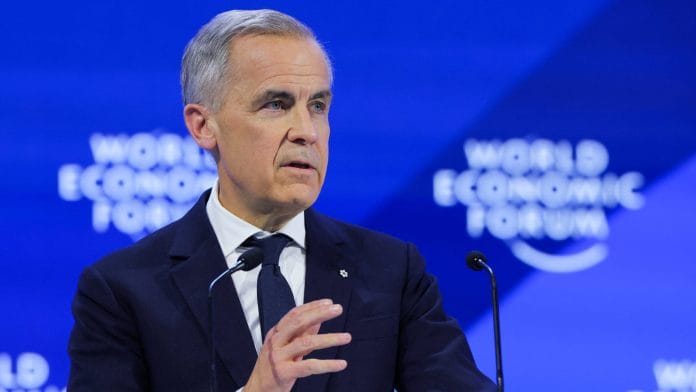



Canada is on a public-relations roll. Prime Minister Mark Carney wowed Davos elites by declaring a “rupture” with the American-led financial and industrial system that has prevailed for decades. That’s a message that resonates in Asia, where economies grew rapidly by supplying an abundance of goods to American consumers, only to be confronted with tariffs that were scarcely conceivable a few years ago.
Ottawa is stepping up its courtship of the region. The campaign was readily apparent in Singapore last week with a conference devoted to stronger ties with Southeast Asia. This effort isn’t for the fainthearted, nor should businesses expect instant results just because of the premier’s aphorisms. Nor should it be under any illusion that the region is a substitute for America, destination for almost three-quarters of Canada’s exports and with whom its capital markets are intimately bound.
The air was thick with references to fragmentation and the demise of the rules-based order. Singapore, home to one of the world’s busiest ports, can relate. While the country was handed a relatively small US tariff of 10%, it feels spurned. In his budget speech on Thursday, Prime Minister Lawrence Wong described a “more dangerous” world.
There are sound reasons for Carney’s push. He wants to double non-US shipments in a decade, a tall order without seeking fresh opportunities. Economic growth in the Association of Southeast Asian Nations was a better-than-anticipated 4.5% last year, according to the Asian Development Bank, and projected to be about the same in 2026. Trade with the US is robust, despite levies imposed by President Donald Trump.
It’s also a region looking for partners. None have abandoned defense ties with America, but are chastened by Trump’s territorial ambitions — and his musings that Canada itself should be swallowed. Southeast Asia is also wary of China’s military build-up and the risk of a miscalculation in the South China Sea. Ottawa can pitch itself as US-lite: Accents that sound similar, a legal system that seems straightforward and a Group of Seven economy. (Making inroads might also mean Canada pulls punches; I heard little direct criticism of Beijing in sessions I attended.)
Conditions can vary greatly; and businesses looking to invest here should be aware that there’s more than one Southeast Asia. There are prosperous countries like Singapore with first-class infrastructure and a highly educated, outward looking workforce. Vietnam has one of the most impressive rates of growth in the world. Then there are the places that aren’t doing so well: Thailand’s economy languishes and seems unable to escape deflation, while Indonesian markets have been pummeled, and economists are skeptical of economic data. Some speakers praised the region’s young populations. That depends on what you mean. Rates of fertility in Singapore, Thailand and Malaysia are low and unlikely to climb much. Indonesia, Vietnam and the Philippines are headed in the same direction.
And for Canadian firms with goods and services to sell, finding the right local partner is important. As is understanding that ally and the nature of their friends and rivals. This was a point well made at one session devoted to infrastructure. A large slice of business is dominated by family conglomerates that dabble in everything from agriculture to telecommunications and banking. These clans enjoy warm ties with lawmakers and regulators. State investment companies, which ultimately answer to elected leaders, are also enthusiastic investors. This is fine, as long as things go well. But what happens when economies or joint ventures take a turn for the worse?
Also beware cultural and political landmines. A question from the floor startled me: Should Canadians try to engineer or encourage social change while they invest? Absolutely not. Western executives should steer clear of promoting views on gender, identity, and even freedom of the press, they were told. What sells in Montreal or Toronto won’t always go down well in Jakarta or Manila.
No economic or political order is set in stone. Just because the US under Trump has turned from protector to insurgent doesn’t mean everyone else is a reliable bet. I remember when Vancouver was awarded the honor of hosting an early meeting of Asia-Pacific leaders in 1997. Prior to that year, the story was all about bountiful growth. By the time I arrived to report on the summit, Thailand and Indonesia had been forced to secure emergency loans from the International Monetary Fund and South Korea was finalizing terms of its rescue.
As much as Carney’s soundbites were applauded, closer ties can sometimes come down to more basic requirements. Speaker after speaker at the Singapore gathering bemoaned how long it took to travel to the city state, and the convoluted passage they had to take to get here. Adding a few more direct flights would be a great — and very practical — enhancement.
Canada’s interest in Asia has come a long way since Justin Trudeau, the former premier, took a selfie in a Singapore park in 2018. Trudeau squatted in front of a plaque dedicated to a distant relative from the colonial era. By all means, come to Southeast Asia, she might have said. But keep your eyes open. The region is complex, and today’s corporations should pay heed.
This report is auto-generated from Bloomberg news service. ThePrint holds no responsibility for its content.