









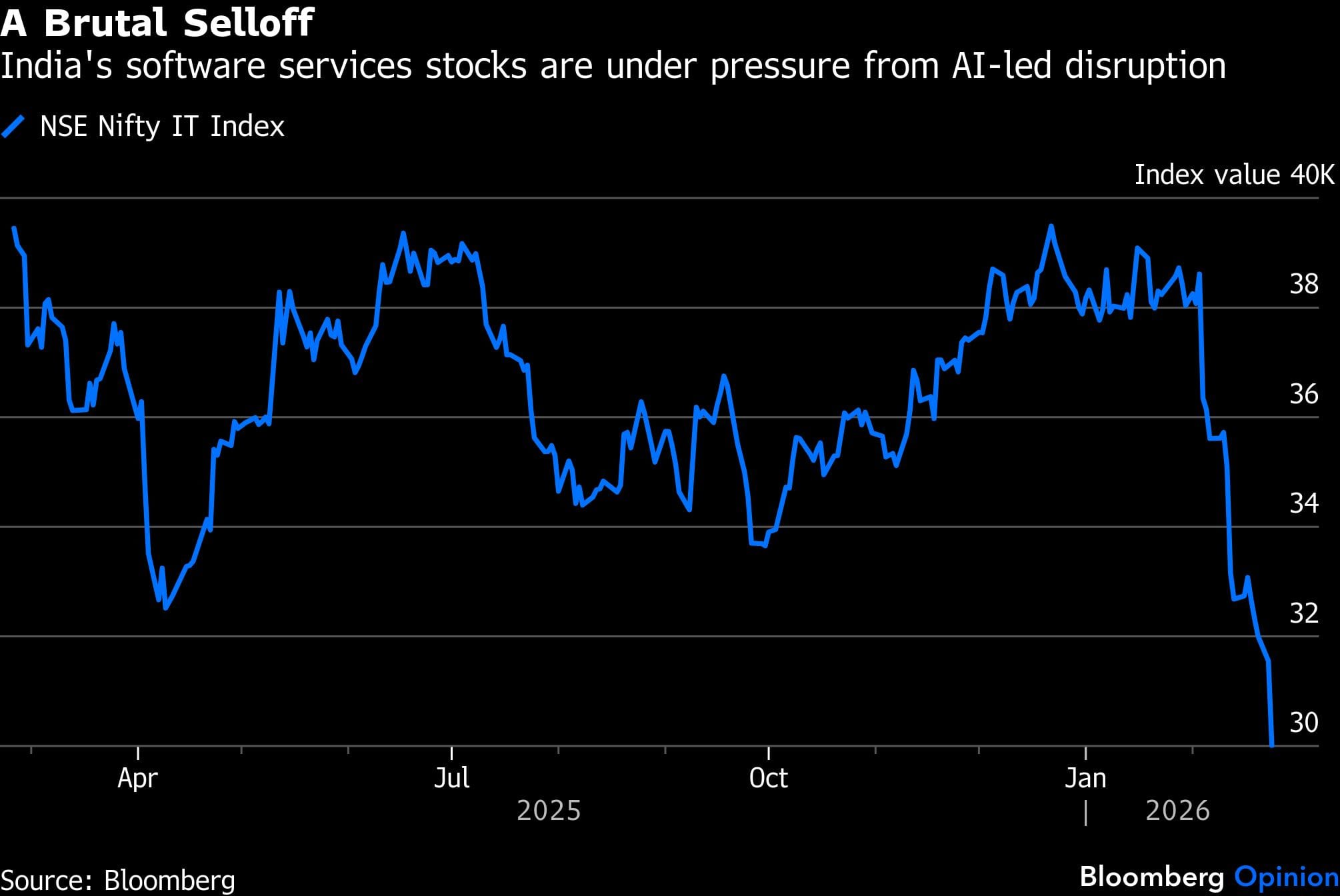
For a quarter-century, software services have been India’s calling card. No longer. The next 25 years belong to tokens — the Lego bricks of the artificial-intelligence era. As AI agents require quintillions of them to supplant human effort, India is pitching its tent there. But is that wise?
New Delhi has offered a 20-year tax holiday to any foreign company setting up inference hubs — token factories that convert electrons into intelligence — to meet AI agents’ 24/7 workload. Given that these algorithms will be empowered to act autonomously, writing their own programs, where will this leave the country’s 6 million coders?
To be sure, the sheer volume of automation-related tasks will explode, but it won’t be easy to upskill the workforce to undertake them. It is one thing to write a Python script that processes a refund for a retailer; it is quite another to build the guardrails that decide if an AI agent should autonomously issue a $50 voucher to an angry customer. As day-to-day coding is commoditized, India’s $200 billion services export engine faces a crisis: Global clients won’t pay programmers for syntax; they will only value those who can audit intelligence.
Meanwhile, India is an attractive “virtual battery” for US hyperscalers. They are plagued by fragmented electricity grids and policy gridlock at home. Communities don’t want power-guzzling data centers in their midst. By leveraging India’s daytime solar surplus to power nighttime inferences in the West, Silicon Valley can challenge the cost advantage of Chinese rivals. While Western frontier models like GPT-5 or Claude now hover around $15 to $20 per million output tokens, Chinese open-source alternatives like DeepSeek-V3.2 cost a fraction of that.
By promising cheap electrons, India has written itself into this energy-intensive vision of the AI future. Alphabet Inc., Microsoft Corp., and Amazon.com Inc. — the three largest Western cloud services providers — have all announced big plans for factories that will churn out tokens. Indian politicians have laid out the red carpet. Media reports suggest that the southern state of Andhra Pradesh has offered $2.4 billion in incentives to Google for a $15 billion data-center hub.
But consider the problem from the point of view of fresh graduates. Ever since India burst onto the global software services scene with the Y2K scare, programming has been a vaunted career option. Since manufacturing has simply not taken off, these white-collar jobs are viewed as offering some of the best returns on education, even though starting salaries for coders haven’t improved in years. The software industry has strong linkages with domestic consumption and property demand in cities.
However, many of these jobs may not last. Outsourcing companies like Tata Consultancy Services Ltd. and Infosys Ltd. may initially meet the challenge by helping clients build AI agents. They may even protect their margins by shrinking their workforce and adopting more artificial intelligence in their code-writing workflow. But at some stage, these franchises won’t be large-scale employment generators. That will leave policymakers to grapple with the question: “What do we do with our 375 million young people?”(1)
An investor in AI data centers told me privately that by 2030, India will be producing between 8 quadrillion and 18 quadrillion tokens annually, with the baseline estimate at roughly 12 quadrillion, a sixfold jump over last year. This output could help lower global AI costs. Assuming India sends 80% of its production overseas at $2 per million tokens, its data centers will garner almost $19 billion in hard-currency revenue by 2030, a number that could grow rapidly thereafter as AI agents take over more — and more complex — tasks. While that may blunt the blow from loss of services exports, it won’t replace the lost coding jobs.
A different approach is needed. While politicians woo hyperscalers, public universities lack AI chips. Having joined Pax Silica, a US-led multinational initiative to secure supply chains for semiconductors and critical minerals, New Delhi has tied its AI future to the West. As part of the bargain, it must at least secure high-end Nvidia chips for research.
One way to do that would be to insist that for every 100 megawatts a hyperscaler uses, it should provide 5% of its high-bandwidth memory chips to a national research cloud. Not only will this help India’s plan to get 500 of its universities AI-ready, breakthroughs in fields like chemistry or drug discovery could finally excite the local private sector. So far, Indian tycoons have looked at AI as an energy-infrastructure play and shied away from bold bets on foundational models. Even top AI talent’s stock-option expectations are beyond their risk appetite. That must change.
As for the average graduate, it’s impossible to plan exact future careers amid intense technological upheaval. But since politicians are actively promoting AI tokens over human intelligence, they must open other pathways for students. Let today’s 6 million code-writing jobs shrink. With some imagination, New Delhi could spawn several times as many AI supervisors and managers to oversee fleets of autonomous agents and robots for global companies, large and small. That will be a fair exchange with the West for India’s land and power.
This column reflects the personal views of the author and does not necessarily reflect the opinion of the editorial board or Bloomberg LP and its owners.
Andy Mukherjee is a Bloomberg Opinion columnist covering industrial companies and financial services in Asia. Previously, he worked for Reuters, the Straits Times and Bloomberg News.
Disclaimer: This report is auto generated from the Bloomberg news service. ThePrint holds no responsibility for its content.
Also read: Joining Pax Silica is not all positives for India. We must guard strategic autonomy