









Domestic passenger traffic in India has been growing since the early 2000s, and reached 1,653.8 lakh in 2024-25. And if we add 338.6 lakh international passengers, 1,992 lakh air passengers travelled in India 2024-25. In November 2025 alone, domestic airlines ferried around 154.5 lakh passengers. The number of airports has increased from 74 in 2014 to over 160 today. India now ranks third in the world in terms of air passenger traffic.
Privatisation ended Air India’s monopoly in the aviation sector, with several private airlines emerging in the country during the era. With this, air travel, once privy to the wealthy, became accessible to the common man.
Captain Gopinath, who came from a middle-class family, established himself as a symbol of affordable aviation, and his company, Air Deccan, emerged as the first major budget airline. Airfares were reduced, and to economise operations, food facilities were curtailed. Fares for the same trip, which previously ranged from Rs 5,000 to Rs 10,000, were now limited to Rs 1,000 to Rs 2,500.
Rising GDP and per capita income, the growing middle class, changing demographics and the burgeoning youth population, the rise of start-ups and entrepreneurship, and the improving economic situation of government employees, among many other factors, have led to the ever-growing demand for air travel in India. Government policies also contributed to the growth of aviation. Encouraging the private sector to build airports and easing policy initiatives have all given India’s aviation sector new wings.
Gradually, more companies began entering the aviation sector. New Indian entrepreneurs started grasping the nuances of the global aviation industry. Rising GDP and increasing purchasing power boosted demand for air travel. Many airlines came up, though not all could survive. Major airlines that went down before 2023 include Air Deccan, Jet Airways and Kingfisher. There remain four major airlines—IndiGo, Air India, SpiceJet and Akasa.
Also read: India needs a hybrid aviation model. Passengers deserve safety and reliability
Emerging duopoly
It’s worth noting that initially, due to competition in this sector, airfares were very low, and at one point, aviation companies were competing with even rail travel. This provided both convenience and affordability for passengers. But that has changed with this highly competitive sector being converted into a duopoly. Two companies started dominating this sector. The world was astonished when IndiGo and Air India placed orders for more than 1,000 aircraft in 2023.
The financial health of all airlines deteriorated during the Covid-19 pandemic. While IndiGo, Air India, and its affiliates were able to weather this crisis, GoFirst and SpiceJet suffered significant losses.
GoFirst Airlines, India’s fourth-largest airline at the time, with an 8 per cent market share, went bankrupt due to financial troubles. Initially, its problems were more technical than financial, for which Pratt & Whitney Engines, the engine supplier for the Airbus A-320 Neo aircraft, was primarily responsible. Problems with the engines supplied by the company forced GoFirst to ground several of its aircraft. This resulted in significant financial losses for the company. Failure to meet its obligations led to the initiation of bankruptcy proceedings, and GoFirst suspended operations effective 3 May 2023.
GoFirst was declared bankrupt very quickly due to the new bankruptcy law, while SpiceJet, despite significant difficulties, managed to salvage its business.
While the company managed to significantly adjust its debt, its share of the Indian aviation market declined from 12.6 per cent in 2017 to a meagre 2.3 per cent in 2024.
As a result, IndiGo’s market share increased to 65 per cent and the Tata Group’s airlines to 27 per cent. Other than these two companies, the share of the remaining airlines, including SpiceJet, was reduced to only 8 per cent.
The emergence of a duopoly in the aviation sector has allowed major companies to increase their fares. Airfare between Delhi and Mumbai, which previously ranged from Rs 3,500 to rs 4,000, has now risen to Rs 6,000 to Rs 7,000. Fares in other sectors have also risen exponentially. There have been repeated complaints about, but neither the government nor the regulatory body (Director General of Civil Aviation) has been able to address the same.
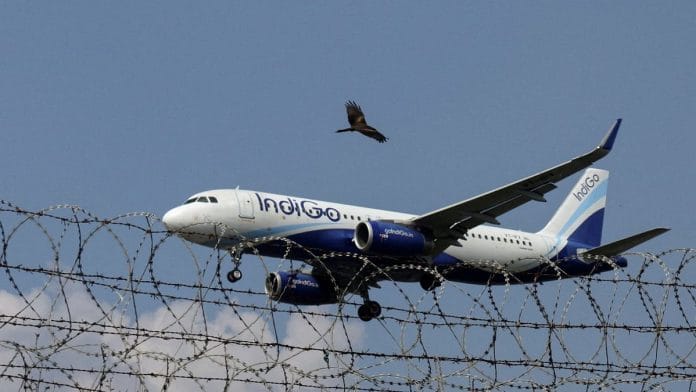
Recently, the issue of duopoly in aviation came to sharp attention when an old rule restricting pilots’ working hours was strictly enforced, forcing IndiGo Airlines to cancel thousands of flights. This not only caused inconvenience to passengers but also raised questions about the government and regulatory authorities. How were these companies allowed to expand their market share to such an extent? How did a single company monopolise certain routes, and how did they seek profit by selling air tickets at inflated rates after flights were cancelled due to their own fault?
Also read: India is an aerospace giant on paper, importer in practice—what China did right and we didn’t
Need for competition
This situation calls for increased competition in the aviation sector so that passengers can be saved from unfair treatment. Companies should not unnecessarily increase fares to increase their profits and should adhere to aviation regulations to ensure passenger safety. The need today is to issue licenses to new players in the aviation sector and allow them to expand their operations.
The government should focus on structural reforms to encourage competition in India’s civil aviation sector. First, uniform and fair compliance with DGCA regulations must be ensured to ensure that no major airline receives implicit protection. Second, the “use it or leave it” principle should be strictly enforced in slot allocation at congested airports, and peak-hour slots should be reserved for new entrants.
Third, airport charges should be rationalised to reduce entry barriers, and aviation turbine fuel should be fully brought under GST. Fourth, the Competition Commission should actively monitor predatory pricing and abuse of dominance. Fifth, aircraft leasing, aircraft arrival clearance, and bankruptcy procedures should be simplified and predictable. Sixth, transparent allocation of international flight rights in bilateral air service agreements should be implemented.
Finally, regional competition should be strengthened by promoting multi-operator participation in the UDAN scheme.
India’s aviation market is ripe for competition, with two new airlines—Al Hind Air and FlyExpress—receiving No Objection Certificates (NOCs) from the Ministry of Civil Aviation.
Another carrier, Shankh Air of Uttar Pradesh, which already has an NOC, is expected to begin flights in 2026, bringing greater competition in this sector dominated by a few large companies.
More such licenses need to be facilitated by the regulator.
Ashwani Mahajan is National Co-Convener of Swadeshi Jagran Manch and a former professor at PGDAV College, University of Delhi. He tweets @ashwani_mahajan. Views are personal.
(Edited by Theres Sudeep)