









There’s so much for us to talk about. Each hour, if not minute, brings developments in news that need our attention as journalists. If US President Donald Trump isn’t doing this, he is doing that – and if he isn’t doing that, he’s talking. That by itself is always news.
Each one of us has an opinion on Trump. Most of us have an opinion on how India can be launched into the stratosphere of superpowers. Every fan thinks (s)he knows better than the team selectors, coach, and captain of the Indian cricket team.
At ThePrint, we give readers the chance to express and share their views with other readers. There’s the YourTurn section, open to all subscribers. They send in the articles, and our team publishes selected pieces.
And, now, there’s Campus Voice. This popular platform for younger minds returns after a gap of a few years.
In this Readers’ Editor column, I want to explain a little more about Campus Voice and urge all students to write in. Do make this a vibrant, intellectual space by sharing your views on issues that matter to you, your future, or indeed, to our global village.
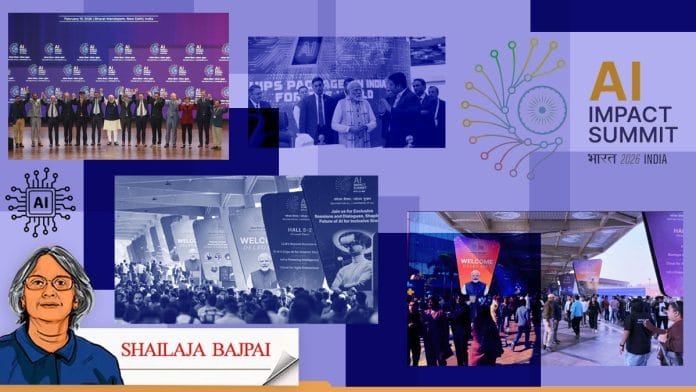
I will also write about ThePrint’s coverage of the big talking point this month: the India AI Impact Summit held in New Delhi. ThePrint’s reporting shows that there was much more to the AI Impact Summit than glitches, which made headlines.
Call for young authors
Campus Voice is back after a break of a few years. It’s returned because ThePrint wants to reflect views beyond expert opinion. A new generation of educated, intelligent people who want to be heard—or read. ThePrint is the place for them.
It gives Gen Z a space of their own to convey their thoughts on any subject under the sun, the moon, and the veil of pollution that hangs over so many Indian cities.
Open to all students in schools, colleges, and universities, Campus Voice runs on a weekly cycle. All you have to do is write about 800 words on a topic you feel strongly about and submit it at https://theprint.in/campusvoice/.
Simple, right?
ThePrint will publish a selection made by senior editors. There are prizes for the best entries and a certificate of recognition for all published authors. Authors: That sounds important – and young voices are important. They deserve to be heard, and we need to understand their points of view.
Keep one thing in mind. Fact-check everything, give sources and links. Don’t plagiarise. Don’t use AI tools to write. We have software that catches everything. Your article will immediately be disqualified if problems are flagged.
So, come on, what are you waiting for? Write in, now.
Beyond the chaos
The AI Summit made international and national news for the wrong reasons: traffic snarls and organisational glitches, the last-minute absence of Bill Gates from the speaker’s list, and a robodog named Orion.
At ThePrint, we looked beyond them: “We didn’t let the controversies cloud the larger purpose of AI summit—the positioning of India on the unfolding map of the future,” said Rama Lakshmi, Editor Opinion, Ground Reports, and Science.
ThePrint 50-word edit urged readers to appreciate the “innovation, ingenuity and wisdom…” on display at the Summit.
This is not to say that the mismanagement of the event on the first two days was ignored—read this story.
We didn’t downplay Galgotias University’s fiasco. There were news reports that a Galgotias professor claimed the university had invented a robodog, which was actually a Chinese product.
That was followed by an in-depth profile of Galgotias University, which revealed that this wasn’t the first time the university had overstated its accomplishments.
And when Youth Congress workers appeared without their shirts at the Summit, ThePrint sat up and took note.
“Traffic snarls, crowd control, and Galgotias goof-ups were a tiny part of ThePrint ‘s overall coverage of the global summit,” said Rama Lakshmi.
Instead, ThePrint focused on what the Summit offered: conversations and debates on AI’s benefits, and its regulation, “Indians and global innovators, tech sovereignty, tech AI race, pavilions by Indian and global companies as well as state governments,’’ she added.
Also read: How ThePrint’s foreign affairs team makes sense of the world for Indian readers
Real triumphs at AI Summit
Four reporters went to find out what the AI Impact Summit was all about: Soumya Pillai, Senior Assistant Editor, Keshav Padmanabhan, Principal Correspondent, Akanksha Mishra, Senior Correspondent, and Vrinda Tulsian, Senior Correspondent.
While Padmanabhan focused on what foreign leaders and delegations had to say, Tulsian concentrated on the tech aspect and regulations, as well as other stories.
Pillai and Mishra reported from the Bharat Mandapam premises where the Summit was held, looking for innovations, start-ups, international and national—and what they could find at state government pavilions.
They found quite a bit as this story on companies working with AI illustrates: “I was pleasantly surprised, I didn’t expect to see so much implementable work,” said Pillai, who writes on science and the environment for ThePrint. “Companies, state governments had deliverables.’’
Take her visit to the Airtel pavilion as a case in point, which has developed a scam detector.
She was with Akanksha Mishra when they discovered another robot at the Bihar government pavilion.
Mishra uses AI for her personal use, “Yes, to find out healthy recipes,’’ she laughed. “Now I was introduced to AI and governance.”
She also discovered AI being used in agriculture at the IIT Ropar pavilion. “The strength of their model was that it was designed for local conditions with local solutions,” she said.
Mishra was impressed by the number of students who visited the Summit and engaged in deep conversations with the innovators. “The students were wowed,” she said.
Tulsian doesn’t “like” using AI, but she was ready to learn more about it. She read up plenty, did her homework, and attended several discussions at the Summit. She found they were informative with “good speakers”.
For Pillai, who attended the Summit from start to finish, it was a very satisfying experience. In the beginning, it was overwhelming, and yes, the crowds were unnerving— “it was poorly managed”.
By Day 3, the situation had vastly improved, and Pillai discovered something she hadn’t known before. “Here was work by homegrown companies, state governments that was being used now—it wasn’t for the future. These were real-world things that worked,” she said.
Shailaja Bajpai is ThePrint’s Readers’ Editor. Please write in with your views and complaints to readers.editor@theprint.in
(Edited by Ratan Priya)