





Deal or no deal? No big deal, as far as much of the world’s news media is concerned.
In fact, they see it as a failure for US President Donald Trump, since he could not achieve the goals he had outlined when the war with Iran started on 28 February.
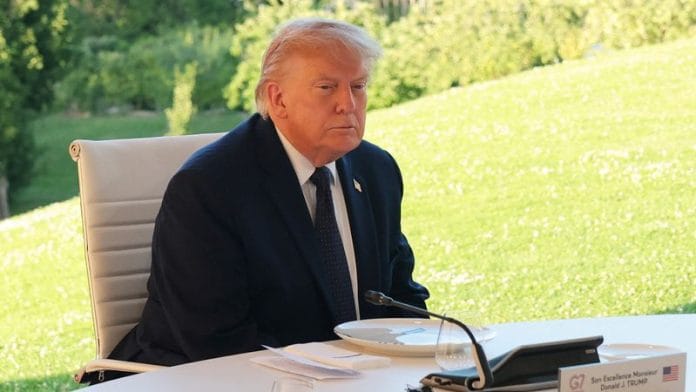
However, the Memorandum of Understanding reached by Washington and Tehran on 14 June excited Trump no end. As it perhaps ought to: for weeks, he has been telling the world through media interviews and Truth Social posts that the deal was done—only it wasn’t.
On Sunday, he celebrated on Truth Social: “Let the oil flow”. His post announced the agreement that potentially ends the US-Israel-Iran war.
In the American and international media, the declaration excited mostly skepticism and some derision. One US news portal, thebulwark.com, went so far as to describe it in scatological terms, but we won’t go there.
More respectable and respected news organisations weren’t always polite either. Look at some of the headlines from the world press:
‘President Trump Lost This War,’ wrote The News York Times in its editorial.
‘Trump’s Iran deal is a national humiliation,’ stated the Canadian Globe and Mail.
‘Iran deal is tacit admission of strategic defeat by Trump administration,’ wrote Sky News (UK).
‘Trump Does Not Understand the War He Lost,’ was The Atlantic’s (US) take.
The Wall Street Journal (US) editorial headline read, ‘Trump Stages an Iran Retreat’, while Financial Times (UK) wrote, ‘Donald Trump settles for a truce of convenience with Iran.’
The Guardian (UK) summed up its opinion of the deal in six little words: ‘a pause is not a triumph’. The editorial called it ‘a failed war of choice’ for US and Trump.
Distance, in this instance, did not make the heart grow fonder. News outlets in other parts of the world were equally dismissive.
‘The US tore up the Iran deal. Now it may settle for a weaker one,’ wrote a commentator in the Russian RT, adding that this deal had “fewer advantages” than the one former president Barack Obama reached with Iran in 2015.
If you want to decide for yourself if the MoU is a good deal, a bad deal or any kind of deal at all for the US, Iran, and even the world, then Bloomberg published what it claimed was the text of the MoU.
Also read: This is how Indian TV channels covered Trump threats, ceasefire and Pakistan’s role
What Indian newspapers said
In India, some newspapers greeted the MoU with a sigh. The Indian Express editorial wrote: ‘Iran-US framework pact is a relief. Work lies ahead’. It found the reopening of the Strait of Hormuz “heartening”.
Business Standard counselled a wait and watch approach. ‘Hope versus experience: Optimism over US-Iran deal should be cautious,’ it wrote, stressing that “many constraints lie ahead between the US President’s exuberant social media messages and cautious Iranian statements”.
Others looked at the pros and the cons. Hindustan Times examined in detail ‘What did Trump actually achieve in Iran?’ through a deep dive into his ‘unmet objectives’.
Others flagged ‘discrepancies’
Some networks remembered the third angle of this triangular conflict: ‘Iran deal presents political nightmare for Netanyahu,’ said BBC, referring to Israel’s prime minister. “The US ceasefire agreement with Iran has presented Israel’s prime minister with a political nightmare, smashing the three cornerstones of Benjamin Netanyahu’s political career, and leaving him trapped in a new security dilemma,” it wrote.
News channels such as CNN (US), BBC World (UK) and Al Jazeera (Qatar) covered ‘deal or no deal’ with carpet coverage on Monday and into Tuesday before they were beckoned to Évian-les-Bains in France for the G7 heads of state meeting.
Al Jazeera stressed that the deal must be viewed with “extreme caution” as there were many discrepancies, not least the differing viewpoints of the US and Iran on financial compensation for the latter. All of Monday, we heard Iran claiming this was part of the deal while Trump administration denied it. On Al Jazeera, a reporter said that the US had made ‘a lot of concessions’
How much money might we be talking about? The Financial Times wrote, ‘Trump administration considers $300bn fund for Iran if deal is upheld’.
Even on Fox News, commentary was not complimentary to Trump: A US general on the channel said that “some of the things in the deal made no sense whatsoever. It’s not defensible.”
Also read: ‘Tehran Tames Trump’—Indian news TV mocks five-day pause as Western media scratches its head
Opinions don’t vary
Some news outlets were looking long-term.
Days before the MoU, The Economist questioned the long-term viability of a ‘deal’ if it was signed. ‘Even if America and Iran find an accord, don’t expect it to last’. “The Donald Trump Show could be back on air later this year,” it added with heavy sarcasm.
An opinion article in The Guardian was headlined: ‘So is the US war with Iran over? In a word: no’. The author, Mohamad Bazzi, argued in his sceptical piece that the deal is just “a 60-day extension of the ceasefire”.
The American news portal Politico was also unconvinced: “President Donald Trump and his team are celebrating an Iran peace deal they say will end Tehran’s nuclear ambitions. But the accord rests on commitments that Iran hasn’t actually made yet. And it may never.”
Most news media argued that if anyone had won the war, it was Iran. One BBC correspondent said the deal left “the Iran regime in an even stronger position than before.” And there was no certainty that this deal was “permanent”.
In its editorial, The New York Times said, “On balance, Iran emerges the strategic winner of the four-month war. It did suffer substantial losses, including much of its navy, air force…(But) For his sins, (Trump) has now agreed to a peace framework that the entire world understands is a defeat for him. It is a setback for America, too.”
However, some news organisations emphasised that this wasn’t a great victory for Iran either. Reuters wrote: ‘With war likely over, Iranian rulers must face demands of angry, embittered population’. Iran’s rulers’ “real problems may be about to begin: managing the competing demands of hardliners buoyed by surviving the onslaught and those of an impoverished, angry people,” the publication reminded its readers.
There was also talk of a new world order—and the one country no one was talking about in the relief over the deal—China.
In an opinion piece in The Straits Times (Singapore), ‘As deal to end war emerges from chaos, Iran and China sweep the stakes’, the writer claimed that a “new world order is on the cards, with Trump losing support at home and allies in Asia.”
Did anyone defend the deal? Yes: US Vice President JD Vance. It fell to him to meet the press. He was on Fox News, CNN, ABC News, and CBS News to explain the ‘no’ deal—and defend the deal. He told Fox News that the deal would herald a “new day” for the Middle East.
And presumably, the rest of the world.
The author tweets @shailajabajpai. Views are personal.
(Edited by Prashant Dixit)