






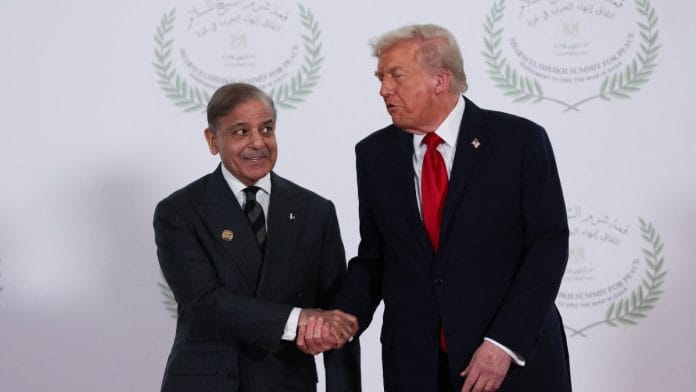



Pakistan is making news all over the world. Not for its violent conflict with Afghanistan, nor for any of its sponsored terrorist attacks in Jammu and Kashmir. Not for its bankrupt economy, either.
India’s neighbour has been the talk of leading news media for its proposed role as mediator in the US-Israeli war on Iran.
From daily newspapers such as The New York Times, The Wall Street Journal, Financial Times, The Guardian, and South China Morning Post to top international television news channels such as CNN International, BBC World, Al Jazeera (Qatar), CNA (Singapore), and the German DW, Pakistan grabbed the headlines with its offer to mediate.
Just this week, it hosted foreign ministers from Saudi Arabia, Egypt, and Turkey on 29 March for what Al Jazeera called a meeting “to prepare ground for de-escalation in the US-Israel war on Iran.”
Then, its busy foreign minister travelled to China to discuss the Gulf War with Chinese Foreign Minister Wang Yi. On 31 March, China and Pakistan issued a five-point peace plan.
Such was the potential importance of Pakistan’s insertion into the Middle East conflict that Indian publications also took note. The Hindu, The Hindustan Times, and The Times of India carried commentaries on it, and external affairs minister S Jaishankar calling Pakistan’s role ‘dalaal’ made headlines.
“Impressing domestic constituencies with word play may be politically satisfying…. (But) it shows us Delhi in poor light,” journalist Nirupama Subramaniam wrote in her article in The Tribune.
Indian readers might find Pakistan being praised as a goodwill negotiator galling, given its history of supporting terrorism in India. However, it’s not all bouquets for Pakistan. Several news outlets have warned that this is a high-risk strategy for our Western neighbour and that India needs not bother with FOMO.
‘Pakistan the peacemaker’
The news media greeted Pakistan’s role in the Gulf War in three ways: it gave it headline news, analysed why Pakistan was suited to play the go-between, and pointed out the risks involved. Indian news commentary addressed what one commentator called India’s ‘competitive anxiety’, while television news channels only laughed at Pakistan’s efforts. “Broker Pak is Broke,” sneered Republic TV.
Internationally, the praise is evident: China’s Yi has lauded Pakistan. “Wang said that after hosting a quadrilateral foreign ministers’ meeting in Islamabad, the Pakistani side came straight to Beijing without pause to jointly discuss how to ease tensions in the Middle East, which China welcomes,” wrote the Global Times.
‘Pakistan the peacemaker’ is hailed in the article, ‘How Pakistan Wooed Trump and Styled Itself as a Peace Broker in Iran Conflict’.
“Pakistan, a country once isolated by Washington for harboring Osama bin Laden, is assuming a surprisingly prominent position in the multination effort to push the U.S. and Iran toward the negotiating table,” read the article in The Wall Street Journal.
Similarly, the Financial Times wrote on ‘How Pakistan put itself in the middle of US-Iran peace talks’. “The move underlined the prominent role Pakistan has sought to assume in negotiations,” the paper read.
Michael Kugelman, a South Asia scholar, observed in a tweet: “Pakistan is the rare country that has warm ties w/US & Iran but also the GCC states, Turkey & China. Heck, its ties w/Russia are good too.”
He would make similar comments in an opinion piece in The Times of India.
As The New York Times put it, “It is a striking rise in station for Pakistan, which little more than a year ago was a diplomatic afterthought in Washington.’’
Also read: US talks like a hawk, acts like a chicken under fire—history shows it
A history of mediation
Much of the news analysis of Pakistan’s current position has made several points: that it has played mediator before, that it is “using its relative neutrality… to provide a venue for negotiations”, and that the strategy make come to nothing.
US President Donald Trump’s fondness for Field Marshal Asim Munir aside, Pakistan has a history of mediation.
“Pakistan takes pride in what it sees as its historic role as a mediator. The country facilitated former US secretary of state Henry Kissinger’s visit to China in 1971 as well as negotiations between the US and Afghan Taliban in Qatar during the first Trump administration,” wrote FT.
Indian commentators have also weighed in. In ‘Pak. as U.S. mediator with Iran recalls Nixon’s China outreach’, The Hindu’s Diplomatic Editor Suhasini Haider detailed the role Pakistan played in Kissinger’s secret visit to China.
Haider also suggests that Pakistan’s deals with Trump and members of his administration have helped its cause, plus its offer of a critical minerals deal to the US and its joining the Gaza Board of Peace.
Besides sharing a border and religious ties with Iran—after Iran, Pakistan has the highest number of Shia Muslims—Pakistan doesn’t recognise Israel, Haider wrote, which would make it acceptable to Iran.
Also read: Where is the OIC? ‘Collective voice of the Muslim world’ can’t disappear after a statement
Vested interests?
The Economic Times told readers more about Pakistan’s “vested interests”.
The risks for Pakistan are considerable, too, according to several news media outlets.
One reason, The Diplomat wrote, is its bilateral defence agreement with Saudi Arabia. “Islamabad will have to support Riyadh in the event of an Iran-Saudi showdown. That is not in Pakistan’s interest,” the article read.
Pakistan has an energy crisis—up to 80 per cent of its oil comes from the Middle East and travels through the Strait of Hormuz. And then there are the 5 million Pakistanis working in the Arab world, who “send home remittances each year roughly equal to the country’s total export earnings.
Several news media pointed out that if the US and Israel are using Pakistan’s mediation efforts to buy time for a larger assault on Iran, it would be very uncomfortable for Islamabad. There is the possible internal unrest among its Shia population, for one.
“Pakistan is mediating because it is desperate for relevance and has essentially no downside,” wrote Indian security expert Happymon Jacob in HT.
To Indians unhappy with Pakistan’s newfound prominence, Jacob has a word of comfort: Relax. According to him, India’s “competitive anxiety” doesn’t make for good foreign policy. “India has too much to lose from a failed attempt and too little leverage to guarantee success,” he wrote.
He also reminded Indians that endorsing third-country mediation in active conflicts “weakens” India’s “longstanding resistance to third-party involvement in Kashmir”.
If India wants to be a mediator because Pakistan is at it, “that is not statecraft. That is vanity,” he concluded.
You may or may not agree with him, but it’s certainly worth thinking about.
The author tweets @shailajabajpai. Views are personal.
(Edited by Prasanna Bachchhav)