






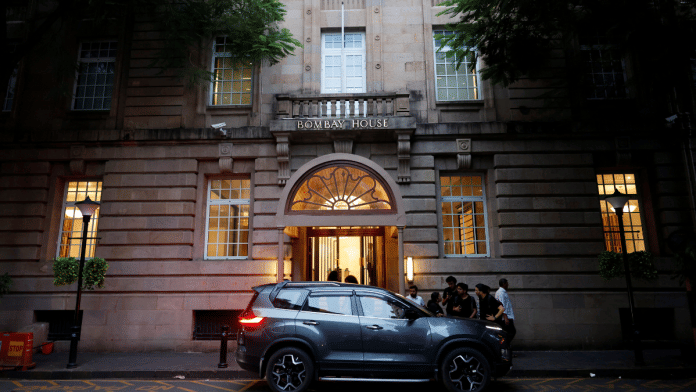



Bombay House, the headquarters of the Tata Group built in 1924, continues to be a historic landmark for corporate India. But the core of the Tata Group at Fort in South Mumbai — witness to thousands of critical meetings over the decades — may now be in the midst of clearing the air over leadership uncertainties in the salt-to-software conglomerate.
The context here is a board meeting of Tata Sons on February 24, when Tata Trusts Chairman Noel Tata raised questions related to losses in some Tata entities, mainly in the semiconductor, aviation, and ecommerce businesses. Noel Tata, who became chairman of Tata Trusts in 2024, sought to link the financials of the Tata Group with any decision on extending the term of N Chandrasekaran (or Chandra) as Tata Sons chairman. Noel Tata’s intervention on the subject of Chandra’s extension in the February 2026 meeting was contrary to the unanimous stand taken by Tata Trusts in July 2025 on the matter. July last year, Tata Trusts, including Noel Tata, had recommended a third five-year term for Chandra as chairman of Tata Sons while batting for continuity in leadership at a time when the group was foraying into transformational businesses.
Following the unexpected turn of events, it may help to take a closer look at what Tata Trusts, its trustees, its chairman, and the nominee directors stand for vis-à-vis Tata Sons. Tata Trusts, which owns a majority stake of 66 per cent in Tata Sons, the holding company of the conglomerate, is the promoter of the group. However, trustees of public charitable trusts, such as Tata Trusts, are described as custodians and not owners, irrespective of family name. So, no individual in Tata Trusts is an owner or a promoter.
Tata Trusts is a group of public charitable trusts, which are different from family trusts in the case of global philanthropies. As for regulations, Tata Trusts is governed by the Maharashtra Public Trusts Act, which confers no distinct authority to the chairman of Tata Trusts.
That brings us to these questions: Who is the Tata Sons chairman answerable to? And what power does the Tata Trusts chairman have in determining the Tata Sons chairman’s appointment, tenure or termination? The chairman of Tata Sons is answerable to the board of directors of the company and is also accountable to the principal shareholder—Tata Trusts.
According to Article 121A of the Tata Sons Articles of Association (AoA), key board decisions of Tata Sons require the affirmative vote of directors nominated by Tata Trusts. This allows Tata Trusts veto power over major matters, including strategic plans, investments and top leadership changes such as the appointment and removal of Tata Sons chairman.
To put things in perspective, in the current scenario where Noel Tata has raised questions about Chandra’s performance as Tata Sons chairman before granting him a third term, any review of the unanimous decision taken by Tata Trusts trustees in July 2025 must also require the unanimity of the trustees. The only occasion that was put to a vote in Tata Trusts was the removal of a nominee director in September 2025. Following that, there are only two nominee directors on the Tata Sons board —Noel Tata and industrialist Venu Srinivasan, vice-chairman of Tata Trusts. One-third of the total number of Tata Sons board members, currently six, can be Trusts nominees.
It’s important to highlight that Tata Trusts chairman does not enjoy any special rights that are different from other trustees. While Cyrus Mistry’s ouster as Tata Sons chairman in 2016 is widely seen as a call taken by then group emeritus chairman and Tata Trusts chairman Ratan Tata, insiders explain the process as a “unanimous’’ decision by Tata Trusts in the following manner: Ratan Tata had convened a meeting of the trustees and obtained their unanimous approval for the next step of removal by the Tata Sons board. The impression is that Ratan Tata’s position as a former Tata Sons chairman for more than two decades gave him a “unique standing’’.
In terms of authority, there is another oddity in the current situation. After the Cyrus Mistry saga, article 118 of the AoA was amended to provide that the same person cannot be chairman of both Tata Sons and Tata Trusts. The amended article did not mention that a Tata Trusts chairman cannot be inducted into the Tata Sons board. But, it was unusual when Noel Tata, soon after becoming the chairman of Tata Trusts, got inducted into Tata Sons as a nominee director.
Historians point out the last individual promoters of the Tata Group were Sir Ratan Tata and Sir Dorabjee Tata, who had no heirs and whose liquidated assets form the core of the two trusts (by their names) that now own Tata Sons. More recently, Ratan Tata may have felt that “the family’’ should find a place in the Trusts, but businesses were intended to be free of Trusts’ control.
While the leadership issues may get sorted in the upcoming board meetings of Tata Trusts and Tata Sons, listing of the holding company of the Group on stock exchange should potentially resolve the bigger question on ownership and control. If Tata Sons is listed, the special veto rights of Tata Trusts, under Article 121A, may be a thing of the past, thereby removing many of the current ambiguities. Once that is done, Bombay House can get back to business as usual and Tata Trusts can focus more on charitable activities.
Nivedita Mookerji @nivmook is the Executive Editor of Business Standard. Views are personal.