






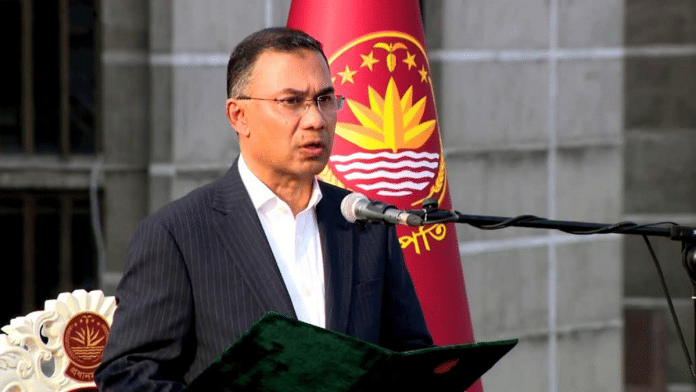



After 17 years of self-exile, when Tarique Rahman landed in Bangladesh on 25 December, it marked the electrification of Bangladesh’s electoral politics for many. He addressed a mass gathering in the heart of Dhaka city, in the run up to the parliamentary elections on 12 February. Rahman spoke of hope, promising to uphold belief, bring order, and ensure peace in the country. But what struck many was the Bangladesh Nationalist Party Chairman’s promise— “I have a plan for the people of my country”—in Bhadralok style.
But for a country, charged with anti-Sheikh Hasina emotions, many expected a polarised verdict where Jamaat-e-Islami, in coalition with the National Citizens Party, could have benefitted from hypernationalism coloured with religious rhetoric and sentiments of the July Movement. Against such assumptions, the final verdict is the BNP’s court. The party secured a historic and massive electoral success in the polls.
His first address to the nation as Prime Minister on the eve of Ramzan carried three components—warnings, inclusiveness and hopes—for the development of a notun (new) Bangladesh.
The warnings
In his approximately 10-minute address, a calmer Tarique Rahman, speaking from his new abode—the Office of the Prime Minister—assured that the country would act against any miscreant in the society and no loose ends would be tolerated in the country’s law and order situation. He added that “no party or political pressure or force would be tolerated, and upholding the rule of law will be final in administering the country.”
While assuring that the constitution is the only rulebook, Prime Minister Rahman’s first warning was to traders and businesses, asking them to uphold the sanctity of the holy month and “not to exploit consumers” through price hikes— a grassroots issue that directly affects the people.
The second warning addressed corruption and syndicates across every sector—something that captures the spirit of the July Movement that toppled Prime Minister Sheikh Hasina’s government in August 2024. He added, “The BNP government is determined to dismantle all syndicates of irregularities and corruption in every sector.”
Rahman also issued a warning for the newly elected BNP members, not to avail the tax-free commute service and the government-allotted residential plot—reiterating what he promised the people of Bangladesh during elections. Party discipline among the elected BNP members would be key to the functioning of the government, and the party.
The accusations of corruption, misuse of power and nepotism have hollowed out Bangladesh in recent and past decades, which included Rahman himself. While allegations of corruption against Rahman in 2007 were seen as politically motivated, the new prime minister has a tough job at hand.
Also read: Bangladesh and Myanmar show winning the streets doesn’t translate to winning elections
An inclusive approach
Advocating a non-partisan approach, Rahman said, “Those who voted for BNP, those who did not vote or did not vote for anyone, all of you have an equal right over this government, irrespective of the political choices, ideology or religion. The country belongs to all Bangladeshis, and every citizen has equal rights.”
Prime Minister Rahman’s assurance in this regard would be seen as a positive beginning. Especially after the volume of violence and mobocracy seen during the 1.5 years of Muhammad Yunus’s interim government, especially against the Hindu minorities. While the data on the electoral choices minorities made in recent polls are unclear, BNP has presumably been successful in attracting those votes—a base previously dominated by the Awami League.
An all-inclusive governance approach could also mean improving ties with India. During the Yunus administration, India had raised the issue of violence against Hindu minorities on multiple occasions, and Yunus was proactively in the denial mode, causing friction and resulting in an all-time low in bilateral ties.
Rahman’s assurance also aligns with Prime Minister Narendra Modi’s congratulatory message to him, which said, “India will continue to stand in support of a democratic, progressive and inclusive Bangladesh.”
Also read: India shouldn’t romanticise 1971, Bangladesh wants transactional ties now
The hopes
Though Rahman’s warnings aimed to create an orderly Bangladesh, hopes for development began with addressing traffic congestion in the capital city, Dhaka. Notably, Dhaka ranks 4th among the most populous cities in the world, with an annual population growth rate of 2.86 per cent, which has led to a housing and traffic crisis. Prime Minister Rahman promised to improve public transportation, including railways, buses, and flyovers.
He promised to provide convenient public transportation as the first step toward improved and conscious urban planning.
Additionally, as the world races toward the acquisition of Artificial Intelligence, Rahman plans to deliver a better educational infrastructure, foster science and technology education and innovation in the country and provide scientific opportunities to the country’s youth. Such steps could also address the issue of mass migration from Bangladesh in search of educational and employment opportunities.
Reiterating his pre-poll promise—“I have a Plan”—Rahman added that he has already begun work on all-inclusive strategies and hopes that the people will join him in this journey.
Concluding on a note of “May Allah Keep Us All Protected, and Healthy”, Rahman’s first address to the nation from the office bears the responsibility of a massive electoral mandate.
Also read: Tarique Rahman’s govt is on a mission of de-Yunusification. It will fix India-Bangladesh ties
Challenges await
In a politically charged country like Bangladesh, Rahman’s biggest challenge would be dealing with a reasonably strong opposition in parliament led by Jamaat-e-Islami and the National Citizens Party, who would be pressing the government to work toward the July Charter referendum, which voters approved during the elections.
Although Rahman would benefit from the numbers in the house in creating a shield, an ideology-driven opposition could still drag the government into issues beyond development and law and order.
Additionally, by keeping the defence portfolio to himself, Rahman may also be looking to de-Yunusify the army, which would not only be key to restoring the civil-military relationship but also direct control over external relations, mainly border-related issues with India and Myanmar. Indicating conscious planning in dealing with the country’s delicate security-related issues.
Rishi Gupta is a commentator on global affairs. Views are personal.
(Edited by Theres Sudeep)