






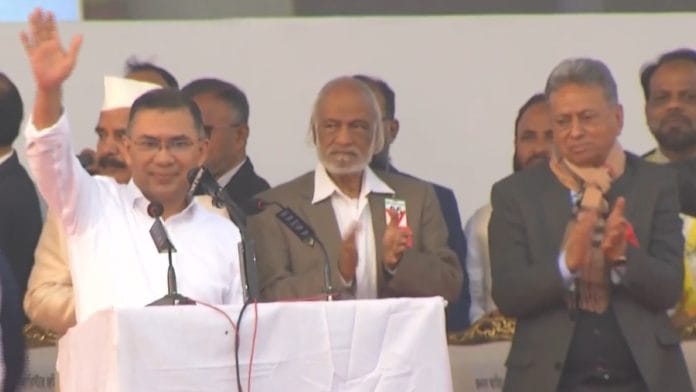



In the winter of Bangladesh’s discontent, Bangladesh Nationalist Party leader Tarique Rahman returned to his people with the sweet promises and cozy warmth of a Christmas morning. “I have a plan,” he told the cheering crowd that had come to greet him at the 300 Feet Road in Purbachal, Dhaka on 25 December. Seeing his arms outstretched, news portals compared his monologue to Martin Luther King Jr’s famous speech: “I have a dream”.
The acting chairperson of BNP, Bangladesh’s largest political party, in the absence of Sheikh Hasina’s Awami League (whose political activities are banned), has returned home after 17 years in exile in the UK.
Rahman’s homecoming saw thousands of supporters and party workers line the streets of Dhaka to hear him. Rahman started his speech with the words, “Beloved Bangladesh”. He went on to talk about an inclusive Bangladesh, the need to fix the economy, and bring peace, order and stability in the country currently in the grip of lawlessness and communal violence.
Rahman’s speech became an instant hit in many quarters of Bangladesh. Dhaka University’s Political Science professor Sabbir Ahmed described it as “inspiring and hopeful”. But before we see Rahman as the next big thing in Bangladesh’s fractured polity, the 60-year-old political heir to Bangladesh’s first female prime minister Khaleda Zia and former president and founder of the BNP, General Ziaur Rahman, needs to fix his party. He must also dissociate with the long shadow cast by his own past in Bangladesh’s politics.
The trouble within
Not all is well with Tarique Rahman’s BNP. In October this year, the Bangladeshi press reported that the party’s top leadership was dealing with many allegations against “unruly” leaders and activists across the country.
“BNP took action against over 1,000 leaders and activists in the past two months for violating the directives of the party and other allegations including attacks, occupation, extortion, establishing supremacy since the change in situation on 5 August (2024),” a Prothom Alo reported.
The report added that despite taking tough actions like expulsion, demotion and cancelling committees, new allegations keep coming. It was the first ever incident of BNP leadership taking such action against so many leaders within such a short span of time, senior leaders of the party told Prothom Alo.
It remains to be seen whether things have improved within the party in the past two months since the publication of such a damning report. The other big challenge that the BNP faces today is the rise of its former ally, the Bangladesh Jamaat-e-Islami. The Jamaat and the BNP had come together to form a government in 2001 and had even fought against Sheikh Hasina’s Awami League when she was in power. This time, in the February 2026 polls, Bangladesh’s largest Islamist political party and Tarique Rahman’s party are pitted against each other.
Though Jamaat’s political heft is considered to be far below that of the BNP’s and the latter was expected to win the next polls, Jamaat students’ wing’s surprise victory at important university elections have raised reasonable doubt in the minds of Dhaka’s political watchers.
After the Bangladesh Jamaat-e-Islami’s student wing, Jamaat Shibir, trounced BNP’s student wing in the central students’ union elections at Dhaka University and Jahangirnagar University, alarm bells began ringing within the BNP.
Speaking on the condition of anonymity, a BNP vice-chairman told the press that the party has decided to halt the formation of new committees across its units and associate bodies, except in the areas where no committee exists, ahead of the national election. Referring to university election results, he said Rahman now believes the party should fully focus on the national election and strengthen public engagement nationwide to maintain its popularity.
A BNP source told ThePrint that with 40 per cent of the country’s voters being young, both Jamaat and the National Citizen Party (NCP), led by students who played a key role in the July 2024 uprising, are prioritising young candidates.
“Not just the NCP, a significant number of the Jamaat’s nominated candidates are relatively young and the party has launched targeted campaigns to attract young voters,” he said. In contrast, discontent is growing at the grassroots level of the BNP, where tickets went to older party leaders. “Candidates who lack direct engagement with this generation or are not active at the grassroots level may find it difficult to attract young voters,” the source added.
In Noakhali-4 (Sadar-Subarnachar), the source said, BNP’s vice-chairman Md Sahjahan has fallen critically ill, creating uncertainty in the race. Doubts have been raised if he will at all be able to be on the campaign trail. Similarly, in Brahmabaria-4 (Kasba-Akhaura), the party has given its preliminary nomination to 88-year-old Mushfiqur Rahman, triggering resentment among young party workers, the source told ThePrint.
According to Dhaka journalist Maruf Hasan, Tarique Rahman has run the party from London for a long time and that’s why some distance has developed between him and the grassroots leaders and workers. “But his return has generated renewed enthusiasm among workers and leaders of the party which could prove to be a big factor in the upcoming polls,” Hasan told ThePrint.
Also read: Violence over Osman Hadi is about Islamist Bangladesh. India-baiting is a distraction
Past imperfect
In Hasina’s Bangladesh, Tarique Rahman was declared a fugitive, faced over a dozen cases, including for corruption and attempted murder. On 21 August 2004, 13 grenades were lobbed at an anti-terrorism rally organised by the Awami League on Bangabandhu Avenue in Dhaka. The attack left 18 people dead on the spot, with the toll eventually reaching 24. More than 500 people were injured, including Sheikh Hasina.
Tarique Rahman was given life imprisonment for the attack. At the time, his mother Khaleda Zia was the prime minister of Bangladesh. On 4 September 2025, a month after Hasina fled Bangladesh, the Bangladesh Supreme Court cleared Rahman and all other defendants in the 21 August grenade attack case.
There are other allegations as well. In an interview with India Today on 23 February 2023, Major General Gaganjit Singh (Retd), former deputy director general of India’s Defence Intelligence Agency, said a huge consignment of weapons — 10 trucks full of arms — was seized at Bangladesh’s Chittagong in April 2004. The shipment, he said, was meant for the United Liberation Front of Asom and other insurgent groups in India’s Northeast to destabilise the region.
Singh alleged that the arms supply was done through an alliance between the BNP and the Jamaat. ULFA chief Paresh Barua, the “mastermind of the plot”, was in close contact with Bangladesh’s intelligence agencies, which he said had links to Tarique Rahman.
And then there were allegations of patronising bribery and financial irregularities during the 2001-06 period, when Khaleda Zia was the prime minister—charges that earned Tarique Rahman the sobriquet of the “dark prince” of Bangladeshi politics.
Bangladeshi journalist Sahidul Hasan Khokon, who has closely tracked Rahman’s political career, told ThePrint that the BNP acting chairman’s political rise began after his mother Khaleda Zia became the prime minister. “Despite holding no constitutional post, he expanded his influence within the party, and allegations emerged of an informal system of control over governance and of political syndicates controlling business and government contracts,” Khokon said.
After his 25 December speech, Bangladeshi diplomat and former ambassador of Bangladesh to Morocco, Mohammad Harun Al Rashid wrote on X: “There was no pulse in it. No risk. No vision. He managed to get their junior wing across by saying he has a plan. That was enough. The playwright could not build the scene – only announce the scene existed.”
It remains to be seen whether Rahman can build the scene for a new Bangladesh by galvanising his party cadre and severing ties with his own past.
Deep Halder is an author and a contributing editor at ThePrint. He tweets @deepscribble. Views are personal.
(Edited by Ratan Priya)