




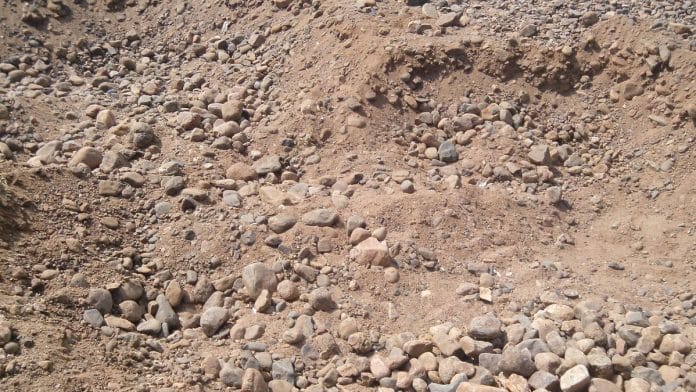

Anyone visiting the southern seashore of Tamil Nadu will come across communities of fishermen who have lost land and livelihoods to the receding coastlines. Their houses were swept away for good. These are not just statistics—this is what siphoning off Rs 20,000 crore looks like at the ground level.
Ironically, this siphoning of funds has been going on for over 25 years across multiple governments, and is still happening now, as you read this. It is not a single government that is party to this, it is the entire system.
Between 2002-03 and around 2016, 88.4 lakh metric tonnes of sand were illegally transported. This amounts to more than Rs 5,832 crore in unpaid royalties and penalties in Thoothukudi, Tirunelveli and Kanyakumari. Losing this amount of revenue is an alarming issue.
To understand the process behind illegal sand mining, we must understand the mined sand. The two types are river and beach sand, both having differing uses and importance. River sand is extracted from the sacred lifelines Cauvery, Palar, Vaigai, Bhavani, Thamirbani, which destroys the riverbeds, aquifers and life sources of the state in the process. This sand is majorly used for construction purposes.
The second is beach sand. This sand is mineral-rich, containing rare earth minerals garnet, monazite, ilmenite and thorium. Monazite, which is a radioactive mineral, has national security implications due to its nature and importance in the nuclear power generation process. This beach sand is illegally mined in the districts of Thoothukudi, Tirunelveli and Kanyakumari.
Also read: Vijay’s victory has turned Tamil Nadu upside down. He must be fearless, not accommodating
Process and factors
This process begins with the extraction of sand dredged from beaches and rivers. It takes place under the cover of night from 12 am to 4 am to evade the forest and revenue departmental security patrols. Then the dispersal process begins with the use of smaller vehicles—cycles, auto-rickshaws, and two-wheelers—to hidden staging points. These vehicles are difficult to track and can avoid detection by the police.
From here, the sand is transported in bulk. It’s loaded in trucks with forged permits and no proper documentation and routed through the backroads and smaller routes to avoid being caught. The goods then reach the storage warehouses and are sold from there at below-market prices to construction sites and contractors. This further undercuts legalised vendors and processes. Investigations have also found links between illegal miners and politicians in the state.
Interestingly, an IAS Officer, U Sagayam, when posted in Kanchipuram as ADM, had ordered the sand mafia to stop the illegal mining in the Palar riverbed. But they sent men to assault him, threaten him and get him transferred. This was the first of 26 transfers over the course of his career. Each transfer came as soon as he submitted a report or took an action against the mafia.
The demand for sand is increasing manifold due to increasing urbanisation and a construction boom in Tamil Nadu. The legal supply of sand is severely limited, and illegal supply of sand fills the gap at a lower cost, making it a lucrative deal for the demand and supply side both. Sixty four mining leases across Thoothukudi, Tirunelveli and Kanyakumari have been flagged for having massive irregularities.
Despite the blanket ban imposed by the Tamil Nadu government and the National Green Tribunal in 2013 on beach sand mining in Tuticorin and Kanyakumari districts, it continues illegally.
Between 2000 and 2008 a group of companies mined over 34 lakh tons of sand containing garnet, ilmenite, monazite and Thorium from the Southern Coast. This is despite the fact that licenses of these companies had been cancelled by the Department of Atomic Energy in 2002 as these areas were reserved for IREL. Monazite, which contains thorium, the central component of India’s three-stage nuclear programme was mined illegally and was then exported internationally. Where did that go? Who bought it? Nobody knows.
Also read: India needs to talk about over-tourism, before the great asset becomes the greatest liability
Dying ecosystems
Illegal sand mining from Cauvery, Palar, Vaigai, and Thamirabarani has led to lowering of water tables and destruction of the freshwater and aquatic life systems in the surroundings. The fish populations have depleted.
While beach sand mining operations have accelerated shoreline erosion and threatened the livelihood of fishermen in the neighborhood. The groundwater levels have also drastically fallen, destroying drinking water availability in several districts. Citizens face drought, impure water and lack of drinking water, difficulty for irrigation, weakening of soil structures in nearby areas.
Preventive steps
The judiciary took up suo motu cognisance of this issue in 2015. A PIL kept the case alive against strong pushback from the mafia bodies. Then in April 2024, the investigation by central agencies raided locations in five districts—Tiruchirappalli, Thanjavur, Karur, Vellore and Ariyalur—for money laundering linked to sand mining and questioned the collectors. Following this, in February 2025, the Madras High Court ordered a probe in beach mining citing corruption, collusion and national security concerns. This led to an investigative raid at 12 sites with IREL taking over the mineral stocks. In April 2025, the Supreme Court stayed the Madras HC’s CBI-probe order pending further hearing.
However, forged permits point to the involvement of officials. The questioning of District Collectors by investigative agencies and the ban by the HC being sidelined by the system is a grave threat to the integrity and standing of the state government. It projects an image to the citizens and onlookers that investigations are used only as a political tool and not allowed to work efficiently—which needs to change immediately.
What must happen now?
Change from within or outside the system has been slow. Change needs to be fast and absolute to prevail over this system. There should be a massive crackdown on the nexus, with complete transparency maintained. There should be public dashboards for tracking sand mining, along with stronger monitoring measures. GPS and drone surveillance must be mandated for sand-carrying vehicles and quarrying zones. Constant consistent checks are necessary now. A proper, direct and monitored recovery of the pending dues must be made from the 64 leases, under the High Court’s lens.
Steps also must be taken to enact the Whistleblower Protection Act for field officials, district collectors, field revenue officers—all of whom face death threats when acting against the mafias.
Citizens losing their houses, farmers losing their land, lack of access to drinking water, droughts, and depletion of strategic mineral reserves are irreversible losses. The state’s inaction is consequential. The question that looms overhead is—how long will the innocent pay the price of greed and corruption before the state gathers courage to step in?
Karti P Chidambaram is a Member of Parliament for Sivaganga, and a Member of the All India Congress Committee. His X handle is @KartiPC. Views are personal.
(Edited by Theres Sudeep)