






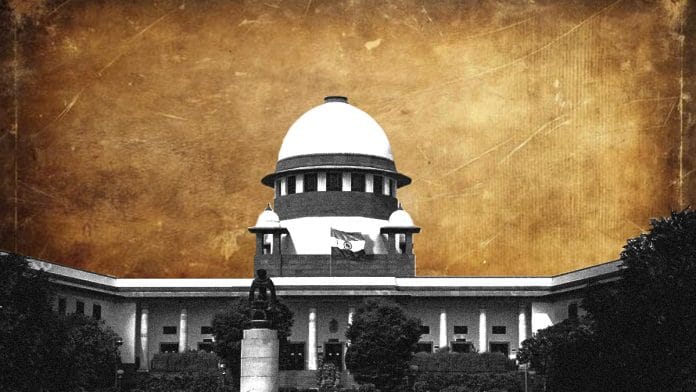



For decades, the Supreme Court of India has stood as the final bastion of hope, a sanctuary of reason where the common man looks when the executive fails and the legislature falters. We hold the apex court in a state of reverence that borders on the sacred.
But today, I am frightened. My fear does not stem from a concern for the welfare of animals alone; animals are resilient, and they will survive us. I am frightened because we are witnessing the unraveling of the sanctity of the Supreme Court itself.
The recent trajectory of the suo moto matter regarding community dogs is not merely a legal see-saw; it is a clinical study in how institutional credibility is squandered through unimplementable mandates and a disregard for settled law.
Three benches, three universes
In less than two years, three different benches have gazed at the same problem and somehow seen three entirely different realities. Justice JK Maheshwari’s bench looked at 25 years of functional, tested, repeatedly validated legislation and said: follow the law. Simple. Sensible. The Animal Birth Control Rules have survived 25 years of legal challenges precisely because they work. Courts across the country have examined them, tested them against constitutional principles, weighed public interest, and upheld them. This wasn’t blind adherence to precedent, it was recognition of evidence-based policy.
Then Justice JB Pardiwala’s bench arrived and declared: pick up every single stray dog in India and place them in shelters. India has over 50 million community dogs. Where exactly were these mythical shelters? Who would staff them? How would they be funded? The order was disconnected from reality in a way that defied comprehension.
The Chief Justice, recognising this chaos, constituted a three-member bench. Their August direction seemed promising — designated feeding areas, continued ABC implementation. But then came November, and with it, new directives that introduced their own impossibilities. Remove dogs from schools, hospitals, railway stations, bus stops. Do not release them back. Create infrastructure that doesn’t exist.
The fiction of compliance
Let me paint you a picture of what is actually happening on the ground, because the gap between judicial imagination and administrative reality has become a chasm. Railway stations never close, never sleep. Thousands of people flow through them daily, carrying food, discarding food, creating an endless buffet for any creature with hunger. To keep dogs permanently away would require military-level surveillance. Is this what we envision for India’s railway network?
Schools have spent years building compassion into their curricula through interaction with sterilised, vaccinated campus dogs. When thousands of schools formally refuse to comply with removal orders, they are not being defiant, they are being educators. They understand what the court has overlooked: that teaching empathy toward vulnerable creatures is fundamental to education.
Hospitals? The government’s solution has been generic letters to administrators saying, “Handle it yourselves.” No resources, no guidelines, no facilities. So hospitals chase dogs beyond their gates, the dogs return, they chase them again. It is an eternal loop of futility.
When law contradicts itself
The court has created a legal paradox: it declares that the Animal Birth Control Rules remain valid while simultaneously issuing orders that make those rules impossible to implement. This is not interpretation; this is a contradiction.
A court’s fundamental duty is to interpret legislation, not to override it while claiming to uphold it. For 25 years, these rules have defined how India manages its stray dog population. They have survived every legal challenge. Now, without declaring them unconstitutional, without providing a legal rationale, the Supreme Court has simply ignored them.
This is judicial lawmaking of the most troubling kind. When courts begin issuing directives that conflict with settled legislation without any constitutional basis, they step outside their role. They become, in effect, an unelected legislature accountable to no one.
Also read: SC’s stray dog order fails Delhi. Courtroom absolutes don’t solve bad policy
When compliance becomes performance
Perhaps the most frightening development is how this situation is forcing the executive branch into complete paralysis. States dispatch perfunctory missives — “please comply” — knowing full well the void they commandeer. They file vague reports suggesting progress while knowing nothing substantive is happening. They cannot comply, dare not admit they cannot comply, and so they construct elaborate fictions. This is how contempt of court becomes normalised, not through dramatic defiance but through quiet, systematic dishonesty.
This is the real constitutional crisis. When the executive begins responding to judicial directions with appearances rather than truth, the separation of powers quietly weakens. Courts lose their ability to assess conditions as they actually exist. Governance turns theatrical. And citizens, watching this slow erosion, begin to lose faith not only in the administration, but in the authority that commands it.
The questions nobody asked
What disturbs me most is the intellectual emptiness of this process. Not a single bench appears to have engaged seriously with the actual problem. Why do dog bites occur? What are the risk factors? What infrastructure exists, and what would be required? What do 25 years of ABC implementation teach us?
These are not abstract questions. There are volumes of research, decades of data, hundreds of expert practitioners who could have provided evidence-based answers. But the courts did not ask. They did not examine the documentation offered. They did not hear the experts who sought an audience.
Instead, judgments appear to have been based on newspaper articles — some demonstrably inaccurate — and general impressions. This is not judicial reasoning. This is judicial reaction.
Also read: Dogs matter more to Indian middle class than people
The cost of contradiction
Every institution’s authority rests on consistency, predictability, and connection to reality. When the highest court issues orders that contradict each other, ignore settled law, and demonstrate no understanding of practical implementation, it invites not respect but suspicion.
When judges disagree, they should articulate why. When earlier rulings are modified, the legal reasoning should be explained. When directives are issued, they should be possible to implement. None of that has happened here.
The question that haunts me is this: if the Supreme Court can treat a relatively straightforward matter like community dog management with such inconsistency and disregard for reality, what does this portend for more complex constitutional questions? If judges can ignore expert testimony here, what precedent does this set?
The institution we cannot afford to lose
The Supreme Court remains India’s ultimate constitutional guardian. It protects fundamental rights when other branches fail, upholds democratic values when popular sentiment threatens them, provides remedy when the powerful oppress the powerless. We cannot afford for this institution to lose its credibility.
But credibility is not a birthright. It must be earned through reasoned judgments, intellectual rigor, consistency in application of law, and accountability to constitutional principles. When courts issue contradictory orders without explanation, when they override settled legislation without constitutional justification, when they ignore expert evidence and practical reality, they squander that credibility.
The dog matter is a minor issue in India’s vast catalog of challenges. But the manner of its handling reveals something far more significant: how quickly institutional authority can be eroded when process is abandoned and power is exercised without wisdom.
I still want to believe in the Supreme Court. I need to believe in it, as do millions of Indians who have nowhere else to turn when justice is denied. But belief cannot be sustained on faith alone. It requires that the institution behave in ways that command respect — through consistency, through engagement with reality, through humility in the face of complexity.
The dogs will survive whatever orders are passed. They have survived millennia of human civilisation’s best and worst impulses. But institutions are more fragile than we imagine. Once lost, the trust they embody takes generations to rebuild.
That is what frightens me. That is what should frighten us all.
Maneka Gandhi, former women and child development minister, is an animal rights activist. She is the founder-chairperson of People for Animals organisation. Views are personal.
I am sure , once a pack of aggressive stray dogs attacks on Maneka Gandhi ji, while she is alone walking alone on a deserted street( not in big car ) , like somany poor elderly senior citizen face almost every day in some corner of India, and like young children from poor section of society face attacks from aggressive pack of stray dogs , she will change her stance…. As far as ABC practices is concerned, they are total failure and it’s failure has landed our poor compatriots in dangerous situations. It’s hoped that our Honorable Supreme Court press ahead with the decision already taken and allow the public institutions like Gram Panchayat, Municipal council to cull the stray dogs as per provision of Animal Welfare Act 1960 ..
This is nice ploy to shift the goalpost ! The neta should instead focus her energies on ensuring that victims of dog bites are taken care of. If the dogs will survive nonetheless but the helpless humans of age and infancy die, who should be our focus of attention ? Nice try Netaji. And let us start speaking about more animals. Not just dogs. Poor goats, fishes, sheep and the likes. Shall we ?
Interesting.