









Recent escalations between Israel and Iran have exposed the raw stakes of spectrum dominance in modern conflict. Iran’s missile barrages and Israel’s precision intercepts, enabled by real-time drone feeds, satellite ISR, and AI-driven targeting, relied on secure, interference-free electromagnetic channels. This is what net-centric warfare looks like. And in this, spectrum is a warfighting asset.
Military spectrum availability matters because modern strikes are no longer just about aircraft, missiles, and bombs; they are about sensing, jamming, relaying, synchronising, and re-tasking all of them in near real time to compress the kill chain and sustain tempo.
US military history shows what happens when that spectrum runs short. In Operation Enduring Freedom (Afghanistan, 2001), UHF satellites were oversubscribed by 255 per cent, crippling CENTCOM’s tactical relays for special forces and air operations. Operation Iraqi Freedom (2003) saw networks crash under bandwidth overload, forcing a voice-only “analog fallback”. Troops triaged Improvised Explosive Device jamming, Close Air Support calls, or ISR feeds amid spectrum “e-turf wars”. Bosnia’s Operation Deliberate Force (1995) showed intense use for airstrikes and clearly recorded that the rescue of USAF pilot Scott O’Grady after he ejected from his F-16 could have been thwarted by limited access.
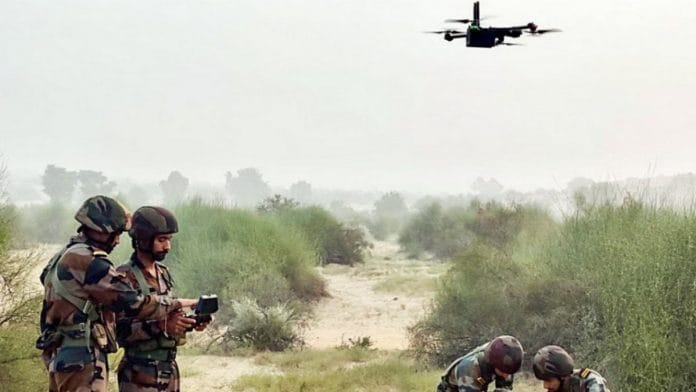
Spectrum is not merely an enabler of war, but part of war itself. Stealth aircraft, stand-off weapons, airborne early warning platforms, electronic attack aircraft, and drones all depend on it for command and control, target designation, battle-damage assessment, and coordination across domains. The side with assured access to secure, protected bands can see farther, decide faster, strike in greater volume, and adapt more quickly than one dealing with congested or vulnerable communications.
In India, over time, a large share of military bandwidth has been auctioned off to meet the growing demand for mobile and 5G services. Civilian requirements can be accommodated, but not at the expense of the bands that will determine wartime effectiveness.
Also Read: 2026 defence budget is not good enough to achieve Viksit armed forces
India’s spectrum squeeze
India cannot afford to cede more defence bands to 5G auctions when its own forces may soon face similar high-stakes battles along tense borders.
In 2015, the Union Cabinet approved a swap of 15 MHz of 3G spectrum between the Ministry of Defence and the Telecom Ministry in the 1900/2100 MHz band, unlocking more commercially valuable 2100 MHz spectrum for auction and mobile broadband. A few years later, as India prepared for 5G, the 3300-3600 MHz band became the new battleground between strategic and commercial priorities. In 2025, the government approved refarming of 687 MHz of so‑called “unused” spectrum from various departments, including Defence and ISRO, to take total mobile spectrum availability to 1,587 MHz, with over 320 MHz released immediately and the rest to follow by 2028-29.
Each individual decision looks technocratic and benign, but taken together, they steadily erode the margin for dedicated, interference‑free military networks that will underpin tomorrow’s operations.
The principal reason behind this cross allocation is the sheer volume of data Indians now consume. Recent official and industry figures suggest that average monthly usage per mobile user in India is close to 36 GB per month, more than 1 GB per day. That’s nearly double the global average for mobile data consumption per smartphone.
India’s data binge is underwritten by some of the world’s lowest mobile tariffs, with an average cost per GB of well under a dollar. The global average, by contrast, hovers around a couple of dollars per GB. In the United States, 1 GB of mobile data costs around $6 on average. Canada, New Zealand, and South Korea cluster in a similar band, with 1 GB often costing between $5 and $6. Cheap data in India has not only driven spectacular growth in usage and digital services, but has also normalised a culture of compulsive, low-value consumption.
Not all data usage is wasteful, of course. Affordable data has enabled UPI, tele-education, tele-medicine, and a vast array of digital public services. Yet it is equally true that a large chunk of the spectrum is effectively being burnt on low-productivity entertainment and endless, mindless scrolling. In a country where spectrum is finite and defence requirements are growing, that is no longer a trivial concern.
Internet discipline for national security
Given the scale of India’s user base, even modest discipline in usage patterns, closer to global norms, could free enormous capacity for more critical applications. The pressure on the government to repeatedly strip bands from defence and space agencies would, therefore, ease.
Internet discipline can take many forms. For the state, the more fundamental lever is pricing. The original logic of ultra-cheap data, to pull millions online and build digital habits, has largely succeeded. It is therefore reasonable to revisit the regime and move towards a two-tier structure: a generous, affordable block for essential communication and digital public services, and a premium price above that for discretionary and entertainment-heavy use.
Ultimately, this is not just an economic or behavioural question; it is a strategic one. As India’s armed forces move towards net‑centric operations, they will depend on resilient, low‑latency, interference‑free networks for everything from real‑time ISR feeds and precision targeting to drone swarms and secure battlefield communications. Those networks will require not just more spectrum, but better spectrum, bands that are protected, prioritised and ring‑fenced from commercial churn.
The current pattern of periodically asking defence to vacate bands to satisfy commercial 4G, 5G and soon 6G demand reverses the logic of national security. The baseline should instead be to identify and lock in critical bands for defence and space, after rigorous military planning, and only then to refarm any genuinely surplus holdings. A calibrated spectrum strategy would combine three elements: higher reserve prices and more disciplined auctions for luxury data consumption, guaranteed and interference‑protected bands for national security, and policies that actively encourage efficient civilian use rather than indiscriminate bingeing.
If we get this balance right, India can achieve three outcomes at once: higher auction revenues from those willing to pay for limitless entertainment; reduced digital distraction and improved workplace productivity; and, most important, assured access to clean spectrum for the armed forces when the next conflict is fought as much in the electromagnetic domain as on land, at sea, or in the air.
The real choice before us is simple: do we want our soldiers competing with viral videos for bandwidth when it matters most?
Air Marshal GS Bedi (Retd) is a Distinguished Fellow at the Centre for Aerospace Power and Strategic Studies (CAPSS) and the Centre for Land Warfare Studies (CLAWS). Views are personal.
(Edited by Asavari Singh)