









Five and a half thousand tons of rubber packed into its cavernous hold, the Polish merchant ship SS Mickiewicz stood at dock in Colombo, its crew sweltering under the savage summer sun. The Mickiewicz’s departure for Tianjin, just up the Yangtze from Shanghai, had been delayed by a call from agitated Indian officials, who demanded that the crew find and unload two 500-kilogram barrels of industrial chemical loaded in Mumbai. The agents representing the Mickiewicz said this request could not be met: Fees had been paid for the cargo, releases had been issued, and title had passed out of Indian hands. The ship set sail—literally and metaphorically—on July 31, 1953.
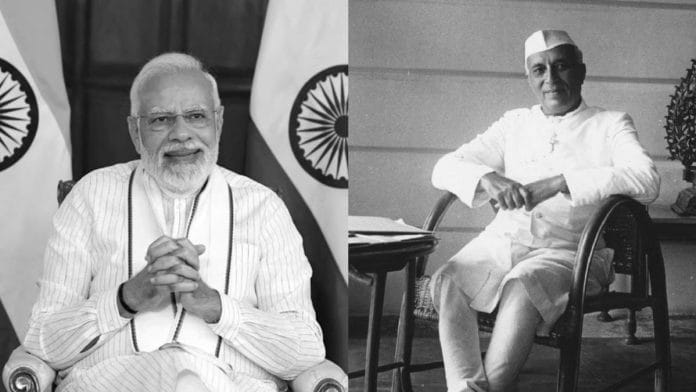
Today—as critics accuse Prime Minister Narendra Modi of having surrendered both national sovereignty and India’s moral compass over the Iran crisis—declassified documents show the dilemmas he has faced are neither new nor unusual. Faced with similar choices in 1953, Prime Minister Jawaharlal Nehru also put aside his principles—as every other Prime Minister was to find themselves doing afterwards.
Likely hoping to expand his leverage with the People’s Republic of China, Prime Minister Nehru had agreed to sell it thorium nitrate mined and processed by Indian Rare Earths in Kerala’s Aluva. From the documentary record, it is clear he was unprepared for the price India almost had to pay for the Rs 40,500 export order—around ₹5.64 million today.
Three days before the SS Mickiewicz sailed out of Colombo, Prime Minister Nehru was told by American ambassador George Allen that India might have to face economic sanctions. The Prime Minister replied that India “would never submit to derogation of its national sovereignty in permitting United States law to determine with whom and in what commodities India could trade.”
Even as he delivered these fighting words, the Prime Minister was planning his retreat.
Also read: India’s risks in the Iran conflict go way beyond oil
Fighting communism
Fighting against North Korea—as well as People’s Republic of China troops and Soviet Union equipment committed on its side—the United States had become mired in a stalemate by mid-1951. Frustrated political leaders enacted Public Law 551, also known as the Battle Act, after its sponsor, Laurie Battle, the Representative from Alabama. Law 551 mandated that the United States would deny military and economic assistance to any country that did not embargo supplies to the Soviet bloc of “arms, ammunition, and implements of war, atomic energy materials, petroleum, transportation materials of strategic value, and items of primary strategic significance.”
The Act contributed to a 47-0 vote at the United Nations on 18 May 1951, prohibiting the export of strategic materials to North Korea and China. Eight countries, including India, did not vote. There was a catch in this apparently iron-clad consensus, though: There was no definition of exactly what strategic materials in fact were.
France sold metals and chemicals for pig intestines used to make sausages. The United Kingdom stopped exports of aircraft parts and gasoline, but continued selling automobiles and machinery. Eight hundred ships carrying goods from across the world arrived in Chinese ports in the first ten months of 1952.
Little recognised in India, Nehru had made common cause with the West during this period. As Indian troops battled communist insurgents in Telangana, he said he was setting up a secret committee to fight communism. Later, in 1949, Intelligence Bureau director TG Sanjeevi Pillai briefed CIA officials on the project’s financial problems—but noted that it had begun work in Kerala.
Tensions had begun to rise along the Line of Actual Control by 1951, as both the People’s Liberation Army and the Indian Army began moving forward to assert their claims to the undemarcated frontier. To Nehru, it likely seemed that selling a little thorium could yield some badly needed leverage.
Also read: India’s response to US-Israel war on Iran isn’t muted. Just read what SCO said on Khamenei killing
The Thorium meltdown
Foreign Secretary Ratan Kumar Nehru put the Thorium issue before Prime Minister Nehru in early 1953. The Prime Minister replied on 20 February, saying he disliked “the idea of our restricting our legitimate business abroad because of the American embargo.” Yet principle gave way to caveat: “While I am clear that we should not restrict our activities because of the American embargo, I do not wish, at this stage, to do anything which might worsen matters. I should like to wait for a brief period, say about a month or so or till the end of March, to see what happens.”
Late in the summer of 1952, US Ambassador Chester Bowles had met the just-retired Foreign Secretary, Girija Shankar Bajpai, for a late-night confidential discussion which revealed that there was no doubt, Bajpai said, that Prime Minister Nehru had shed his illusions about the Soviet Union—even if he remained influenced by a “group of extremely confused Quakers in London.”
That said, Bajpai continued, “India would continue to talk softly on [the] subject [of] communist China because [of their] common long boundary and [for] fear [of] Chinese aggression.” Bowles responded, presciently, that China “would not be deterred by India’s efforts to maintain superficially friendly relations.” That was true, Bajpai replied, but the Cabinet suffered from an “oversupply of fuzzy-mindedness and some wishful thinking.”
Ever since 1951, the CIA had been maintaining a careful watch on Polish merchant shipping, monitoring Sri Lanka’s sale of rubber to China in return for rice. The Mickiewicz had made its first voyage to Colombo that October, the CIA reported, after the importer offered a small margin over the market rate, as well as comprehensive insurance to cover the risk of seizure or war losses.
Faced with protests, Sri Lanka rejected efforts to end the trade: A cable from the American mission in Colombo on 10 September 1951 claimed that the Government stood to make more from taxes on a single shipment than the total aid it was to have been given in the next financial year. The cable also cited Sri Lanka’s “ultra-sensitive nationalism.”
Less than nine months later, a naval officer stationed at the United States Embassy reported that thorium nitrate had been loaded on the Mickiewicz in Mumbai. This new situation, the State Department responded, was “extremely grave.”
Also read: Trump’s hard-power world has exposed India’s economic dependencies
The critical moment
The United States was well aware, from its own nuclear programme, that although thorium nitrate could be mixed with uranium to fuel civilian reactors—including India’s research reactor in Trombay—this was not the ideal pathway for nuclear-weapons programmes. “Although an atomic energy source material,” the US Embassy explained in a report to the State Department on 31 July 1951, “thorium also has widespread, ordinary commercial uses, such as incorporation in incandescent gas mantles, ceramic products, photographic films, plates and papers, etc.”
Following American protests over the sale, Indian officials adroitly passed the buck. Finance Minister CD Deshmukh pleaded ignorance; Foreign Secretary RK Nehru asserted that neither he nor the Prime Minister was aware of the scope of the Act; and Shanti Swarup Bhatnagar of the Atomic Energy Commission said that the shipment had been made against his express orders.
The Prime Minister insisted, in correspondence with his Foreign Secretary and in a conversation with Ambassador Allen, that India would never accept “derogation of its national sovereignty.” There was no question, he said, of accepting aid with conditions in the footnotes. The Ambassador rejected this proposition with impeccable logic: “Any international agreement between two sovereign nations involved some voluntary limitation on their freedom of action.”
For its part, a CIA assessment carried out by senior analyst Huntington Sheldon concluded that cutting off aid to India would mean “the friendly neutrality now exhibited towards the United States certainly would change for the worse.”
Early in August, the State Department told Allen that a deal had been hammered out. The United States Government would conclude that the violation of the Act had been inadvertent—even though they had been told by no less than the Secretary General of the External Affairs Ministry, Narayana Pillai, that the shipment only went ahead after Prime Minister Nehru’s personal approval. The External Affairs Ministry also provided assurances that it would ensure “effective administrative controls over shipments of strategic materials.”
The relationship between the two democracies, though, continued to deteriorate. From 1953, the United States deepened its military alliance with Pakistan. After the war of 1962, however, Prime Minister Nehru was forced to turn, once again, to the United States for assistance. The relationship became ugly again in the build-up to the war of 1971, until Prime Minister Rajiv Gandhi initiated a rapprochement.
Furious public debates raged after Prime Minister Chandra Shekhar allowed US aircraft to refuel in India during the First Gulf War. Prime Minister Atal Bihari Vajpayee faced sharp criticism for his support of American missile defence plans. Similar controversies dogged Prime Minister Manmohan Singh when he signed the India-US nuclear deal.
Like Nehru, Prime Minister Modi has had to make do with the circumstances he has been dealt. As the German Field-Marshal Helmuth Graf von Moltke famously observed, “strategy is a system of expedients.” Few ethical or ideological principles, he would have argued, survive contact with the real world. Facing crisis, there is no script to read from. Leaders must improvise as best they can, knowing each misstep and misjudgment will be revealed under the harsh light of hindsight.
Praveen Swami is contributing editor at ThePrint. His X handle is @praveenswami. Views are personal.
(Edited by Theres Sudeep)
interesting, but please correct your geography- Tianjin is near Beijing, many miles away from “just up the Yangtze from Shanghai”. Thanks