









In a strange turn of events, Bangladesh will face its general election, scheduled for February 2026, with two of the most important personalities since its emergence five decades ago now out of the picture. With the death of Khaleda Zia after a prolonged illness and Sheikh Hasina continuing her political asylum in Delhi, Dhaka faces a leadership crisis never witnessed before.
Both the Begums of Bangladesh were drawn into the vortex of politics by circumstances far beyond their control. While Sheikh Mujibur Rahman’s daughter Hasina was seen as the natural successor to her father after his tragic assassination in 1975, Khaleda Zia’s husband, Ziaur Rahman, was considered the alter ego of ‘Bangabandhu’. The differences between Sheikh Mujib and Ziaur Rahman over the outlook and future trajectory of the nation born in 1971 were too deep to be bridged. It was a question of the foundational principles of the nation in the making, of secular polity versus an Islamic dispensation. The successors of both leaders, unfortunately, carried forward the legacy of their respective mentors.
The two parties — the Bangladesh Awami League under Sheikh Hasina, and the Bangladesh Nationalist Party (BNP), led by Khaleda Zia — briefly came together to restore parliamentary democracy in 1991, following the resignation of military ruler Lieutenant General Hussain Muhammad Ershad. The caretaker government system that followed Ershad’s exit, and was institutionalised in 1996 by the Sixth Parliament, supervised four general elections before being abolished in 2011 by the then Awami League government. A decade and a half later, it is another interim administration, led by Muhammad Yunus, that will supervise the restoration of a duly elected government in Dhaka.
What is unprecedented is that the interim government has banned the Awami League, rendering it ineligible to participate in the forthcoming election. Clearly, the Yunus-led unelected interim administration has overshot its mandate and exhibited a biased, partisan, and undemocratic character. A robust, two-party, secular parliamentary democracy is essential for Bangladesh’s transition from chaos to peace and progress.
Also Read: Begums of Bangladesh: When rivals Khaleda Zia & Sheikh Hasina joined hands to topple dictatorship
A dangerous leadership vacuum
The ground situation appears far from conducive to a peaceful transition from anarchy to political stability. With Sheikh Hasina in exile and her party’s recognition cancelled, the Awami League is leaderless. Now, with the demise of Khaleda Zia, the BNP too is in a quandary. Beyond being a unifying figure for the BNP, Khaleda Zia was the icon of the party’s identity and its long struggle against the Awami League’s political dominance. Her death has left a void in both party and national politics, although her son Tarique Rahman is seeking to fill it.
While his return to Dhaka on Christmas Day after seventeen years of exile in the United Kingdom is seen as settling the succession issue, the BNP is facing several challenges with its apex leader gone. Though Rahman is believed to have been in regular touch with the situation in Bangladesh, he likely lacks his mother’s grip over the party rank and file. In recent years, several high-profile BNP leaders have also either left the country or parted ways with the party for personal and business reasons. In the meantime, the BNP’s long alliance with Jamaat-e-Islami, though it ended last year, has drawn a large cadre of radical Islamists into the party’s ranks. The new leader, who is yet to be formally appointed, will have to navigate these radical elements.
Now, the newly formed National Citizens Party (NCP), once touted as the fresh hope for reform, has joined hands with an alliance led by Jamaat-e-Islami. If the BNP also joins this bloc, it risks losing its secular appeal among the small but significant section of Bengali voters who still remember the atrocities committed by the Punjab-dominated Islamic army of Pakistan. Such a political coalition of radical elements would set the clock back to the pre-1971 era and destabilise not just Bangladesh, but the entire region.
Only a healthy two-party contest, with convergence around a progressive democratic agenda, can provide stability in Dhaka.
Also Read: Bangladesh is worshipping Islamists as heroes. Jamaat is having the last laugh
India’s new stake in BNP
For India, emerging as the leader of the Global South, stability in Bangladesh is an important component of its regional strategy. When it comes to Dhaka, that stability depends on a healthy two-party contest and convergence on a progressive democratic agenda.
For too long, New Delhi has invested heavily in the Awami League and its only leader, Sheikh Hasina. The BNP should not be reflexively branded as pro-Pakistan or anti-India. As the first woman prime minister of Bangladesh in 1991, Khaleda Zia restored parliamentary democracy and took visionary steps such as free girl child education and economic liberalisation, which had a positive impact on the country’s economy. This economic resurgence, along with Khaleda’s efforts to forge better relations with India, facilitated later bilateral treaties and promised to add greater value to the Look East policy initiated by the Narasimha Rao government.
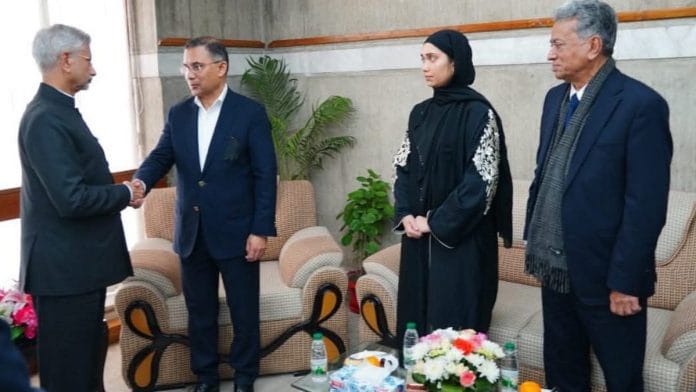
Given the importance of the BNP and the support it requires, External Affairs Minister S Jaishankar’s attendance at the funeral of Begum Khaleda Zia was a much-needed step in resetting New Delhi’s ties with the BNP and democratic forces in Bangladesh. India should prevail upon the interim administration to lift the ban on the Awami League and pave the way for a robust two-party democracy. Too much is at stake for New Delhi in stabilising the situation in Dhaka to allow it to be ruled by radical Islamic vandals.
Seshadri Chari is the former editor of ‘Organiser’. He tweets @seshadrichari. Views are personal.
(Edited by Asavari Singh)
PM MOdi has taken the best and only practicable route to restoring Indo-Bangla relations by sending Mr Jaishankar to attend Khaleda’s funeral. But there are many in the BJP who take ashort sighted a bigoted approaach and even want Bangla cricketers banned from the IPL. Hopefully the BJP leadership will take the strictest action against members like Mr Sangeet Som and take steps to expel such dangerous elements.