









There must be something remarkably profound about the 1920s to 1930s phase in India’s socio-political history. The Gandhian era began in 1920 with the launch of the Non-Cooperation Movement, following the death of Bal Gangadhar Tilak. But these tumultuous years also witnessed the formation of several socio-political and religious organisations that envisaged a metamorphosis in the collective and individual lives of ordinary Indians
These included the following organisations:
- Congress-Khilafat Swaraj Party (1923), formed by CR Das and Motilal Nehru
- Bahishkrit Hitkarni Sabha (1924), founded by BR Ambedkar for the upliftment of untouchables
- Labour Swaraj Party (1925), formed by Kazi Nazrul Islam, Muzaffar Ahmad, and Hemanta Kumar Sarkar for mobilising industrial workers
- All India Trade Union Congress (AITUC), founded in 1920 by Lala Lajpat Rai
- Akhil Bhartiya Hindu Mahasabha (1921), which emerged out of the Hindu Maha Sabha (1915)
The decade saw the rise of two other organisations. In 1925, the Rashtriya Swayamsevak Sangh (RSS) was founded in Nagpur by Dr Keshav Baliram Hedgewar, and the Communist Party of India (CPI) was established in Kanpur. However, the Communist Party of India (Marxist) (CPI-M), which split from the CPI in 1964, considers 17 October 1920 to be the CPI’s founding day.
The RSS and the CPI have different agendas, objectives, working styles, and ultimate goals and cannot be compared on the same parameters. However, it would be interesting to study their growth, present status, and relevance.
Why the Left was left behind
A century after it was founded, the RSS has more than 83,000 shakhas (with one–hour gatherings every day) in about 50,000 places. This is besides the 45,000 regular, non-shakha meetings. More than 100 organisations have been inspired by its ideology, and it has an institutional presence in more than 100 countries.
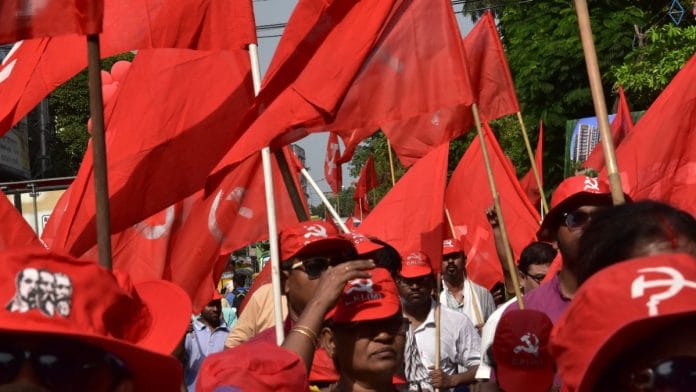
On the other hand, the Left has government in just one state, with 13 seats in both Houses of Parliament. The CPI is not currently recognised as a national party by the Election Commission. The Left ideology is no longer relevant, even in the Opposition.
Once a strong political force that played an influential role in the policy formulation of the Union government, the Left has now become politically extraneous and organisationally non-existent. The Communist movement, which was once synonymous with labour unions and considered a strong competitor to the Congress for power at the Centre—on the lines of China, Vietnam, and the Soviet Union—was consigned to political oblivion.
The reasons why the Left was left behind in politics lie in a combination of factors such as structural inadequacies, ideological rigidity, strategic failures, and historical pressures.
The Communist movement in India owed its origins to the twin principles of Marxism as propounded by Karl Marx and the dialectical materialism of Friedrich Engels. Both theorised that reality is based on matter—shaped by economics and factors of production—and that we need the dialectics of inherent contradiction to understand the ongoing conflict between thesis-antithesis-synthesis played out by opposing classes. This diagnosis of the social milieu could have been close to being apt for Europe in the early 19th century. But it doesn’t work in India, replete with ancient philosophies and modern ideas juxtaposed.
The founders of the Indian Communist movement relied on the Western origins of Marxism and failed to provide a homegrown alternative to rearrange the social organisational structure based on Indian philosophical thoughts. Meanwhile, the struggle for the “annihilation of caste” was spearheaded by Ambedkar, Hedgewar, and MK Gandhi in their respective ways, which overshadowed the call for class struggle by the Left parties.
Also read: Climate crisis in India is being normalised. Country’s poor are paying the price
Indian Marxists ignored religion
Although its origins were skewed, the Communist movement began to be greatly influenced by Lenin’s 1917 October Revolution in Russia and later by Mao Zedong’s ideas, which developed into Maoism in China. Both interpretations were alien to an Indian mind seeped in Vedantic philosophies that had a strong belief in the concept of Dharmic existence—a euphemism for a value–based society.
The idea that religious alienation was essential for ending exploitation and poverty—and to achieve absolute control over factors of economy and political authority by capturing the state apparatus—became the cornerstone of the Indian Communist movement. Before declaring “religion is the opium of the people”, Marx added a rider:
“Religious suffering is, at one and the same time, the expression of real suffering and a protest against real suffering. Religion is the sigh of the oppressed creature, the heart of a heartless world, and the soul of soulless conditions. It is the opium of the people.”
Gandhi underscored the need for religion and criticised the Communists:
“I am yet ignorant of what exactly Bolshevism is. I have not been able to study it. I do not know whether it is for the good of Russia in the long run. But I do know that in so far as it is based on violence and denial of God, it repels me.”
Indian Marxists failed to understand religion in the Indian context and negated its importance in social, cultural, and political spheres.
In the late 1950s, deep ideological and political differences arose between the Communist Party of China (CPC) and the Communist Party of the Soviet Union (CPSU). It led to the CPC’s denouncement of the CPSU led by Nikita Khrushchev as a ‘revisionist’ party in 1963. The Indian Communist movement also split with CPI-ML [Communist Party of India (Marxist–Leninist) Liberation], owing allegiance to Maoist China.
Both Russia and China have successfully defeated Marx. These models cannot revive the Left movement in India. A truly Indian model of “Gandhian socialism”, suggested by former Prime Minister Atal Bihari Vajpayee, may work for the Communists in India. But its copyright is already with the Bharatiya Janata Party.
Seshadri Chari is the former editor of ‘Organiser’. He tweets @seshadrichari. Views are personal.
(Edited by Prasanna Bachchhav)
Shame on BJP for wasting money on socialism.