









The debate over a potential ground operation in Iran is not really about the United States’ capabilities. It is about time and perception. And in the same vein, about deception.
Prima facie, the military options would have three broad pathways.
The first involves the continued use of Special Forces—targeted missions aimed at securing enriched uranium stockpiles or even enabling internal insurgencies.
The second contemplates a more tangible deployment of conventional forces—marines, airborne units, amphibious elements—to de-strangulate Iran’s weaponisation of the Strait of Hormuz.
The third combines the first two approaches.
Yet beneath these options lies a quieter consensus among specialists: Special operations are happening inside Iran and will continue irrespective of whether and how conventional forces will deploy.
Perils of all guns blazing
A full-scale invasion borders on implausible. Iran is not Iraq. It is four times larger and more complex. As former US Ambassador to Qatar Patrick Theros has observed, no state in the region is willing to host the kind of force required to occupy Iran, nor could Washington sustain the political cost. A campaign of that scale would push America in precisely the kind of “forever war” that US President Donald Trump pledged not to get into.
An airborne seizure of the top brass, closer to the Venezuela scenario, very much circulates in Iran’s local media. But it finds little credibility among serious analysts in Washington, Europe, or Israel, for Iran is not a personalised regime like Venezuela.
The reality remains that a US withdrawal is not on the table. In his latest address, Trump once again made confusing statements about ending the war and starting a military operation.
For all their current haplessness, the Gulf states have drawn a clear boundary. They did not invite this war, but they are now deeply invested in its outcome. Their response, while measured, has remained focused on air defence, naval positioning, internal stability, and new defence agreements for cheap drone interceptors with Ukraine.
Bahrain, Qatar, the UAE, Oman, and Saudi Arabia have avoided escalation and neutralised internal threats, including local cells and assets suspected of aiding targeting operations.
But there is one outcome the Gulf states will not accept: an Iranian-controlled—and by extension, weaponised—Strait of Hormuz functioning as a geopolitical toll booth. Across the region, and across the GCC, the message is consistent and oft-repeated: The US must finish what it started.
That takes us back to the central question: Boots on the ground, but to what end?
Also read: Where is the OIC? ‘Collective voice of the Muslim world’ can’t disappear after a statement
US mobilisation
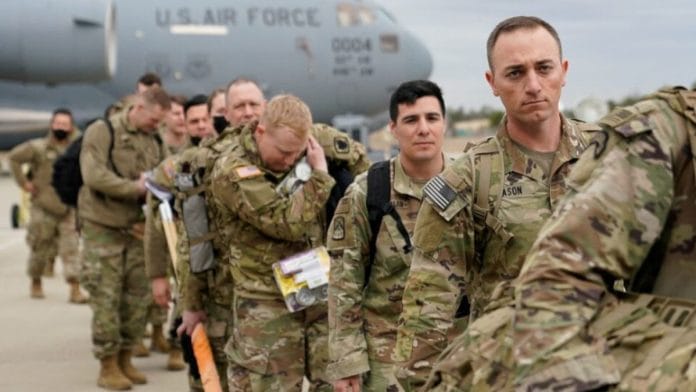
The US forces currently deployed or en route offer a revealing insight. The country is readying for precise, surgical operations.
From Army Rangers and Navy SEALs to Delta Force, 5th Special Forces Group, and the 160th SOAR, the US has put together a capability build-up designed for speed, precision, and flexibility. These are supported by conventional-elite forces such as the Marine Expeditionary Units and airborne divisions such as the 82nd Airborne Division, positioned in Jordan. This is not a build-up for a full-scale invasion. This is a force designed for surgical strikes.
A potential target for such strikes could be Iran’s nuclear infrastructure and uranium stockpiles. But here, the primary variable is not capability but intelligence. Israeli scholar Eitan Shamir argues that if the location of high-grade uranium stockpiles is known, they can be secured.
According to British-Iranian geopolitical analyst Shahriar Sabet, who often consults Greek shipping in the region, there is a distinct advantage in such a scenario. Iran cannot publicly retaliate against an operation to extract weapons-grade uranium stockpile that it denies having access to, exposing its own security failures and legitimising the operation retroactively. The domestic political cost of acknowledgement may exceed the cost of absorbing the loss in silence.
But tactical success does not guarantee strategic outcomes.
The Strait: Prize or trap?
The second objective of the US mobilisation could be to gain control of the Strait of Hormuz.
The targets are well known: Kharg Island, responsible for 90 per cent of Iran’s oil exports, and the three islands of Abu Musa, Greater Tunb, and Lesser Tunb, part of a seven-islet complex key to controlling the Strait.
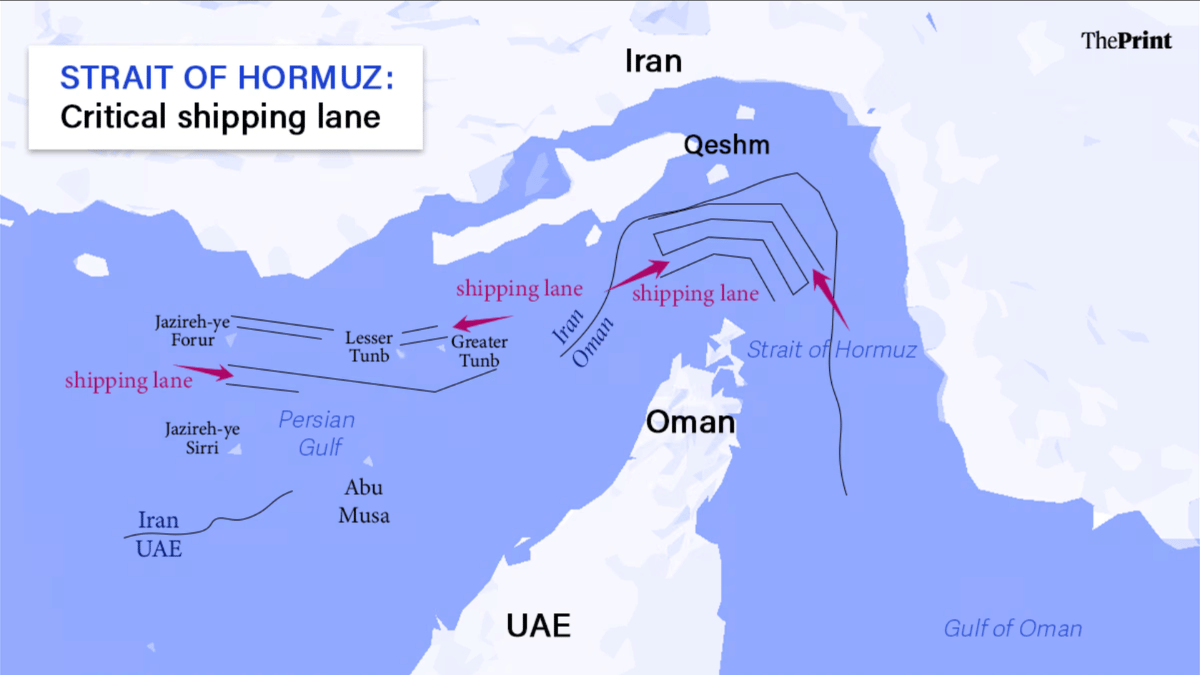
This is not unfamiliar terrain for US planners. The scenario has been war-gamed for decades, and there is plausible confidence that such positions could be seized, although holding on to them is a different challenge.
But control of territory does not equate to control of the conflict.
Iran’s asymmetric capabilities—drones, cheap mines, and anti-ship missiles—even if decimated ruthlessly, can ensure that disruption remains possible even without dominance or control. And no matter how robust the capabilities of the US and its allies are, some drones or mines are likely to get through.
Additionally, Iran retains one particularly disruptive option: mining the Strait of Hormuz. It is a poisoned chalice as the move would hurt Iran’s own exports and eliminate any possibility of selectively controlling maritime flows. But it would also introduce a level of disruption difficult to reverse.
Iran’s strategy is not likely to hinge on sustainable variables in conventional terms. It is likely to depend on endurance—on its ability to outlast and out-disrupt, no matter what the cost.
That brings us to the most important aspect of this war, where the logic of “limited operations” begins to fray.
Also read: India’s oil and gas vulnerability runs on diesel trucks
It’s not about tactical victories
A conflict that appears tactically contained can trigger strategically uncontrolled consequences. As Iranian scholar Vali Golmohammadi warns, such interventions carry disproportionate escalation risks. A targeted strike can quickly cascade into disruption, which can snowball with unbearable costs.
One can imagine military responses to the escalation as asymmetric and geographically diffuse: missile salvos, proxy activation across multiple theatres, and strikes on energy and logistics infrastructure.
In effect, notes Sabet, the battlefield would not expand in a straight line—it would fragment. Add to it the question of a possible internal destabilisation, and the picture immediately starts to look murkier with many more variables and actors than one can predict.
Ultimately, the question is not whether tactical victories are possible. They are. But will they be able to end the war in time?
If the conflict escalates into sustained disruption of global energy flows, the consequences will extend far beyond the battlefield. Countries with limited reserves—India, Vietnam, the Philippines—will feel the strain within weeks. Prices will rise again and supply chains will disrupt further.
It is tempting to frame the Iran debate in terms of decisive action versus restraint. But the reality remains far more complex. The US very much possesses the capability to act—quickly, precisely, and with considerable force. What it does not possess is a clear pathway from tactical success to strategic outcome.
Ilya Roubanis is a Senior Fellow, Institute of International Relations, Athens. Views are personal.
(Edited by Prasanna Bachchhav)