






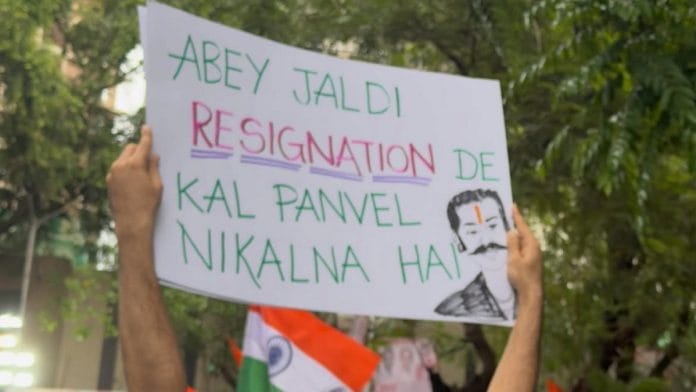


A placard held up proudly among a sea of protesters shows a drawing of the Golmaal villain Vasooli Bhai, with the line: “Jaldi resignation de, kal Panvel nikalna hai” — Resign quickly, we have to leave for Panvel tomorrow. And harrowing images of students fleeing police lathis and tear gas during the Cockroach Janta Party protest are set to the lively soundtrack of the popular game Subway Surfers.
To the uninitiated, it may seem flippant. But this is the first Indian mass protest whose native language is the funny Instagram reel.
More than half of Indians rely on YouTube for news, by the Reuters Institute’s latest count, and protesters no longer have to rely on traditional media to keep their POV alive. They can be as irreverent as they want. Humour is the movement’s operating system: it recruits, it disarms fear, and it archives what the state would rather delete. Laughter has always been how the powerless speak truth when direct confrontation turns dangerous—the court jester’s old privilege, updated with a front camera.
Before you dismiss this generation as unserious or trivial, laugh along at the content on your feeds.
Also Read: Artists are documenting the CJP protest, one cartoon at a time
Humour widens the coalition
The spectacle at Jantar Mantar captures the wide social coalition of people who are showing up across class, caste, religion, region, profession. They fan each other amid the humid heat. And as people from different corners of the internet converge on common ground, they bring their own online culture with them.
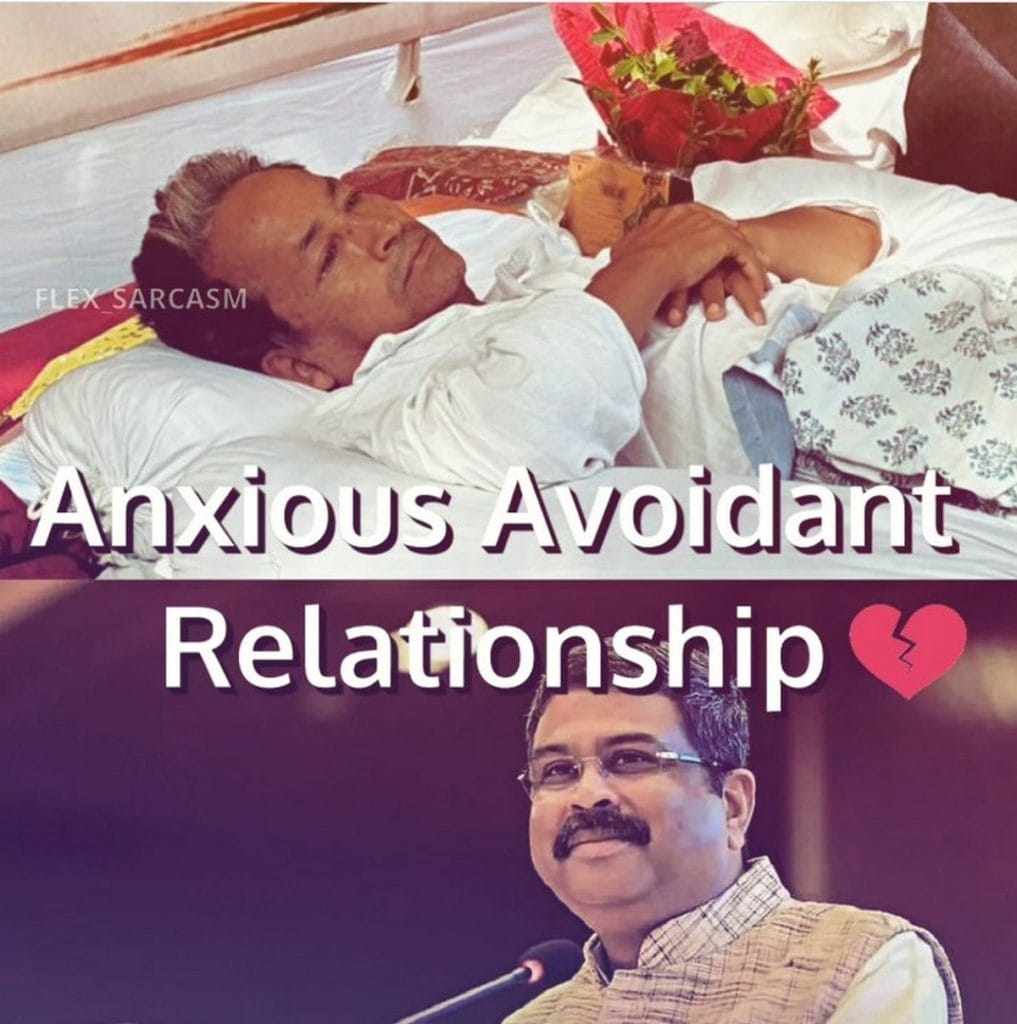
“Baddies are not apolitical” claim It girls. “Yahan paper leak ho rahe hai, aur wahan Taylor Swift ki shaadi ka ek bhi photo nahi leak ho raha hai” (Here we have paper leaks, and there not even Taylor Swift’s wedding photos get leaked) jokes a Swiftie. “Raat ko FIFA, subah isteefa (FIFA at night, Resignation in the morning), chant football fans. Even therapy-speak Instagram gets in the door: one meme diagnoses the standoff between a fasting Sonam Wangchuk and an unmoved Dharmendra Pradhan as a textbook “anxious-avoidant relationship”.
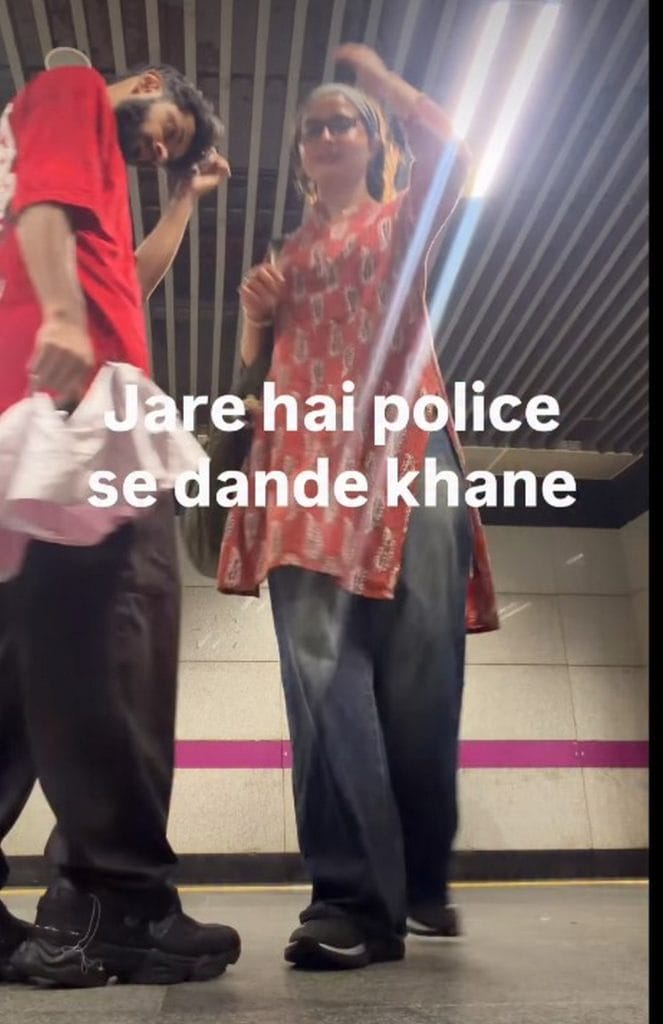
Face repression the Gen Z way: if the police tries to beat you up, pose with the barricades. Document it all. And not all of the protest content is coming out of Jantar Mantar in Delhi or sites in Mumbai, Bengaluru, Kolkata. Students are making videos from inside their research labs. Every trend format arrives with built-in audience and engagement, and every audience is one reel away from learning what happens when anyone in this country tries to protest today.
Ridicule disarms fear
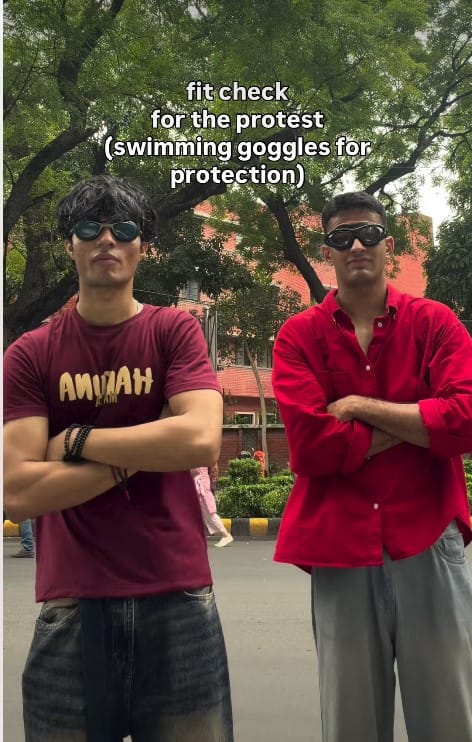
The memes and trends have gone analog. Fit checks taken at metro stations show people decked up in goggles to protect themselves from tear gas; sunscreen, caps, bandanas, and umbrellas to protect themselves from the weather; shoes to run; flags and the Constitution in hand as they stake claim to a fundamental right. Videos of running away from the Delhi police get captioned “run club”. Fitness geeks film a day in their life, having a breakfast of overnight oats before heading to their ‘cardio session’ with Delhi police, rating it as a 10/10 marathon.
The Get Ready With Me is the internet’s most intimate genre—a face in the mirror, narrating its own preparation for the day. Pointed at a protest, the form turns political without changing shape: I expected violence from my government, and I dressed for it anyway. A generation trained to narrate the self is now narrating the state. Even in moments of extreme danger, irony becomes a way of reclaiming agency over fear.
People on the ground distribute Melody chocolates, recreating Modi’s gift to Italy’s Georgia Meloni. They put up prank stalls to mock palmistry and superstition. In Bihar, protestors ask policemen about tear gas, laathi charge arrangements. Protest FOMO has become its own genre: just look at comment sections and quote tweets.
Street chants beyond Inquilab Zindabaad are now finding their way into our screens. “Jab jab Modi darta hai, police ko aage karta hai (Whenever Modi is afraid, he hides behind the police)” encapsulates pretty much every protest under this government. The catchy refrain of “Kaisi sarkar hai, yeh kaisi sarkar hai (What kind of a government is this?)” fits neatly into every retelling of the issues plaguing India today:
“Gareebon ka dushman hai, Ambani ka yaar hai
Kaisi sarkaar hai, yeh kaisi sarkar hai
Godse ko guru keh kar Gandhi se bhi pyaar hai
Kaisi sarkaar hai, yeh kaisi sarkar hai”
(The enemy of the poor, the friend of crony capitalists Ambani / What kind of a government is this?
They call Godse their guru but claim to love Gandhi too / What kind of a government is this?)
Critics have called the protests disorganised, frivolous, and immature. However, this perceived lack of seriousness is precisely what kept the campaign going. It might have begun with paper leaks, CJP, and Wangchuk, but it has moved beyond a single leader or issue. The protests were easy to understand and participate in because they did not use serious ideological terminology.
Kahin main anti-national toh nahi?
You can control media narratives, but you cannot arrest a thousand memes being shared through Instagram and WhatsApp.
The template was set in late June, when a reporter asked a student at Jantar Mantar whether the protests were foreign-funded. Deadpan, he itemised his accounts: forty rupees from Pakistan for the bus fare, twenty from America for the auto, and hopes that Nepal would sponsor the ride home—because no funding is available within India, as the BJP has already utilised it all. “Tarike se beizzati ki hai bhai (Now that’s a classy insult)”, reads the top comment. The delegitimisation playbook—every Indian protest is eventually accused of a foreign hand—was pre-empted, mocked, and converted into a running joke before it could be deployed in earnest.
This is a generation that scrolls past its counterparts’ lives abroad every day and constantly compares its civic quality with that of countries at similar levels of economic development.
When a photo of Tehran under bombardment went viral, Indian comment sections marvelled at how clean the air looked. It’s the same logic behind a protester showing how he took water from potholes to counter tear gas, another joking that tear gas is nothing compared with the naalah gas he inhales every day in Jamnapar, and a young girl ironically romanticising getting a window seat on the police van. Another protester complained that even the tear gas shells being used are expired.
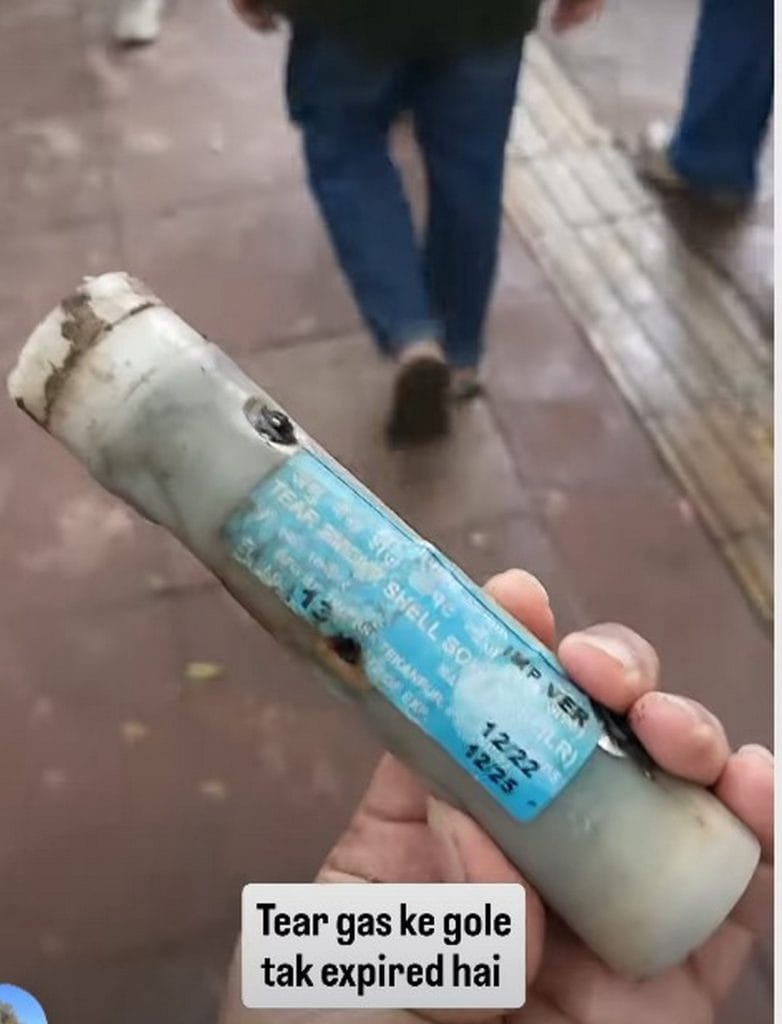
Finding common ground with the ‘enemy’ becomes a joke too. One sympathises with Pradhan: “I get it Dharmendra bhai, mere se bhi resign nahi ho paa raha” (I get it brother Dharmendra, even I’m unable to resign from my job). Cynicism is often mistaken for apathy when it is in fact an emotional response to repeated disappointment.
The self-awareness extends to the censor itself. On a reel captioned “Kahin main anti-national toh nahi (Am I perhaps an anti-national?)”, a top comment reads, in perfect mimicry of a moderation notice: “This comment was deleted by Narendra Modi.”
Beneath a video of protesters walking off with police riot shields repurposed as umbrellas, a commenter dryly notes that the protest is nowhere to be found on Instagram. The absence of coverage has itself become a joke. Meanwhile, viral clips of students schooling police officers on constitutional rights or carousels explaining the protections that protesters are entitled to teach more law than a semester of civics.
Even the Prime Minister has conceded the medium. This week, instead of the usual televised 8 pm DD address, there was a midnight reel, shot on a front camera. Within hours it was swallowed by ‘kuchu puchu’ edits—the viral AI baby-talk audio reserved for mocking over-the-top relationship drama. And here is the brutal arithmetic of the feed: a good number of Indians will never see the original address at all. They will meet their Prime Minister first, and perhaps only, as parody.
An archive of truth
Students have learnt from the playbook used to malign protesters during the anti-CAA-NRC and farmers’ protests. They now watch for the same tactics, share content to warn others and broadcast state violence in real time. They are documenting the reality of the protests before the state’s narrative engine twists it into something else. We have a live, functioning, crowdfunded record of what happened. Even the preparation is being archived: one creator films himself writing his parents’ phone numbers on his hand in mehendi before leaving for Jantar Mantar, in case he is detained.
This texture is mostly missing from the record of the anti-CAA-NRC winter. Those protests predated the format, so much of the absurdity and solidarity of that season survives only in the memories of those who were there. The brutality, speeches and state-sponsored violence are available in online archives; the humour of it is not.
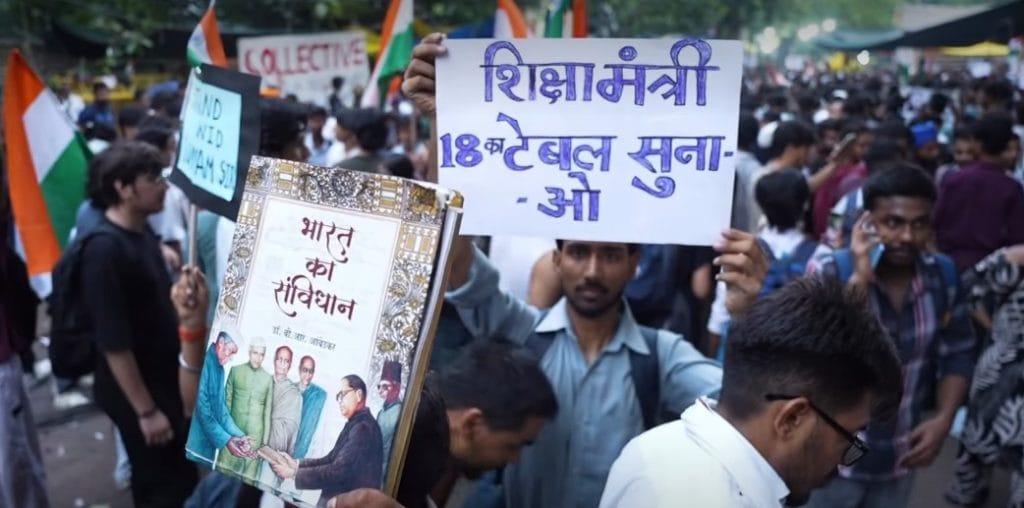
It makes you wonder how differently that winter might have played out with today’s distribution machine. If one day of state violence can generate this much noise, what would months of Shaheen Bagh have done?
Most of all, students today have captured and broadcast the helplessness of an ordinary citizen at scale. You can’t scroll past an aesthetic edit of state violence set against your favourite rage songs from Rockstar or Haider.
Social media solidarity has also come from students in Nepal and Bangladesh, who are sharing their own experiences and tips. This is not a global conspiracy to topple governments, but an understanding that across geographies, across eras, young people have always demanded one thing from their administrations: the hope and promise of a better future.
Also Read: Bhakti poetry for student protests. Marathi content creators reach for Tukaram, Janabai
Humour has limits—but Gen Z is serious
Laughter alone cannot force a resignation, and memes cannot supply rozi-roti. Plenty of the students filming these reels juggle gig shifts and long hours studying for the next competitive exam between marches. Visibility cuts both ways: every lathi charge broadcast live widens distrust of the state and invites global scrutiny, but it also raises the price of showing up. The state has a long memory and better lawyers. The past week has proved that the feed can make a movement impossible to ignore but it cannot, by itself, make a minister resign.
Then there is the mockery of the method. On the ground, some reporters asked protesters Koffee with Karan-esque questions: Do you know the full form of CBSE? Of NEET? The intention behind these questions, the disdain for this ‘unserious’ way of doing serious things, has been very evident.
But the events of the past few days show that there is some strength in being underestimated.
An entire generation accused of being unserious, lazy and entitled has turned the charge on its head. They play cricket against police barricades and ring “Parliament’s doorbell” before bolting. Sometimes, they use Strava stickers to map the chase. They walk through tear gas clouds, calling it not so bad—0% ethanol, after all—and remake songs: “Yeh Dilli Police hai yaar, bas ishq mohabbat maar” (This is Dilli Police, only love, love and beatings).
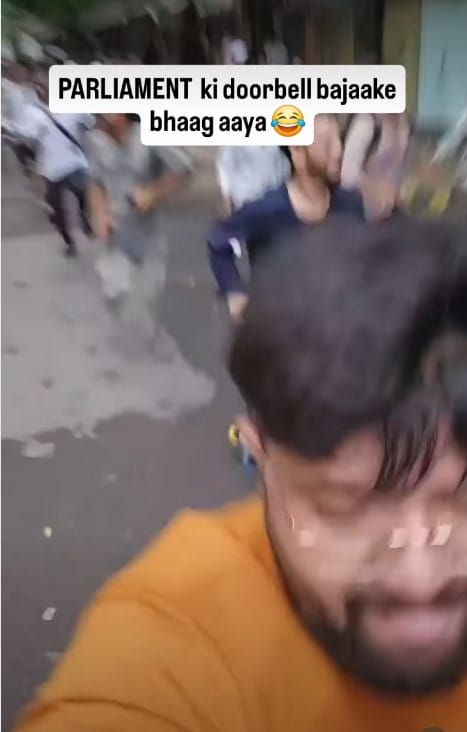
They put up facades of bravado. “Aaj tear gas mein usko yaad karke ro liya” (Got hit by tear gas, cried remembering her), reads one caption. Another declares: “Ya to aapka bhai Parliament mein milega, ya thaane mein milega” (You’ll either see your brother in Parliament today, or in jail)—the modern-day do-or-die call.
Classic Indian literary tropes of the scorned lover meet the internet’s yearning subculture in reels of injured students lying on the street, with captions such as “Itna toh usne bhi ignore nahi kiya tha” (Even she didn’t ignore me this badly) and “Ghosting culture is convenient until it’s your prime minister doing it.”
By contrasting mundane emotions against a dystopian setting, they melt away the fear that has gripped people.
The jester has survived because the jester adapts. This generation does the same. In a world that often dismisses them as frivolous, they have shown that humour can be revolutionary and that laughter can coexist with rage. History does not always change through solemn declarations or formal authority; sometimes, it changes through a joke piercing enough to reveal the truth underneath. The solidarity it builds comes from capturing the ridiculousness of it all.
Paint this generation with one brush at your own risk—they paint back, funnier, faster and in the trending font. But yaar, they are insanely funny. And their deadline stands: jaldi resignation de de, kal Panvel nikalna hai.
Shreya Kapoor is a Gen Z social media strategist who communicates climate change for a living, and is an alumna of IIT Gandhinagar’s Society and Culture Programme. She tweets @someotherkapoor and is on Instagram @justanotherkapoor. Views are personal.
(Edited by Asavari Singh)