






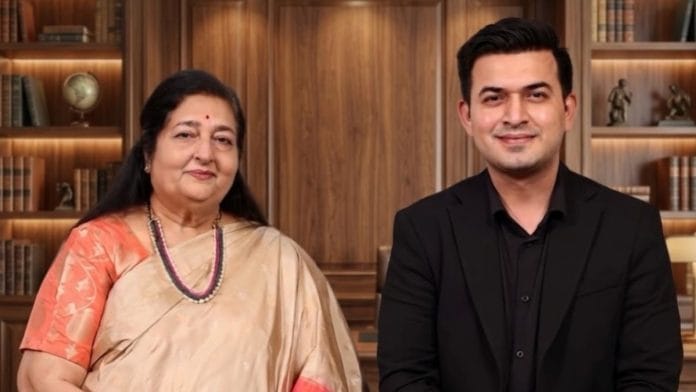


Anuradha Paudwal is finally having her moment in the sun. With Lata Mangeshkar and Asha Bhosle gone, she has no natural predators to worry about and can finally step out to voice her Very Important Opinions. And she has opted for a format weaponised by buffoons worldwide—the podcast.
“Marriage has lost its sanctity, barring maybe 1 per cent. Reason being, these new laws giving rights to homosexual people. How are they contributing to society, I would like to know,” she said in Hindi on YouTuber Shubhankar Mishra’s podcast.
After terrorising the stereo of my family’s Tata Indica throughout my childhood, the Bhajan Queen is now back to haunt my feed. And I’m having none of it—neither is the community.
“We bought your cassettes. We watched your films. We paid for your concerts. We helped build the audience that made countless artists successful. That, too, is contribution,” wrote activist Rudrani Chhetri in the caption to a recent reel on Paudwal.
Filmmaker Nakshatra Bhagwe argued along similar lines. “Before you started bhajan-kirtan, you sang in Bollywood. The directors, producers, people in the makeup and fashion industries—maximum of those people are from the LGBT community,” he said in Hindi in a reel posted Saturday.
Perhaps that is Paudwal’s wound. She had to quit Bollywood and pursue a career in devotional music, and now blames it on the queers who supposedly run the industry.
It’s our fault, guys. We hailed Bhosle as a queer icon, and now Paudwal is cross with us.
Most of the responses to Paudwal focused on the economic contributions of queer individuals. The argument has been made many times before: queer people are consumers, and hence a nation must foster a safe ecosystem for them if it wants to profit from the capital they will create and consume. But when gays and lesbians tie their everyday rights to productivity, they alienate some of their kin.
Such an exercise, wrote academic Rahul Rao, would “cleave potentially productive queers from those who are unable or unwilling to be productive within the terms set by the market—the unemployed and underemployed, the disabled, the aged, the Indigenous, the anticapitalist.”
Scholar Rey Chow calls it “placebo rights”—championed by capitalism but not by the State. Plus, this reliance on the market is what allows companies to invade Pride marches. (Not that that’s a major concern in the Trumpian economic order.)
I much prefer the route essayist and content creator Katyayini Saksham took. “I am hot. That is my contribution,” she commented on the Instagram reel posted by Yes, We Exist.
Also read: Queer protesters refuse to be a meme. Armed with painted nails & defiance
A second innings
More than anything, Paudwal’s comments are hilarious. She lives in an alternate reality where the Indian government isn’t despatching every tool at its disposal to marginalise queer lives. Even when the likes of Menaka Guruswamy perform the monogamy ideal when asking for same-sex marriage in court, they are rudely denied.
The poor singer is so confused, she bundled up homosexuality with a woman’s choice to have a child with a man who is not her husband.
“Some lady has a child not belonging to her husband, and then he becomes the father,” she mumbled along in the interview.
Not all is lost, however. Paudwal seems to be waking from her long slumber. She admitted during the interview that she isn’t entirely convinced that India’s Vishwaguru dream is realistic.
“Almost 93,000—or 93 lakh, I’m not sure—schools have closed down. So, what is the base for Vishwaguru?” she asked.
She has politely requested for a list of things that would make India Vishwaguru, so we may work on them. Paudwal is already an improvement on my three buas. They would happily dance at a gay wedding before uttering a word against the 2047 goal.
“You tell me, maybe I have missed a point,” she said magnanimously after dismissing the queer community as utpatang (illogical or absurd).
I would recommend Paudwal some sensitisation lessons from Zanai Bhosle, Asha Bhosle’s granddaughter, who collaborated with a trans band on a song in 2016. If that’s too much, there’s always bhajan-kirtan. And with bhajan clubbing picking up among the Gen Z, Paudwal may yet have a bright second innings, this time entirely unencumbered by more talented contemporaries.
Views are personal.
(Edited by Theres Sudeep)