






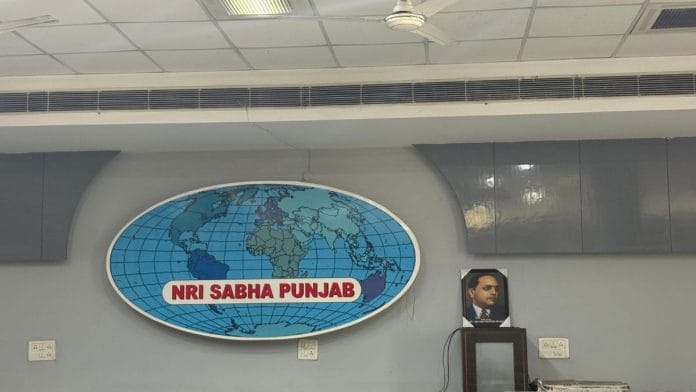



The Punjab NRI Sabha has seen an institutional decline over the years—empty presidencies, rigged elections, stonewalled RTI applications, and NRIs carrying armed guards while fighting land encroachment cases. But there is a structural impossibility at the heart of this failure.
The NRI Sabha is not a government department. It is a registered society under the Societies Registration Act, 1860—a private voluntary association with the Chief Minister and NRI Affairs Minister holding ceremonial positions. It has no legal powers, no enforcement capacity, and no constitutional mandate. Expecting it to deliver expedited justice is like expecting a residents’ welfare association to override municipal law.
Punjab has attempted administrative fixes. When NRIs applied for the partition of agricultural land, the process was shifted from the tehsildar to the District Revenue Officer, bypassing the lower rungs to expedite matters. But the appeals hierarchy remained unchanged. Partition orders still lingered. The bottleneck didn’t disappear; it merely shifted.
NRI police stations were established in 2008 to handle diaspora complaints. But they operate under the same CrPC and IPC as any other station. No special relief is available beyond what the law permits for any citizen. Procedural tweaks cannot override substantive law.
The real punishment often comes from the process itself. An NRI implicated in a criminal case—rightly or wrongly—immediately faces restrictions on leaving the country. Lookout circulars are issued. Bail hearings stretch on. The process becomes the penalty, with the accused trapped in India while livelihoods abroad collapse.
What cripples NRI Sabha
A proposal was floated during former chief minister Parkash Singh Badal’s tenure: Draft a comprehensive statute giving NRIs preferential classification in land partition, matrimonial disputes, and criminal procedure. The idea was to create a legislative framework that would genuinely differentiate diaspora cases and mandate expedited timelines.
It raised immediate objections, legal and political ones.
First, could a state legislature constitutionally create a special class of citizens based solely on residence status? Article 14 permits reasonable classification, but would preferential treatment for those who neither vote nor pay taxes in India survive judicial scrutiny?
Second, why should people with no ongoing stake in the state receive faster justice than ordinary Punjabis languishing in the same courts? Would this not create a superior class of “overseas citizens” in a republic that abolished princely privileges precisely to ensure equality?
The proposal died. And with it, any realistic prospect that the NRI Sabha could deliver on diaspora expectations.
Even as an advocacy body, the Sabha’s effectiveness is crippled by its legal form. A registered society can write letters, convene meetings, and shame departments into action. But it cannot compel a District Magistrate to prioritise a case, override bail conditions, or enforce timelines on revenue officials. It has no locus standi to intervene in litigation, no statutory right to demand action-taken reports, no power to escalate non-compliance.
A recent report in ThePrint notes that an RTI application seeking voter lists and financial records was denied, with the officials citing privacy exemptions. That is what one expects when a private society—not a public authority under the RTI Act—holds elections and collects funds. Transparency is courtesy, not a legal obligation.
The Sabha’s funding model has atrophied. Amendments to the Foreign Exchange Management Act (FEMA) and the Prevention of Money Laundering Act (PLMA) make it difficult to receive overseas contributions without regulatory entanglements. What remains is the default funding mechanism of Punjab politics: cash bags. Especially in Gram Panchayat-style elections for district units, this is the path of least resistance. It does not build institutional credibility.
Also read: What ails Punjab NRI Sabha today? It was the protector of the global Punjabi rights and roots
The choice Punjab refuses to make
The core issue is not leadership vacuums or rigged voter lists. Punjab wants the appearance of an NRI grievance redressal mechanism without the constitutional architecture to support one.
If the state believes that its 5-lakh-strong diaspora deserves expedited relief, it has two choices.
The first option is to draft a Punjab NRI Affairs Act, constituting a statutory commission with defined powers—authority to call for action-taken reports; right to set enforceable timelines; mandate to intervene in diaspora cases; and transparent, FEMA-compliant funding from the state budget.
This requires confronting the Article 14 question head-on. It means defending, in court and the Assembly, why NRIs merit a separate procedural track. It means answering the political charge that Punjab is creating a privileged class of absentee landowners.
The second option is to acknowledge that the Sabha is a legacy advocacy club—useful for networking and cultural events, but structurally incapable of delivering systemic relief. Rebrand it accordingly, and stop pretending it is quasi-governmental. Let NRIs know the same courts, police stations, and revenue officials who serve ordinary Punjabis will handle their cases on identical terms.
What Punjab cannot do—but continues to do—is maintain the current arrangement: a registered society with ceremonial patrons, no statutory powers, opaque finances, and a collapsing membership base, which is expected to function as a de facto arm of the state.
Also read: Where RBI and HDFC Bank went wrong in their response to Atanu Chakraborty’s exit
The human cost
The theatre continues because it serves everyone’s interests except the diaspora’s. For the state government, the Sabha provides plausible deniability: “We have an NRI body; take your complaints there.” For politicians, it offers diaspora outreach without budgetary commitment. For those controlling the Sabha, it provides social capital and access to a globally dispersed network.
But for the NRI whose land has been encroached, whose spouse has fled with dowry, whose bail application has been pending for eight months—the Sabha offers little beyond a file that circulates between departments with no binding force.
The recent report captures the human cost. California-based Mandeep Singh sold his truck and returned with armed guards to fight a land case. A family in Canada watched as caretakers occupied its Jalandhar home. These are not symptoms of poor leadership. They are predictable outcomes of a structural mismatch between institutional form and functional expectation.
If Punjab wants an effective NRI redressal mechanism, it must legislate one. The current model is governance by illusion. It wastes the diaspora’s time and erodes trust in Punjab’s institutions. The choice is legislative courage or honest retreat.
KBS Sidhu is a former IAS officer who retired as Special Chief Secretary, Punjab. He tweets @kbssidhu1961. Views are personal.
(Edited by Prasanna Bachchhav)
NRI Sabha is declared Public Authority under RTI Act. It currently operates under Government Control