





In January this year, retired Indian Army Major Khushboo Patani made a video showing women how to use pepper spray. Nine months later, she is recommending something heavier: an air gun.
It was in the aftermath of several cases of sexual assault against women, reported within a month. On 19 September, a teenager was assaulted in Bihar’s Jamui by a group of men. They also beat her friend and filmed the entire incident.
Patani posted a video demonstrating a CO2-powered air pistol and urged women to learn how to use one for self-defence. She advised training at a shooting range and said women should not depend on others for their safety.
For a long time, pepper spray has been one of the pocket-sized shields women are told to carry for their safety. Along with, of course, a fully charged phone, a friend on speed dial, a location shared with someone at home, keys between the knuckles, and sometimes a prayer under the breath at every unlit lane. From the pepper spray to an air pistol, what changed between Patani’s videos is less about the object in a woman’s hand and more about the gravity of the threat it is meant to answer. Whistle, spray, air pistol—with each new atrocious incident, the last object stops feeling enough.
Ever-growing safety checklist
Pepper spray is usually imagined as a way to buy a few seconds to escape. An air pistol, however, introduces the possibility of confronting the threat.
So, the fear is no longer simply of someone getting too close on a dark road, or a cab driver’s eyes lingering in the rear-view mirror. It is of being cornered and surrounded by multiple men, with nowhere to run. This situation, too, is not new, but the frequency of such incidents in recent weeks has made it feel uncomfortably closer to home, and perhaps that explains why the safety kit is getting an upgrade.
Meanwhile, the safety checklist keeps getting longer. Don’t walk alone at night, share your location, learn self-defence, avoid parks after 7 pm. And now, add an air pistol.
After the string of sexual assault and rape cases in Delhi NCR in the past few weeks, it is easy to see how we got here. What is harder to understand is why every new threat ends with women being handed one more weapon to carry, one more precaution to take, one more skill to learn.
And this time, the weapon being handed over is not available to everyone. Patani advises buying the air pistol from a legitimate dealer and training at a shooting range. Further, Glock-style CO2 air pistols are listed by Indian dealers at anywhere from roughly Rs 40,000 to Rs 80,000, depending on the model.
A woman who can afford the air pistol, find a legitimate dealer, and spend time training at a range is different from a middle-class schoolgirl returning from coaching, or a domestic worker travelling home after a late-night shift.
Women’s safety turns into what an individual woman can afford to do to protect herself.
Now the debate can easily get stuck on pepper spray or an air pistol, which one of them is more effective, and what women should carry. But we are arguing over the contents of a handbag as though that is where the solution lies. It doesn’t, and it never was. The burden primarily belongs with the men who attack women and the system that lets them.
It also lies in the unlit streets, the last bus home, and the deserted parks that women pass through.
After the 2012 Delhi bus gang rape and murder case, the public conversation was about buses, streetlights, policing, faster investigations, accountability, and whether women could move through public spaces without calculating the risks first. Those demands haven’t gone away.
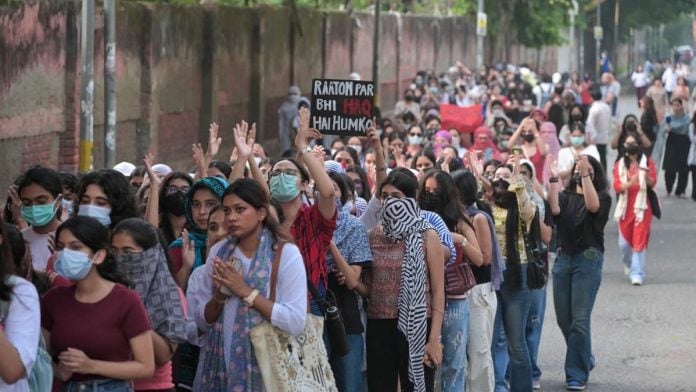
After the Kalkaji gang rape case on 21 September, Delhi University students have led massive campus protests, demanding much of the same things: safer public spaces and an end to the harassment and restrictions that shape their days.
Also read: India’s outrage over rape now comes with an ‘ideal victim’ checklist
Prepare for danger
Whether it is pepper spray, a martial arts class, a well-practised escape plan, or a Glock 17 air pistol, the skill has value.
But there is a strange endpoint to a society where the answer to an unsafe street is that every woman should learn to shoot. The question stops being “Why isn’t this street safe?” and becomes “Why didn’t you carry something to protect yourself?”
We have already normalised the pepper spray in the handbag, and perhaps the air pistol is next, understandably. But if women are now expected to think like armed guards before they can think like students, commuters, friends or simply people going home, the problem isn’t that women need upgraded weapons.
We have just become far too comfortable asking women to prepare for violence instead of asking why they should have to prepare for it at all.
Views are personal.