




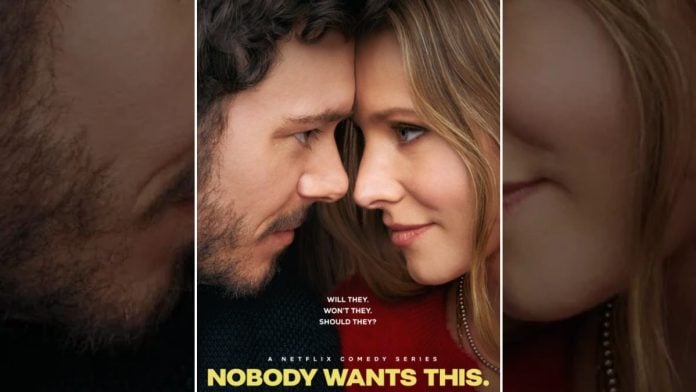

Adam Brody has spent three seasons playing a rabbi on Nobody Wants This. Last month, he told GQ exactly where he stands on Israel and Gaza.
“Put me down as thinking it’s a genocide. Put me down as wanting a free Palestine,” he said.
The response from people associated with the show was immediate.
Rabbi Steve Leder, who advised the first season and helped Brody prepare to play Noah, called him a “relatively ignorant Jew” and said his comments were “shocking” and “disgusting”. Tovah Feldshuh, who plays Noah’s mother Bina, strongly rejected his use of the word genocide. Creator Erin Foster said she loved Brody but disagreed with him.
Suddenly, the argument that Nobody Wants This has spent three seasons keeping outside the frame is playing out all around it.
Foster has repeatedly called the Netflix series a “love letter to Judaism”. She has also been equally clear that Israel and Palestine are deliberately kept out of its story.
“We never say Israel or Palestine in the show, and that’s intentional,” she has said, arguing that bringing the conflict into the series would be a distraction and that this is simply not the show to tell that story.
That might work if Judaism were incidental to Nobody Wants This. It isn’t.
Noah is a rabbi. His family’s Jewishness drives much of the central story. We see Shabbat dinners, temples, rabbis, holidays and arguments over whether Noah can build a life with a non-Jewish woman. By season three, Joanne is taking classes in Judaism and eventually converts.
The show spends three seasons introducing Joanne, and by extension the viewer, to Judaism. She finds community, traditions and a sense of belonging in it. By the end, she isn’t just choosing Noah. She is choosing the religion too.
There is nothing wrong with that. Foster converted herself, and the show is partly inspired by her own experience. If she wants to write a love letter to the religion she chose, she should.
But that love letter is glaringly incomplete.
Also read: Janhvi Kapoor speaks for the girls who just want a champi, a kaftan and no male gaze
A love letter with limits
In contemporary life, conversations about Jewish identity are often inseparable from conversations about Israel. That does not make Judaism and the Israeli state the same thing, nor does it mean Jewish people agree on Israel.
The cast and crew of Nobody Wants This make that obvious.
Brody thinks Israel is committing genocide in Gaza. Leder thinks Brody is wrong. Feldshuh has fiercely defended Israel. Foster disagrees with Brody but says disagreement is fine.
That disagreement is precisely the point. Israel is already part of arguments about Jewish identity, Zionism, antisemitism, the Holocaust and Jewish safety. Treating it as a separate conversation does not make it one.
Nobody Wants This first arrived in September 2024, nearly a year after the 7 October Hamas attacks and the beginning of the war in Gaza. This was not a series made in a different political moment and later overtaken by world events. It was created as the war was unfolding.
And yet, for three seasons, the show has been happy to give us the parts of contemporary Jewish life that fit neatly inside a romantic comedy.
The food. The family. Faith. Weddings. Traditions. Belonging.
Israel stays off-screen.
That is where the “love letter” starts looking like an advertisement. If the series is going to spend three seasons showing us why Joanne falls in love with Judaism, it cannot also suggest that one of the most consequential and contested questions surrounding Jewish identity today belongs somewhere else.
Especially when it clearly doesn’t.
Foster recently defended the disagreement around Brody by saying the set was similar to “dinner tables around the world”, where people debate and disagree with each other.
Exactly.
That argument is on her set. It is between the creator, the star, his on-screen mother and the rabbi who helped make the show’s Judaism feel authentic.
The only place it apparently does not belong is around the Roklovs’ Shabbat dinner table
(Edited by Raunaq Lekhi)