






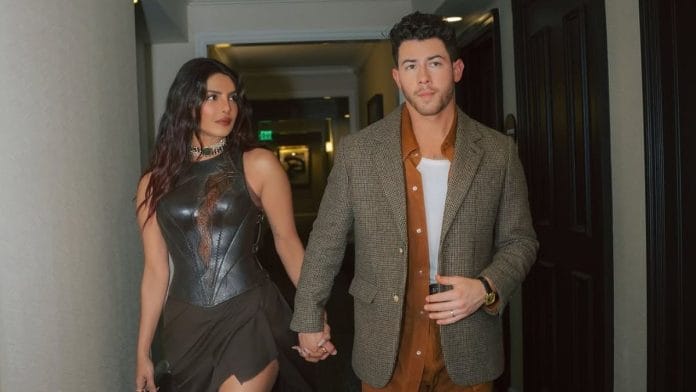



A black-and-gold beaded bracelet flashed on screen as American popstar Nick Jonas mixed a drink to promote The Bluff, the upcoming film starring his wife Priyanka Chopra. The fleeting frame featured a familiar object in an unfamiliar place: a mangalsutra on a man’s wrist.
The internet approved instantly. For the nth time, fans christened him a green forest. Their favourite ‘jiju’ had done it again.
The affection is not misplaced. Over the years, Jonas has cultivated a public presence that rests on visible partnership. He dances to his wife’s songs, champions her projects without any disclaimers, and appears entirely unthreatened by her stature and success. In a celebrity culture that often applauds men for the bare minimum, public admiration can look extraordinary.
But what made the mangalsutra linger was not just romance.
In India, marriage has traditionally been announced on a woman’s body. Vermillion in the hair parting, mangalsutra around the neck, coloured bangles, toe rings—the vocabulary is extensive. These markers serve as social signals; they communicate belonging, sexual boundaries, and ‘availability’. They reassure families and inform strangers.
Men, in contrast, often move unmarked.
A married man, even without his ring, invites little scrutiny. But a married woman without visible symbols often invites intrusive questions. “You’re married? But you don’t wear…?” The sentence trails off, but the expectation is voiced loud and clear: marriage should show, and it should show on a woman.
This asymmetry is what makes Jonas’ mangalsutra subversive.
Also read: Everyone’s ‘damaged’ in modern dating. Love will soon be called a mental illness
Unsettling the hierarchy
Over the past two decades in India, the mangalsutra arrangement has been renegotiated, particularly in urban areas. Many women have redefined how, if at all, they wear these symbols. Some reserve the mangalsutra for occasions; some replace it with minimalist designs. Some never wear sindoor. The choice may be aesthetic, practical, professional, or ideologjcal and yet the societal commentary persists. A woman’s body remains a site of cultural audit.
And in many Western contexts, wedding rings operate as mutual signifiers. The symbolism is shared, even if not equally policed.
Against this backdrop, a White male celebrity choosing to wear a symbol historically imposed on women unsettles the hierarchy.
To be clear, Nick is not the first or the only one to embody equal partnership. There are countless Indian men who wear wedding rings, introduce their wives without possessive bravado, take pride in their achievements, and share domestic labour. They don’t want marital markers and surname changes.
Times are changing, but the widespread applause to Jonas’ gesture reveals how unusual and rare this still feels.
It reads as respect, even validation, for many. But there is an uncomfortable truth: when a man voluntarily adopts a symbol long expected of women, it appears progressive. When women are expected to bear it, it is tradition. The difference lies in choice.
The mangalsutra itself is not inherently oppressive or liberating. For some women, it signifies love and tradition. For others, it is an obligation gradually shed. Jonas is not trying to modernise the mangalsutra, but his gesture shows that choices can be equal. And if commitment must be flaunted, it need not be gendered.
None of this diminishes the sweetness of the gesture. Romance and social commentary are not mutually exclusive. But it does expose the structure clearly.
For centuries, marriage in India has been something women wore and men assumed. Jonas’ bracelet cannot dismantle that history. But for a moment, it reversed the sentence.
(Edited by Prasanna Bachchhav)