




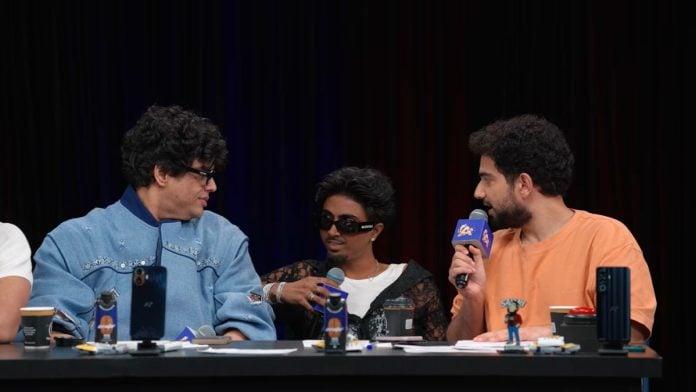

Rapper MC Stan, during a recent episode of India’s Got Latent, asked a female rapper: “Why are Indian female rappers always in the mood of revolution? There is so much anger in them. You can write about other things like bhande, bartan (utensils).” For all his fame and talent, Stan could do with a lesson in rap history, and in why women have every reason to be angry.
Rap was never meant to be calming or relaxing music. It is a genre built on aggression, confrontation, boasting and rebellion, a way for artists to tell the world what it has done to them.
Rap emerged in the Bronx, New York, in the 1970s, giving African-American and Latino communities a way to narrate their realities, confront racial inequality and push back against a system that systematically ignored and oppressed them. Anger, defiance and confrontation were central to rap long before it became a global commercial force.
From NWA’s unflinching accounts of police brutality to Tupac Shakur’s meditations on poverty, violence and injustice, rappers have used fury as both protest and performance. Women, too, have always been part of this tradition. Artists such as Queen Latifah, MC Lyte and Roxanne Shanté challenged sexism within hip-hop, while Lauryn Hill, Missy Elliott and later Nicki Minaj used their music to assert autonomy, ambition and power.
Rap gives people a language for their circumstances. Sometimes it is political. Sometimes it is vulgar. Sometimes it is petty. And sometimes, it is all of these things at once.
So when anger comes from women, it invites a different kind of scrutiny—including, in this case, from a fellow rapper who ought to know where the rage originates.
Stan’s own music is hardly an exercise in restraint. He has built an artistic identity around his experiences of struggle, drawing on his upbringing in Pune, street culture, material ambition, personal rivalries and the desire to establish himself in a world that does not make room for everyone. His songs are often aggressive, abrasive and deliberately confrontational.
Tracks such as Tadipaar, Khuja Mat and Basti Ka Hasti are marked by brash boasts, taunts and abusive language. In “307”, he calls a rival a “label ka kutta”. In “Bitch”, he uses a gendered slur while airing his grievances against an ex. His lyrics often turn conflict into performance, with anger serving as both subject and style.
That aggression is part of the persona he has built. His music speaks of the need to prove himself, of being underestimated, of rivalry and of the rewards that come with success. He has made a career out of turning his struggles and resentments into music. There is nothing inherently wrong with that. But it makes his question to women rappers all the more curious.
Why is anger an acceptable expression of male rap, but something women have to explain?
For many women in rap, anger has been a response to being silenced, sexualised or expected to make themselves palatable in a genre that has long celebrated male aggression. Why should a woman rapper be expected to leave her own experiences out of her music? For women in India, these experiences can include abusive marriages, the policing of their clothes, harassment, inequality, double standards around infidelity and the unpaid labour of running a household.
Indian women rappers have every right to be angry about whatever they choose to be angry about — and to rap about it. Rap has never imposed limits on whose rage belongs in its verses. So when Sharlane Menezes, the rapper who appeared on India’s Got Latent, rapped about her hustle and ambitions, and said she did not want to be the girl in the kitchen, it was hardly an invitation for Stan to question the subject of her music.
Are men the main character?
Rapper Sharlane Menezes did little to invite the kind of scrutiny Stan directed at her. But her appearance also brings up a pattern worth examining in Indian reality rap shows and the music emerging from them: women rappers often seem to be writing about men, relationships and heartbreak, sometimes at the expense of the many other experiences that could shape their music.
At least in the most visible corners of the scene, the genre risks becoming a repetitive argument about men, leaving little room for women to explore everything else that makes them who they are.
This is not a problem unique to Indian hip-hop. International stars such as Cardi B and Nicki Minaj are hardly strangers to songs about men, sex, betrayal, rivalry or the politics of desire. Their music often draws from the worlds they inhabit, including relationships, ambition and sexual autonomy, as well as the business of being a woman in an industry that is quite comfortable selling female sexuality but less comfortable with women controlling it.
There is, however, a difference between making men the subject of a song and making them the centre of your artistic universe. If every other track is about an unfaithful ex, a useless boyfriend, a man who cannot handle a successful woman or a generalised indictment of the male species, listeners can begin to wonder what else is happening in the artist’s world.
There are women who cannot leave abusive homes, women who are expected to abandon their careers after marriage, women who are financially dependent on their families, women who face discrimination because of their caste or class, and women whose sexuality is scrutinised by everyone from relatives to strangers on the internet.
The point is not that women rappers must speak for all women or turn every song into a social statement. Nor should they be expected to make music that is always serious, political or instructive. The question is whether they are exploring the full range of their experiences, rather than returning to the same handful of subjects.
Something like what rapper Raja Kumari has been doing. In Rani Cypher, featuring Dee MC, SIRI and Meba Ofilia, the subject is not a man. The track is about women carving out space in an industry that has historically marginalised them. It speaks of ambition, self-worth and solidarity, challenging the idea that women must compete for a seat at the table.
In I’m a Rebel, Raja Kumari turns her attention to the social expectations that dictate how women should behave. These are stories about womanhood that do not need a man at their centre.
Also read: Janhvi Kapoor took responsibility for Peddi. The makers must too
Good lyricism has gone missing
Raja Kumari broke into Indian hip-hop in 2016, when she performed at NH7 Weekender in Pune and released her debut EP, The Come Up. Since then, she has helped create a visible space for women in a genre that has historically celebrated male artists.
Her work has also drawn on her Indian-American identity, cultural heritage and the experience of moving between worlds. In Mute, Raja Kumari addresses cultural stereotyping and the frustration of being misunderstood. In an interview with Hindustan Times, she discussed how people embrace Indian symbols such as the bindi while often ignoring the culture and people behind them. The song offers a way to discuss identity, prejudice and the anger of being reduced to a stereotype.
Then there is her track Goddess, which Raja Kumari has described as a battle anthem intended to remind women of the warriors within themselves.
The Grammy-nominated rapper has made an Indian woman occupy a hip-hop stage without having to imitate a male rapper’s idea of toughness. She brings her cultural identity into her music while remaining unapologetically ambitious about her place in the global industry.
But opening a door is only the beginning.
Consider Hustle, the five-season rap competition that has aired on MTV and is available on JioHotstar. Women have remained a small minority among its contestants, with only one or two female rappers featuring in a season at most. No woman has won the competition so far. The question is not simply one of representation, but also of the space and support women get to develop their craft.
And representation alone cannot make up for weak writing. Rap needs more than a forceful delivery or a collection of broad statements. Good lyricism requires specificity, metaphors, rhyme schemes, wordplay and structure. Anger can give a song its energy, but it cannot do the work of writing by itself.
There are exceptions, from Pho’s Jaadu and Mrunal Shankar’s Albela Sajan to Agsy’s Janani and Shrusti Tawde’s Chill Kinda Guy. These tracks show that women in Indian rap are capable of exploring different sounds, moods and subjects. Not every song needs to be rooted in anger or speak directly to the challenges women face.
A woman can be furious about sexism and still write a tender song about missing her mother. She can challenge marriage and write a love song. She can celebrate sexual freedom, be politically conscious or make a fun commercial banger. She should be free to make frivolous music that boasts, flirts, brags, swears and provokes, too.
The freedom to be angry should not become another box women rappers are expected to fit into. The point is not to replace one set of expectations with another, but to let them write about whatever they want, without being told that their anger is excessive, or that their lives are only worth rapping about when men are involved.
Views are personal.
(Edited by Raunaq Lekhi)