






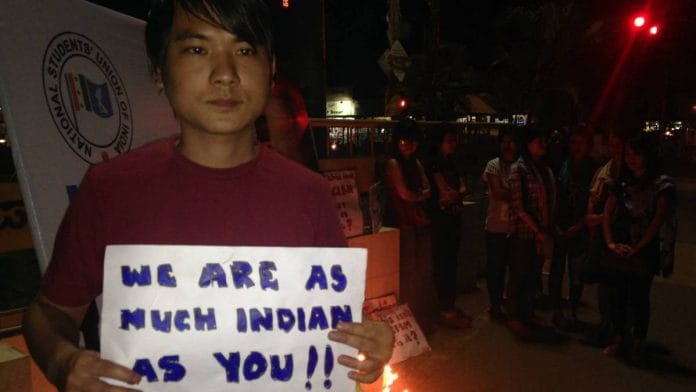



On 22 February, three young women from Arunachal Pradesh and Manipur were subjected to all kinds of racial slurs, abuse and threats by a couple in Delhi’s Malviya Nagar. The reason? While installing an AC on their third floor rented apartment, debris fell on the floor below.
It was enough for the couple to unleash a barrage of hatred and the usual ‘you don’t know who my dad is’.
It’s another example of how Northeast Indians remain on the fringe.
North Indians are excited to eat at the ‘cool’ places in Humayunpur—the Northeast hub of Delhi—or get trendy haircuts and nails at salons run by migrants from the region. But when any inconvenience occurs, even the most minor one, it’s back to racial slurs. It ranges from calling people from the region Nepali, Chinese or “parlour wali”. A major chunk of gig workers from Northeast, do work as masseuse, or stylists. But the profession has now been turned into an insult, an insinuation of sex work.
The same momo Delhiites cannot get enough of, will be used as insults and hurled at people from Northeast. But momo is not a traditional dish from the Northeast. Its origins are Nepali and Tibetan. Of course, people from the Northeast enjoy it too, but it is yet again, an instance of clubbing everyone together.
Also read: DU’s Northeast students’ union fought prejudice with politics—now it’s pulling back at a price
The ‘exotic other’
Racism toward people from Northeast is a constant no matter what you look like. If one looks too ‘mainstream’, the question is, ‘why are your eyes not small and hair not straight?’. If one has Mongoloid features, the terms used are ‘Chinki’ or Chinese.
There is simply no escape from the racial profiling.
Delhi has possibly the biggest concentration of young people from the Northeast, who come to the city both to study and work.
With decades of insurgency, lack of adequate number of higher education institutions, young men and women from Northeast travel all the way to Delhi. The subsidised fees and sheer number of colleges under Delhi University has always been a strong attraction for parents.
The rent in Delhi and its suburbs are also relatively affordable compared to other metro cities, adding to the appeal.
One would think decades of migration from Northeast in Delhi, the recent craze for food from the region and even OTT shows like Paatal Lok (2025) and The Family Man (2025) or even the film Axone (2020) would have sensitised Delhiites.
One could not be more wrong.
Northeast is still the exotic other—a must visit on the travel itinerary, but not good enough to respect. Making jokes about eating dog meat to headhunting is still very much a prevalent trend.
Any ‘acceptance’ is merely on the surface level, constantly bubbling over and creating headlines.
From spitting at a woman after calling her Corona during the Covid-19 pandemic. to asking women partying at Hauz Khas Village their ‘rates’—racism forms the fabric of the city. Women are immediately seen as ‘loose’ or ‘available’ for their jobs or sartorial choices, and men are mocked for their appearance. One instance even led to the death of Nido Tania, a young man from Arunachal Pradesh in 2014. He was first mocked for his hairstyle, before being beaten with rods. More recently, a 24-year-old MBA student from Tripura, Anjel Chakma, died in Dehradun, after being racially profiled and attacked.
Racism is a problem for privileged mainlanders only when it’s meted out to them abroad. In their own backyard, it’s normalised as “I was just kidding. Chill yaar”.
Views are personal.
(Edited by Theres Sudeep)
Very unfortunate. Kashmiri Muslims too face discrimination, sometimes violence, in other parts of the country. It is not just the land that is one, indivisible. It is the people as well.
There is no defence of an issue like this one. None.
However, Das stops exactly where the article should begin. She documents the wound, points to the guilty party, and exits. That is not analysis. That is a grievance filed and forgotten — useful for a moment of outrage, useless for lasting change.
Racism against Northeast Indians is not simply a story of mainland bigots. It is the predictable outcome of decades of geographic isolation, political neglect, and mutual unfamiliarity — a failure of the Indian state to weave its northeastern citizens into the national fabric.
For most of independent India’s history, the Northeast remained physically and culturally cut off from the rest of the country. Congress governments, for all their rhetoric of unity, left the region chronically underdeveloped and infrastructurally starved. The result: two populations growing up with almost no organic interaction, no shared cultural references beyond a passport and a flag.
Improved connectivity and economic opportunity have now changed that. Northeast Indians are moving to Delhi, Bangalore, Mumbai. That is a good thing. But visibility without familiarity is a recipe for friction. When people encounter those they do not know — whose features, food, language, and customs are genuinely different — suspicion fills the void that knowledge should occupy.
This is not unique to India. After 9/11, Sikh men in the United States were beaten and in some cases killed — mistaken for Taliban because of their turbans. In the so-called first world, ignorance translated directly into violence. The mechanism is identical: unfamiliarity breeds fear, fear breeds hostility, and hostility needs only a small trigger to ignite.
The couple in Malviya Nagar did not need a sophisticated ideology to do what they did. They needed only the absence of a reason not to.
Appearance Is Not Prejudice — Targeting Is.
It is also worth saying plainly what Das conflates: noticing that someone looks like they may be from the Northeast is not the same as abusing them for it. Humans read identity cues — appearance, accent, clothing, manner — as naturally as they breathe. A Tamilian in Lucknow, a Kashmiri in Chennai, a Punjabi in Kolkata: all identifiable by various markers, all carrying an identity that precedes their introduction. That is not racism. That is the texture of a diverse country.
Racism begins when that recognition becomes a hierarchy — when ‘you look different’ becomes ‘you are lesser,’ when curiosity curdles into contempt. The incident Das describes is the latter, without question. But conflating all identity-reading with prejudice muddies the diagnosis and makes the remedy harder to prescribe.
Das offers no solutions oversll. That is the article’s central failure. Here is what the conversation should actually be about.
The government must invest in cultural integration — not tokenism, but sustained, structured exposure. School curricula should reflect the full geography of India, including the Northeast. National media should tell Northeast stories routinely, not only when there is an atrocity to report. Cultural exchange programs between states should be funded and scaled.
Bharatiyata — the sense of shared Indian identity — cannot be decreed from above. It has to be built through familiarity, through the ordinary experience of living, studying, and working alongside one another. That requires deliberate policy, not just slogans.
Anti-discrimination enforcement must be strengthened. The legal architecture exists but is poorly enforced. When racial abuse is documented and reported, it must be prosecuted visibly enough to register as a deterrent.
And — this is rarely said — the responsibility is not one-directional. As Northeast Indians gain greater presence in Indian metros, there is value in both communities making the effort to know each other. That is not asking victims to bear the burden of their own mistreatment. It is asking for a two-way bridge rather than a one-way accusation.
Articles like Das’s serve a purpose: they keep the issue alive in public conversation. That is not nothing. But public memory is short, and outrage without direction dissipates fast. The couple in Malviya Nagar will be forgotten in a week. The structural conditions that produced them will remain.
Racism against Northeast Indians is a multi-layered problem rooted in history, geography, and policy failure. It will not be solved by periodic condemnation, however justified. It requires the kind of sustained, unglamorous institutional work that no single op-ed can do alone.
Name the wound, by all means. But then pick up the tools to close it.