






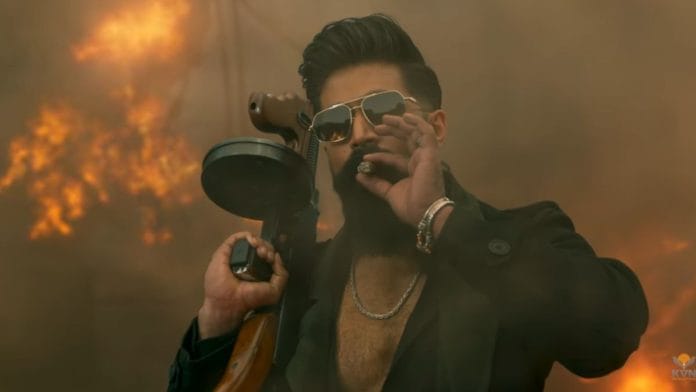


Once upon a time, an Indian film could survive without someone punching a truck.
A hero could have a terrible job, a complicated relationship, overbearing parents, three useless friends, and an existential crisis arriving precisely before lunch. He could spend two-and-a-half hours figuring out love, friendship, or what exactly he wanted to do with his life.
And audiences would happily watch.
Today, the hero has slightly bigger problems. He must save civilisation. Preferably while flying. In slow motion. With a thunderstorm behind him.
Welcome to Indian cinema’s age of spectacle, where mythology, superheroes, VFX, and gravity-defying action are the essential ingredients of a blockbuster. Bollywood has embraced the grand visual experiment with films such as Brahmāstra, Adipurush and Kalki 2898 AD. Upcoming projects such as Ramayana and Varanasi promise even more scale. Telugu cinema, meanwhile, has turned larger-than-life action into a formidable commercial language through films such as RRR, Toxic, Salaar and Pushpa.
There is nothing inherently wrong with any of this. Let filmmakers build impossible worlds. Let heroes leap across buildings. Let VFX artists make mountains explode, if that is what the story demands. The problem begins when every story starts demanding that a mountain explode.
Remember when people simply talked? The beauty of many mainstream Indian films from the 2000s and early 2010s was that characters had problems that did not require a military budget. Jab We Met (2007) was about two strangers whose lives had gone gloriously off track.
Wake Up Sid (2009) was about a young man discovering that adulthood was considerably less glamorous than he had imagined. Jaane Tu… Ya Jaane Na (2008) understood the delicious confusion between friendship and love. Band Baaja Baaraat (2010) turned wedding planning into a combustible mixture of ambition, friendship, and romance.
Then came Piku (2015), Queen (2014), Kapoor & Sons (2016), The Lunchbox (2013), Bareilly Ki Barfi (2017) and Zindagi Na Milegi Dobara (2011)—films that found drama in families, friendships, careers, loneliness, and the deeply inconvenient business of growing up.
Nobody had to save the universe. These films relied on character, dialogue and emotional stakes. Their worlds were recognisable. Their people were messy.
Imagine pitching The Lunchbox to a contemporary action franchise executive: “A lunchbox reaches the wrong person and two lonely people begin communicating.”
“Excellent. Who is the villain?”
“There isn’t one.”
“Can the lunchbox explode?”
The side dish-ification of romance
The appetite for spectacle is understandable. Technology has transformed what Indian filmmakers can put on the screen. Audiences, too, have become accustomed to global-scale visuals, and theatrical cinema increasingly needs to offer an experience that feels worth leaving the sofa, putting down the phone, and paying for popcorn at criminally inflated prices. Indian filmmakers have also earned plenty of applause for pushing those boundaries. RRR demonstrated how flamboyant action could become a global calling card.
But spectacle has an unfortunate habit of making everything else look small. As a consequence, romance has lost prime real estate. Today, the mainstream male star is far more likely to be handed a rifle than a love letter.
Have audiences stopped caring about romance, or has cinema stopped giving them enough versions of it? The excitement around Imran Khan’s confirmed acting comeback after a decade, with Netflix’s Adhoore Hum Adhoore Tum, is a reminder of that appetite.
Of course, Hollywood is hardly a monastery of quiet cinema. It has superhero franchises where the destruction budget could probably finance several small economies. But it has also retained room for films where the biggest catastrophe is an engagement gone wrong. A24’s The Drama, starring Zendaya and Robert Pattinson, centres on an engaged couple whose relationship is tested before their wedding. People We Meet on Vacation turns the familiar friends-to-lovers equation into a full romantic comedy.
Voicemails for Isabelle similarly builds its premise around an unexpected emotional connection.
Then there are films such as Past Lives, The Holdovers and A Real Pain, which prove that character-driven stories can create conversation without requiring the earth to split open in the third act.
Hollywood understands the value of a buffet.
In India, though, it seems that ordering a rom-com after an action blockbuster would cause a nationwide shortage of testosterone. The industry must rediscover the middle ground where films can be theatrical without costing a fortune and stories can be ambitious without being apocalyptic.
The audience has already seen men fight armies, gods, monsters, and gravity. Perhaps it is time to give them something truly radical: Two people, one room, a conversation. And, for once, nobody has to save the world.
Views are personal.
(Edited by Prasanna Bachchhav)