








But she is a problematic person, yaar.”
“And a great writer. Let’s go for that.”
“You cannot separate the two. We are not going for the launch.”
So went an eavesdropped conversation on the Delhi Metro, and it does seem to complement the socio-political mood of the day in India (and around the world).
Certain individuals—and by extension, their work—are deemed invalid from the get-go by self-anointed jurists of morality. “Cancellation”—of their work, life, experiences, and entire being —is therefore not only just, but also necessary to preserve the moral order of our spaces: Schools, universities, the arts, and culture.
I did my MA from IIT Gandhinagar, which, apart from being one of the most sought-after institutions for technical learning, also offers a uniquely curated Masters in Society and Culture. One would have expected its campus to be a sanctuary that allowed for free thought to prosper, with young minds marrying their sharpness with a receptiveness that is so needed for brilliance. That, sadly, wasn’t always the case.
It was common for the otherwise exceptional student community to cherry-pick guest talks, book launches, performances, and even electives, based on the problematic-ness of the person involved. The subject of the book, discussion, play, or even course often became secondary: The alleged politics of the individual took centre stage.
A talk by historian Manu Pillai would be a no-go zone for some. For others, an elective offered by scholar Michel Danino would have to be rejected, preferably discarded. A book launch by a decorated former faculty witnessed footfall that rivaled the box-office run of Bombay Velvet, because it “celebrates Vedic culture”. The common thread passing through them all? They were too “problematic” for either of the two fringes.
In the 2010s, works of scholar AK Ramanujan were removed from Delhi University’s syllabus for undergraduates, because some of them “hurt sentiments”—his seminal Three Hundred Ramayanas explores the diversity in the epic’s narratives across South and South-East Asia, which is seen to be a challenge to dominant, established narratives. More recently, a conservative scholar known to me received no backing from his previous employers in the middle of a raging controversy, despite his academic credentials never being doubted. He has a history of ideological disagreements with them.
Also read: Ranveer Allahbadia fought Left cancel culture. And yet, the Right came after him
A minefield
Even after stepping out of the hallowed portals of my alma-mater, this phenomenon continues to haunt me.
You cannot say you listen to Led Zeppelin without a routine reminder of the band’s deplorable antics off stage – most notably members’ underage relationships, stories of other sexual misconduct, and fascination with the occult. These, of course, should be condemned. But that does not take away from the fact that they produced some iconic music.
You cannot say that you like Timothee Chalamet because that means you are disrespectful to the opera and ballet communities.
Lunch at work frequently becomes a minefield. Canonical works are discarded because of what their author allegedly said centuries ago. Legendary filmmakers do not deserve to have an audience because of a tweet they liked a decade ago. The body of work is an irrelevant prick in the face of an opinion fixated upon by the morality jurists of the times.
The phenomenon’s worst manifestations include the entire purging of the “problematic” person and their body of work from public consciousness. But there are also subtler forms, which are often the starting point of the process of erasure: The cancellation of talk here, the refusal to rent out a venue for a book launch there, and a disdain and disinterest in case the event manages to overcome the earlier hurdles.
What is most disheartening in all of this is how much richer our discourse, both personal and public, would be if only we had an openness to thought and the willingness to consume without judging the value that they deserve. Great ideas can emerge from anywhere – even from people we do not agree with on other accounts. Does that mean we starve ourselves intellectually to appease a self-imposed, distorted sense of morality? I do not think so.
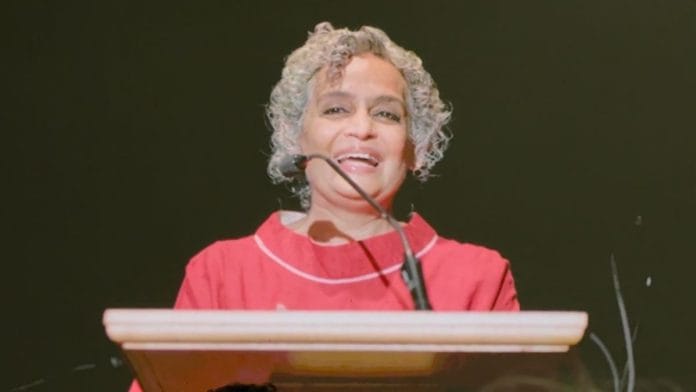
The God of Small Things was thoroughly enjoyable: Gut-wrenching and magical at the same time. It managed to paint my cerebral cortex in a glitter few other works have. Does that mean I agree with Arundhati Roy’s position on Kashmir? No.
But here’s an idea. For the world’s morality jurists, there could be a way out.
Also read: The pleasure of watching an Instagram downfall and cancel culture
The death of the author
Cancel Culture is passe. It’s time to engage with what (who) you abhor. This is not just me saying it: Some of humankind’s greatest thinkers have said it over the centuries. It just needs some repackaging for current times.
In his seminal essay The Death of the Author (1967), French critic Roland Barthes tells us that once a text is produced, it no longer belongs to the author, or “scriptor”. The death of the author is accompanied by the birth of the reader. The text is an entity separate from the author. There is no context. There is no intention. The text is what the reader makes of it. It is an individual’s relationship with the text that makes it endure.
Jacques Derrida, in equally monumental Signature, Event, Context (1971), also follows a similar vein. He dismantles the traditional idea that writing simply transmits an author’s intended meaning. Instead, Derrida argues that words are fundamentally “iterable”: That a written mark can always be detached from its original context, and repeated in new, unforeseen situations. Because a text (this can extend to any creative act), through its very nature, ends up out-surviving its author, its meaning cannot be confined within an intention, context, or even ideology. Therefore, every time you send a text, speak a sentence, or sign a document, you are putting a mark out into the world that is completely open to being repeated, reinterpreted, and used in ways you never intended.
So, one can read a book, watch a play or a movie, listen to an album and pick a course without necessarily endorsing the writer, filmmaker, musician or teacher’s views. In fact, one can even discover them in a completely new light.
The recent box-office success of Michael also teaches us a thing or two. Having grossed in excess of $845 million globally, it has emerged as one of the most successful music biopics of all time. All seems to be more than well in the world of Michael Jackson fandom. But here is the catch. This is the same man who has divided opinions like no other. Yes, he made an entire generation sway to his tunes. He was the cultural icon of his times, oozing oomph and chutzpah in measure never seen before. But a quarter century of damning allegations of pedophilia swayed some fans equally far the other way too.
Yet, as Michael’s numbers show, the fandom endures. What explains this phenomenon? Does his deplorable personal life not affect the faithful? Perhaps, it is because Jackson’s fans know how to separate the art from the artist. Whether this was always the case, or it is something that has been acquired over the decades, one will never know. We know one thing, though. Jackson fans tread the tightrope better than most others. They tell us that it is possible to like music, art, and literature without pedestalising the musician, artist or author.
The moral jurists can attend the next book launch without the self-imposed guilt gnawing at their conscience.
Views are personal.
(Edited by Theres Sudeep)