





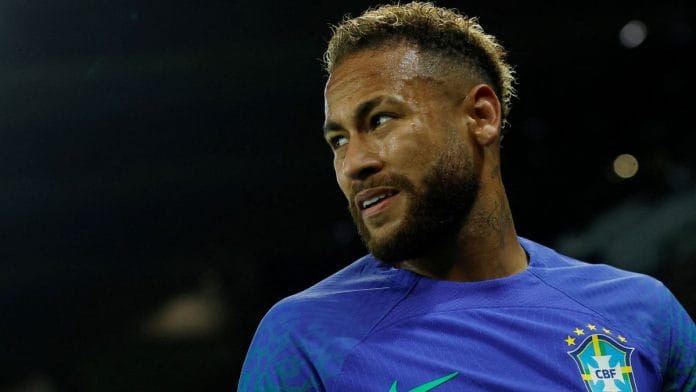


Once compared to the likes of Pele, Neymar Jr, the most expensive player in the history of football, has risen from his ruins and made it back into the 2026 FIFA World Cup 26-man squad.
Filled with tears in a viral reel showing the moment coach Carlo Ancelotti announced his name, Neymar immediately shared the news with his physiotherapist. Why did a player who was once Brazil’s main man—someone who competed with the likes of Cristiano Ronaldo and Lionel Messi—break down after making it to the squad? And why did he share the moment with his physiotherapist?
There was a time when football seemed to serve the Prince of Joga Bonito, that is, Neymar, and the world stopped to see his magic. His story always felt like that of a boy destined to conquer the game. From the streets of Brazil to Santos FC, then to FC Barcelona, and eventually Paris Saint-Germain F.C.—where he became the most expensive player in the history of football—Neymar’s career was supposed to end with the sport bowing at his feet.
Somewhere along the way, the crown became heavy, the magic faded and football became difficult for Neymar. People slowly stopped talking about Neymar the footballer and started talking about Neymar the disappointment. Every rolled ankle became a joke. Every absence became proof that he had wasted his talent. For years, the conversation around one of the most gifted players of his generation stopped being about joy and started becoming about failure. Maybe that is why this story feels so beautiful now—because football hardly offers redemption and even when it does, it doesn’t usually look glamorous.
The return to Santos
Neymar’s comeback started in silence. Once in the wish list of elite European football clubs, he returned to Santos FC in Brazil—the place where he came into the scene. The lanky teenage sensation was so gifted that Pele, the greatest footballer Brazil has ever produced, compared Neymar’s talent to his own.
But the return to his boyhood club felt more like a retreat than a triumphant homecoming, a superstar walking back to where it all began. After suffering an ACL injury against Uruguay in October 2023, Neymar spent a year on the sidelines and was left out of the Brazilian squad for nearly two years. He slowly worked his way back onto the pitch, but Brazil never called him up again.
And yet, there was something deeply unsettling about watching Brazil walk onto a football field without Neymar Jr. There was genuine inconsistency and fitness issues that made it impossible for him to be in the team. But football is beyond tactics, beyond statistics, beyond debates about age or form; certain players become symbols larger than the team itself. Neymar has always been one of them.
For over a decade, he carried the identity of Brazil on his shoulders. Not just the captain’s armband, but the expectation of a footballing nation that still romanticises flair, rhythm, chaos, and beauty. In an era where football has become increasingly mechanical, Neymar remained one of the last few players who still made the game feel playful. He’s the last essence of joga bonito, which is Portuguese for ‘play beautifully’.
That is why his return feels bigger. It feels like redemption. After injuries, criticism, ridicule, and years of being reduced to memes, Neymar finding himself again at Santos FC carries a certain poetry. Football rarely gives players the chance to return to where it all began and rebuild themselves in front of the same people who first believed in them. Yet here he is, forcing the football world to look at him differently once more, not as a fading superstar, but as a man refusing to let his story end quietly.
Also read: Cristiano Ronaldo can learn from MS Dhoni. Sit on the bench this FIFA World Cup
Brazil needs Neymar
And maybe that is why the conversation around whether he should start for Brazil almost misses the point.
Even if Neymar is no longer guaranteed a starter, Brazil still needs him there. Influence is not always measured through 90 minutes. Sometimes it exists in belief, in the way teammates stand taller knowing he is beside them. Brazilian players love Neymar, and that matters more than people admit. Great international teams are built as much on emotional connection as tactical structure. Take the example of Argentina in 2022: a team motivated to complete the arc of one of the sport’s greatest, Lionel Messi, where La Albiceleste were undefeated in the CONMEBOL qualification for the 2022 FIFA World Cup, securing 11 wins and 6 draws. Despite a heart-wrenching defeat in the World Cup’s opening match against Saudi Arabia, Argentina bounced back and went on to win the World Cup after 36 years and Messi’s first World Cup gold medal at the age of 35. Brazil’s dressing room sees Neymar the same way, not as a burden from the past, but as a bridge to the identity they grew up idolising.
Brazil with Neymar feels different. When he wears the colors of his nation, something changes emotionally, not only within the squad but within football itself. There is always a feeling that magic can happen. A pass no one else sees. A touch that changes the rhythm of a match. A moment that reminds the world why Brazil once symbolised imagination more than discipline.
Of course, how much he influences games will depend on how much he plays. Time has caught up with everyone, despite how gifted they are. Neymar may no longer dominate matches the way he once did at his peak. But football history is full of players whose presence alone shifted the emotional gravity of tournaments. Brazil will need his spirit. Right now, there is still more hope with him than without him.
Not necessarily because he guarantees victory, but because of what he represents. Possibility. Joy. Personality. The feeling that football can still surprise us.
Neymar may not be going to the World Cup as the invincible prince of football like he once was, but as something perhaps even more meaningful, a flawed, broken footballer getting one final chance at glory.
And perhaps that is what makes this World Cup journey so important. It may not simply be Neymar chasing one final shot at glory. It may also be football holding onto the last fragments of an era that is slowly disappearing. The end of the last “joga bonito“.
Views are personal.
(Edited by Ratan Priya)