






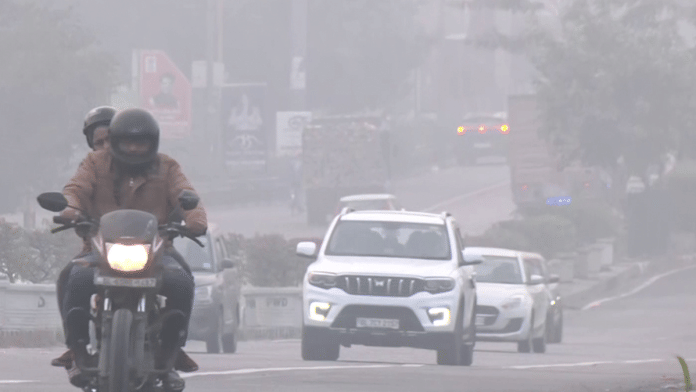



Air pollution kills 1.5 million Indians every year, and afflicts millions more with heart and lung diseases. The acronyms—NCAP, GRAP—pile up, but urban India still struggles to breathe in the winter. But where is the pressure on the government to decisively end this public health emergency?
Recently, the Prime Minister Narendra Modi government rejected the Congress party’s request for a parliamentary debate on air pollution but insisted on a ten-hour debate on Vande Mataram. Adding insult to injury, Modi urged journalists to “enjoy the air” in Delhi on 1 December, even though the average Delhi AQI in November had been 357.
It was not long ago that Modi was forced to abandon plans to commemorate Chhath Puja at the ‘Bisleri Ghat’ in Delhi, a fraudulent effort to show that the Yamuna’s polluted water had been cleaned. The BJP-run Municipal Corporation of Delhi (MCD) was even caught spraying water in the vicinity of air quality monitors to artificially suppress their readings.
Pollution preys on the vulnerable
One reason they get away with this is that while citizens express concern about air quality, they don’t use their only weapon — the vote — to shape political behaviour. A CSDS Lokniti post-election poll was conducted between 29 January and 6 February 2025, right after voting in the Delhi state election, at a time when air pollution levels were still elevated in Delhi. Around 85 per cent of the respondents said that they were concerned about air pollution, but only 1.2 per cent listed pollution as a driving election issue.
Ironically enough, Greens have sizeable support in the Western countries with clean air and blue skies, but not in India, where poisonous air, water and soil kill millions. While it’s true that Indian voters have urgent issues of survival and security, pollution is no less material — it preys on the vulnerable. The young, elderly and working poor suffer most, while the upper classes buy safety through air purifiers and filters.
But how are voters to hold the state accountable? Pollution management has so many complex layers that it seems impossible to fix accountability. Between the central government, various state governments, and municipal agencies, how can a comprehensive solution be found?
Recall how the AAP government initially painted the stubble-burning farmers of Congress-run Punjab as the villain, even though stubble burning occurs for only three weeks each year. This persisted until AAP won the Punjab state elections, after which former Delhi chief minister Arvind Kejriwal appealed to all parties to avoid a “blame game”. At that point, the BJP decided that AAP was the villain, despite the BJP controlling the central government and the MCD.
Now, with a “triple-engine sarkar” under the BJP at the Centre, Delhi and the MCD, not to forget the state governments of Haryana and Uttar Pradesh, who is the culprit? Turns out to be the Maoists. Wow.
Meanwhile, the media does an excellent job of scrambling priorities and leaving voters helpless and confused. They pick one of the episodic irritants, whether crop fires or Diwali firecrackers, for the usual political point-scoring. They fail to point out the far more significant perennial sources of pollution, such as vehicular emissions, traffic congestion, poor road quality, inadequate public transport and dirty household and industrial fuels. It is these year-round sources of pollution that lead to poor air in summer and catastrophic air in the cold months.
To be fair, there has been some action. The Graded Response Action Plan (GRAP) attempts to protect citizens when pollution peaks. A national shift from BS4 to BS6 vehicle engines and the introduction of cleaner petrol and diesel have reduced emissions. Peripheral expressways to the east and west of Delhi have diverted trucks away from the city’s heart. But every winter’s day attests to their ultimate failure.
Also read: Can democracy really function if citizens cannot breathe freely?
Time to buckle up
To find the way forward, Delhi’s citizens must be clear about what they seek. Political parties and citizens’ groups need to demand clear action from each level of government, which would let voters reward or punish them accordingly. Here are some possibilities:
Fix thermal power plants
Of the 35 thermal power units operating within a 300-kilometre radius of the capital, only 14 have operational flue gas desulfurisation (FGD) devices that reduce sulphur dioxide — a major PM 2.5 pollutant. The Modi government has repeatedly postponed the original deadline of December 2017 for all of them to install FGD devices. The current deadline is December 2028, more than a decade late. Meanwhile, these plants continue to pour poisonous sulphur dioxide into north India’s skies.
Big investments in public transport
You can’t expect people to give up private vehicles if public transport remains subpar. The Modi government must fund a major initiative to rapidly expand the Delhi Metro and electrify the entire bus network, achieving a total fleet replacement in a very short period. Light commercial vehicles, taxis, and auto rickshaws must be incentivised to electrify as soon as possible.
Current efforts are far too incremental. Meanwhile, the number of private cars and two-wheelers on Delhi roads increases by 500 and 1,500 per day, respectively. Recall how former Delhi CM Sheila Dikshit converted 1 lakh commercial vehicles to CNG in one year and built a network of CNG stations to fight air pollution in 2001. This is clearly achievable with political will.
Fix Delhi’s broken roads
As the number of private vehicles increases, so does road congestion, which increases the pollutants emitted by each idling or slow-moving vehicle by up to 2.5 times. One reason for this is the poor condition of roads, which is directly linked to corrupt contracting by the MCD. Note that the BJP has controlled the MCD almost uninterruptedly since 2007, with a short break between 2022 and 2025 when the AAP controlled it. We need transparency and reform in the MCD.
Clean up urban industrial pollution
Another source of air pollution is the proliferation of informal enterprises in eastern Delhi and adjoining areas of western Uttar Pradesh and Haryana that use dirty fuels like coal and diesel. Addressing this requires a concerted effort to convert them to cleaner fuels like CNG. The central government can subsidise this fuel transition at scale. The elimination of dirty fuels is one reason Beijing became smog-free within a decade.
It is amusing to see some urging people not to “politicise” air pollution, implying that it has some technical solution. The ruling dispensation couldn’t care less about our health, as long as it wins elections by hook or by crook. Sustained pressure by all who breathe, by civil society and opposition parties, is the only way out. We have to resist attempts to distract and gaslight. Politics is not the problem; it is the answer.
Amitabh Dubey is a Congress member. He tweets @dubeyamitabh. Views are personal.
(Edited by Saptak Datta)
Where were your suggestions when Aam Aadmi Party was in power.
You say, invest in public transport. But when AAP was spending taxes on freebies, weren’t you celebrating that, as pro-poor, and replicating the same in other states?
And did you not regualrize illegal colonies when you were in power? Now, garbage is burnt in same colonies, and you hold BJP responsible.
You yourself were trying to pull down in AAP, in last Delhi elections, and now trying to act like an opposition.