






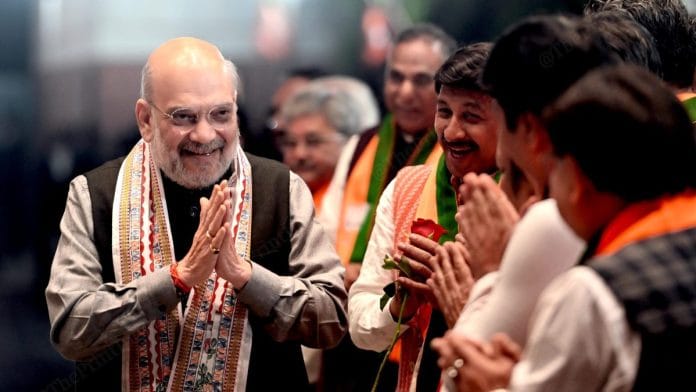



Amit Shah means many things to many people. For Bharatiya Janata Party leaders, he is the Opposition’s nemesis, like Chandragupta Maurya’s Kautilya. They think he is someone who’d know how to keep them in power even in the post-Modi era. To Opposition leaders, he is the master of saam-daam-dand-bhed politics. Their angst is not about political morality—or the lack of it. It’s about their failure to practice the craft with as much perfection and panache. To them, Shah personifies the State—its overarching power and authority, its role as the enforcer of ‘order’ that everyone must submit to for self-preservation.
In 2022, West Bengal chief minister Mamata Banerjee even gave a clean chit to Prime Minister Narendra Modi while blaming Shah for the misuse of the Central Bureau of Investigation (CBI) and the Enforcement Directorate (ED). “I don’t believe the prime minister is doing all this. CBI and ED are not under him … All are under Home Ministry,” Banerjee reportedly told the state Assembly.
The CBI functions under the Ministry of Personnel, Pensions and Public Grievances, a portfolio held by the Prime Minister. The ED is under the administrative control of the Department of Revenue, Ministry of Finance. But what can you do about the Opposition’s perception that Amit Shah runs the government? They aren’t completely off the mark, but this can’t be without the prime minister’s blessings. After all, he is not just PM Modi’s most trusted fellow traveller—who had to undergo many ordeals as Modi’s right-hand man back when the latter was Gujarat CM. Shah is also the home minister, traditionally considered No 2 in the government—with a few exceptions, of course. And he is a tough one at that. The scrapping of Jammu and Kashmir’s special status and its bifurcation into union territories, the Citizenship Amendment Act, the replacement of British-era criminal laws, and an all-out war against Naxalism are only a few examples. His detractors may cite many of his failures, too—Manipur, for one—but the reason was mostly political expediency rather than lack of will or toughness.
Yet, why is it that Shah doesn’t consider the home ministry as the most important one? Interacting with a group of women associated with cooperative societies last year, he said that when he became home minister, people told him that he had got a very important ministry and it was a big deal. After all, Sardar Patel held it. “But the day I was made the cooperation minister, I believe that day I got an even bigger ministry than the home ministry,” Shah told the women.
Bharat Taxi
The Ministry of Cooperation came into being in July 2021, with Shah becoming the first minister. Until then, a joint secretary in the agriculture ministry looked after cooperatives. There is a background to Shah’s love for the cooperatives. Until a dairy came to his village (Mansa in Gujarat), there were only five pucca houses. Within five years, most of the houses were pucca. That’s by his own account. So, Shah had seen the transformative impact of the cooperative movement on the lives of the people early on in his life. By the time he turned 36, he was the president of the Ahmedabad District Cooperative Bank.
Shah’s love for cooperatives may not explain the reason why the country’s home minister, who virtually runs the entire government and the ruling party, should get the prime minister to burden him with another responsibility—that, too, of a seemingly insignificant portfolio like cooperation. Well, that’s what makes Shah who he is. A little over four years since its creation, the cooperation ministry is shaping up as a potentially transformative tool to expand and deepen the cooperatives’ role in every walk of life. There are 8.44 lakh cooperatives with over 30 crore members. As per a recent survey, ministry officials say, about 92 per cent of cooperatives are active in some form or another. It’s just that beyond a few states, such as Gujarat, Maharashtra, and Karnataka, they fell off the radar due to systemic neglect.
Think of the result of government patronage and incentives to such a huge sector in terms of political and electoral clientele for the ruling party at the Centre. Let’s look at the Centre-backed cooperative cab service, Bharat Taxi, that was rolled out on a pilot basis in Delhi-NCR on 1 January. It will be launched in Rajkot next, before it is rolled out across the country. Six lakh drivers have already registered, barely three weeks since launch, according to ministry officials. Unlike Ola and Uber, which charged commissions of up to 40 per cent from drivers, Bharat Taxi takes zero commission. It has already forced the two big ride-hailing services to shift from the commission to a subscription-based model. This means a lot more money in the drivers’ pockets. At some point in time, there may be some subscription model or platform fee, but it will be a paltry amount compared to what drivers have been paid in the past by Ola, Uber, and Rapido in terms of commission. Imagine how many drivers will benefit from this once Bharat Taxi is fully operational across the country. And who would they have to thank for this? Shah and the BJP-led central government, of course.
The cab service is just the start. Plumbers could be the next in the list of mobile-based aggregator services. Apart from the ongoing legal reforms and digitisation, the National Cooperation Policy 2025 lays out the plan to promote cooperatives in emerging areas such as renewable energy, waste management, health and education, biogas and ethanol production, and organic and natural farming. National Cooperative Organic Limited has undertaken the aggregation, branding, and marketing of organic products in national and international markets. Think about it: there is a surge in the demand for organic food but there is no certification. If the government steps in to get it certified and marketed, farmers’ cooperatives for organic farming will be the next big thing, making both farmers and consumers happy. Who will get the credit? No points for guessing.
Then, PACS or primary agricultural credit societies are being converted into common service centres. Think of PACs delivering over 300 e-services to villages, including insurance, health, and education. Think of a villager not having to log in to travel booking apps such as MakeMyTrip to book their train and flight tickets. Over 40,000 PACS have already started providing these services.
Also read: BJP’s Kerala conundrum—courting Christians isn’t working out
Building grassroots connect for BJP
The government is already in talks with the Food Corporation of India (FCI) to use farmers’ cooperatives for godowns and warehousing. As it is, the FCI takes such premises on rent to store foodgrains. These cooperatives can provide the same to the FCI and they can also be used to store farmers’ produce. Various other agriculture infrastructure projects—hiring centres, processing units, and fair rice shops—are envisioned to be a part of the world’s largest grain storage scheme in the cooperative sector. Tribhuvan Sahkari University was started last year by transforming its Institute of Rural Management Anand (IRMA) to educate and train youth in cooperative sector—from management to business and finance.
You don’t even need experts to tell you what this four-year-old ministry is up to. It’s mind-boggling. Just take a look at the National Cooperation Policy 2025 and Press Information Bureau’s ‘Year Ender 2025 – Ministry of Cooperation: “Sahakar se Samriddhi”’.
Many might find it as another slogan like ‘Viksit Bharat 2047’, which many of us voters may or may not survive to see and celebrate. But the way the cooperation ministry is working on a war footing—Bharat Taxi being just the first project of many—‘Sahakar se Samriddhi’ does not look like a mere slogan.
“In the next five to seven years, there will be a revolution in cooperatives sector,” a senior ministry official told me last week, elaborating how things are unfolding so fast. “Amit Shah knows so much about cooperatives that every meeting with him is like a learning lesson.”
Elections in 217 out of 1,700 multi-state cooperatives have already been held, with district collectors being responsible for their proper conduct. The senior official added by way of explaining that even if cooperative societies are in the state list, the Centre is doing its best to streamline and reinvigorate the cooperative sector. Going by the optimism of officials, Shah’s cooperation ministry is expecting to achieve in a few years what the government committed itself to achieving by 2022—that is, doubling farmers’ income.
While Rahul Gandhi and others in the Opposition are banking on the social justice plank to woo rural India, Shah is taking it to a whole new level. Cooperatives are his way of building grassroots connect for the BJP through economic empowerment. And there is an army of swayamsevaks or volunteers, such as taxi drivers, plumbers, farmers, and other beneficiaries, who may soon be co-opted.
DK Singh is Political Editor at ThePrint. He tweets @dksingh73. Views are personal.
(Edited by Prasanna Bachchhav)
BJP should be worried about this new UGC ruling! Or it will be eradicated in the next election!