









It’s a treat to watch Lok Sabha Speaker Om Birla when the House proceedings are on. When he looks to the right, the Treasury benches, he wears a beatific, indulgent smile of a father. When he looks to the left, the Opposition benches, the smile turns into a smirk and grimace, with the visage of a superintendent of a juvenile reformatory.
I have known Birla for over two decades—since his days as Parliamentary Secretary in the Vasundhara Raje-led government in Rajasthan in 2003-2008. He has always been a genial person. I presume his ostensibly stern demeanour when he turns to his left is not necessarily suggestive of a bias that the Opposition accuses him of. I would rather think that, as a leader who has been winning elections since 2003 for the Assembly and the Lok Sabha three consecutive times each, his facial expression may be a sign of frustration and exasperation with the Opposition. It refuses to learn from repeated electoral defeats, doing the same things over and over again, hoping that it will come up trumps one day, god willing. A master of the art and craft of politics—see where he is and where Raje is today—Birla’s ostensible anger with the Opposition, for all we know, might be driven by empathy and angst—and more so, boredom. The Opposition not being up to the mark can also upset presiding officers.
Birla had more reasons to be upset with the Opposition Thursday. He disclosed that it was he who had requested Prime Minister Narendra Modi not to come to the Lok Sabha to reply to the Motion of Thanks to the President’s Address. The Speaker said he had ‘credible information’ that the Opposition MPs could go to the PM’s chair and do something unexpected that would have “shattered the country’s democratic traditions”.
PM Modi’s repeated reference to the ‘Modi teri kabr khudegi (Modi, your grave will be dug)’ slogan in his Rajya Sabha speech later in the day lent credence to Birla’s ‘information’ about the Opposition’s purportedly bad designs. Why was it that the prime minister of the country didn’t find it safe to be physically present in the Lok Sabha? It concerns his security. The Lok Sabha Speaker knows about it. He must order a high-level inquiry by a special investigation team (SIT), if not the National Investigation Agency (NIA). The prime minister’s security can’t be left to wild speculation, conjectures, or political gossip. The truth must come out.
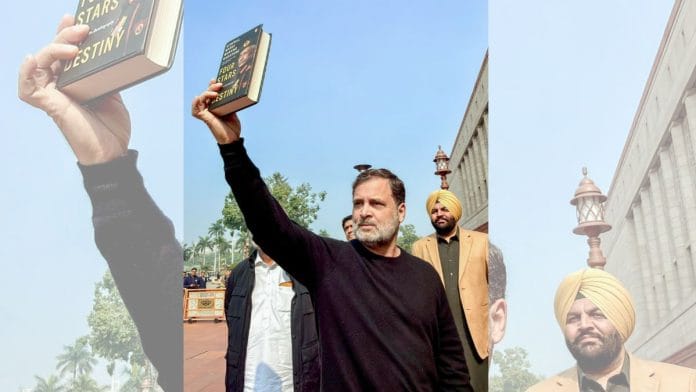
Meanwhile, there were celebrations in the Congress camp last week. The party’s MPs looked convinced that Rahul Gandhi had scared Team Modi out of their wits by what they ostensibly believed were ‘big revelations’ from former Army chief General MM Naravane’s unpublished memoir. These so-called revelations, Opposition leaders told me, would demolish PM Modi’s image as a strong and decisive leader. This was because, they said, instead of the political leadership showing decisiveness in taking a call on what could have potentially started a war with China, the PM left it to then Army chief to decide: “Jo uchit samjhao woh karo (Do what needs to be done)”.
Gandhi’s beaming, gleeful face inside and outside the Parliament said it all. He had put the government on the mat—or so he obviously thought. How often did one see defence minister Rajnath Singh and home minister Amit Shah rise to prevent the Leader of the Opposition from speaking? Gandhi had predicted that PM Modi was so “scared” that he wouldn’t come to the Lok Sabha to reply to the Motion of Thanks to the President’s Address. PM Modi didn’t come, and Gandhi was taking credit for it. Birla gave us a different version, of course.
A trap for Rahul Gandhi
It’s not the first time Gandhi has assumed that PM Modi is scared of him. He says it so often. Only that it seems to scare the voters, too. At least, that’s what the election results repeatedly say. Look at the latest instance. Does Gandhi really think the government was unnerved by the Opposition’s ‘revelations’ from Gen Naravane’s book, which were reported by the Press Trust of India two years ago? Would Mizoram governor and former Army chief General VK Singh have written such a glowing foreword to Gen Naravane’s unpublished book if the government didn’t like it? Here’s what he wrote for the book, Four Stars of Destiny:
“A very thorough appraisal of several events and issues has been put down, which will ensure better comprehension for all who go through it. I would, without hesitation, recommend this autobiography…to all who want to understand the different events that he encountered, relive their own journey in the Army…. My profuse accolades to him.”
Gen Singh was a minister in the Modi government when Gen Naravane’s book was sent to the defence ministry for approval, which hasn’t come yet.
And how does the PM’s purported ‘Jo uchit samajho woh karo’ message to then-Army chief hurt his image as a strong and decisive leader? The government could have simply argued that PM Modi gave operational freedom to the former Army chief. He gave a ‘free hand’ to the Armed Forces to respond to the Pahalgam terror attack, too.
To me, the Treasury benches were only laying a trap for LoP Gandhi with their vehement opposition to his reference to Gen Naravane’s book. Why would they go out of the way to prevent him from speaking in the House, which he would speak outside anyway? The Speaker could also have expunged it from the record later. And Gandhi walked right into the trap, disrupting the proceedings for an entire week and sparing the government any serious discussions on issues that could have really hurt the ruling party.
If the Modi government really cared about Gandhi’s attacks, it would not have sent defence secretary Rajesh Kumar Singh and DG (Acquisition) A Anbarasu to attend an event announcing a strategic collaboration between two private entities: Adani Defence and Aerospace and Leonardo (formerly AgustaWestland). The AgustaWestland VVIP chopper scam case is still in the courts. The company isn’t in the blacklisted category anymore, though. The event was happening when the stalemate was on in Parliament. One could argue that defence officials’ presence only showed the government’s support for private sector collaboration in defence, but their presence itself could have given enough ammunition to Gandhi to raise the question of propriety.
Essentially, the government knows that when it comes to national security and defence matters, PM Modi doesn’t have to worry about Gandhi. Modi vs Rahul over these matters is no contest. And it was clear again Thursday, when PM Modi virtually took the Opposition to cleaners in the Rajya Sabha, pitting his personal imprimatur to counter the Opposition’s attack.
Also read: Bangladesh women take on Jamaat with memes and marches. Their future is at stake
Flanking manouvre
Gandhi needs to study the flanking manoeuvre, a military tactic, when it comes to fighting with a much bigger enemy. Personal attacks on PM Modi may give the Congress leader a sense of heroism or a sort of martyrdom in his ideological war against the BJP, but it’s no help to the Congress. It has been proven time and again. For a change, Gandhi may think of adopting the flanking manoeuvre—attacking weaker spots such as the BJP-led governments in states or the ministries/ministers at the Centre for their acts of omission and commission, if any.
Let me cite an example. The BJP-led Madhya Pradesh government has refused to grant prosecution sanction against minister Vijay Shah for his derogatory remarks against Colonel Sofiya Qureshi, who led the briefings during Operation Sindoor and became a household name. On 19 January, the Supreme Court gave a two-week deadline to the Mohan Yadav government to decide on the prosecution sanction. It is still dithering over the matter. Shah remains a minister. The issue hasn’t drawn Gandhi’s attention yet.
The leader of the Opposition also doesn’t seem very excited about raising in Parliament the issue of water contamination deaths in Indore. And these are only two of many issues that the Opposition can use to pin down the Yadav government in the state and nationally. The Congress’ response, however, has been perfunctory and episodic, mostly through media statements and X posts.
If Gandhi were to look around, he would find so many issues to talk about in every BJP-led state. I listed only some samples in my 12 January column titled “BJP CMs are drawing the wrong lessons from election victories”.
There are many, many other issues in these states. And there are many more to corner individual ministers and ministries at the Centre—the gigantic failure of the much-hyped internship scheme, for one.
But Gandhi ostensibly doesn’t find them worthy of a fight with him. He would rather fight with the BJP’s biggest strength, PM Modi, no matter what. At 55, he obviously has age on his side. As the de facto chief of the Congress and the leader of the Opposition in the Lok Sabha, he enjoys all the privileges. He can keep up the fight for 20-25 years more, simply waiting for PM Modi to hang up his boots. Most of his party colleagues may not have the time or stamina for such a long wait. They should get Gandhi to watch Sniper: The Last Stand. Colonel Modise, a character in the movie, has a message for him: “A leader knows the way, goes the way, and shows the way. Leadership is an action, not a position.”
DK Singh is Political Editor at ThePrint. He tweets @dksingh73. Views are personal.
(Edited by Prasanna Bachchhav)
Rahul needs no lesson in spreading misinformation and confusion.
Grossly misinterpretonh a Hindi sentence and casting aspersions on the Army chief is detrimental to our national security.
This man is dangerous for our country.