









Ghanta”—the Hindi slang word stands for accountability for some politicians in Madhya Pradesh. Or so it seems from their responses to the contaminated water tragedy in Indore. An NDTV correspondent sought minister Kailash Vijayvargiya’s response to the fact that the victims were not getting a refund of their medical expenses and the drinking water arrangement wasn’t proper. The powerful minister found it a “fokat” or useless question and dismissed it with the “ghanta” remark.
So far, the government maintains that the death toll was eight, although the district administration has given Rs 2 lakh as compensation to the families of 18 people.
Chief minister Mohan Yadav sounded philosophical when asked about the discrepancies in death figures. “Even a single life is extremely painful for us…we don’t delve into statistics,” he said. However touching this might be, the government’s response to the tragedy has left much to be desired. It has suspended and transferred a few municipal corporation officials, while the political executive has refused to own up.
CM Helpline data shows that Indore residents filed 100 complaints about water contamination, Bhaskar English reported. In Bhagirathpura, where contaminated water has claimed several lives, 11 complaints had already been sent to the chief minister. No action was taken. About 550 sewage-related complaints from Indore are pending on the CM Helpline.
According to the report, Mayor Helpline was worse. So, where does the buck stop? With unelected officials only, ostensibly. What’s the job of the elected representatives, then? Well, last heard, Yadav was working on shifting the Prime Meridian from Greenwich in England to Ujjain.
He was also working on a campaign to stop people from calling the Hindu deity Kishna ‘makhan chor (butter thief)’, as it was an act of rebellion against his uncle Kamsh.
Is this what the double-engine government was supposed to deliver in Madhya Pradesh? And the triple-engine in Indore, a Smart City? If the people are getting disillusioned with the tepid governance, who would they blame? Not Yadav, of course. They hadn’t voted for him to become the chief minister. Their mandate was for Shivraj Singh Chouhan. Why should Yadav lose his sleep then? It’s Prime Minister Narendra Modi who may be worried—and not just because of what’s happening in Madhya Pradesh.
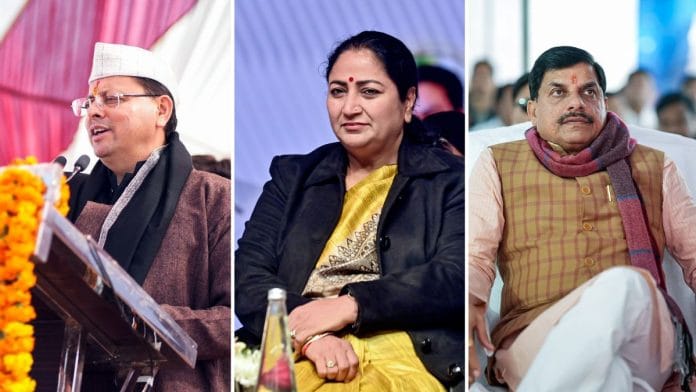
The case of CMs Dhami & Gupta
Look at how the double-engine government has done in ‘Devbhoomi’ Uttarakhand. Chief minister Pushkar Singh Dhami is giving the BJP a scare about a year ahead of the Assembly election. Youth coming out on the streets in protest is becoming a worrisome trend—first over paper leaks in 2025 and now over the alleged involvement of ‘a VIP’ in the Ankita Bhandari murder case. These spontaneous protests have got ruling party leaders jittery. The difference in the vote shares between the BJP and the Congress had already narrowed from 13 percentage points in 2017 to 6 percentage points in 2022 Assembly elections. Dhami has made live-in relationships, ‘land jihad’, ‘thook jihad’, and now a proposed ban on non-Hindus from the 105 ghats of Haridwar his main governance agenda.
It doesn’t seem to be helping the BJP, as is evident from frequent youth protests. The killing of Tripura student Anjel Chakma in a racist attack in Dehradun has only raised more questions about how the BJP is governing the ‘Land of the Gods’. Like Yadav, Dhami may not be overly bothered. The mandate in the 2022 Assembly election was not for him. He had been appointed the chief minister barely six months before the election. As incumbent chief minister, he lost his own election from Khatima but was retained in the position—a decision many of his party colleagues regret today. It’s hardly surprising to hear whispers about the need for a change of guard in Uttarakhand.
Although it would be unfair to judge Rekha Gupta in barely 11 months, her government in Delhi has been all talk so far. Weeks after coming to power, she had launched ‘Air Pollution Mitigation Plan 2025’ with a lot of fanfare. The government has been making headlines for all the wrong reasons since, be it the failure of the much-hyped Rs 3 crore artificial rain experiment or spraying water near pollution monitoring stations to bring down the air quality index. It was a tad unfair to subject her to public ridicule for calling the AQI “a sort of temperature” that can be measured by any instrument. Nobody knows everything. But one would certainly expect the Delhi CM to study and understand the basics before making tall promises of mitigating pollution. Also, to say that Brahmins ignite the flame of knowledge is politically incorrect.
Also read: J&K medical college was shut over ‘unacceptable’ demography. Hindus can be a minority too
Misreading elections
It’s not just Yadav, Dhami, and Gupta. Not even half of the 14 BJP chief ministers seem to be making efforts to justify the trust the party high command reposed in them. Yogi Adityanath, Devendra Fadnavis, and Himanta Biswa Sarma turned out to be great investments. Of the rest, Chhattisgarh chief minister Vishnu Deo Sai is turning out to be an administrator who wants to make a difference. His focus on turning the erstwhile Naxal hotbed into a tourist destination and bringing investment into the state is impressive. Arunachal Pradesh chief minister Pema Khandu is a one-man party who can’t be touched, of course.
What’s wrong with the rest? Watch their words and actions carefully. Their lackadaisical governance seems to stem from their reading of the BJP’s election victories as a result of three Ms: Modi, majoritarianism, and money. That is to say, Modi’s charisma, mobilisation of the Hindus, and direct financial assistance to voters (Rs 10,000 to women in Bihar, for instance) or welfare/populist schemes. Their reading of the election results may not be entirely wrong, but they are missing the bigger picture.
First, if their reading is right, the three Ms make them entirely dispensable. The BJP has done it in many states, including Gujarat, Uttarakhand, and Haryana. Second, these CMs should closely look at why some of their counterparts became powerful and indispensable. Adityanath didn’t get a second term in office just because of his polarising politics. It was also about his development initiatives and the restoration of law and order. Fadnavis emerged as the ‘infrastructure man’ in his first term, which made him the BJP’s undisputed face in Maharashtra.
Most importantly, these BJP chief ministers must remember that they are beginning to hurt Brand Modi. When the prime minister promises a double-engine government, he essentially seeks a mandate for himself in the Assembly elections, too. So, if a state government fails to deliver, it adversely affects Brand Modi. That is to say, non-performing BJP chief ministers may end up undermining PM Modi’s popularity. And that is something the BJP can’t afford when Modi is in his third term. If the first M loses lustre, the other two won’t be so effective either.
DK Singh is Political Editor at ThePrint. He tweets @dksingh73. Views are personal.
(Edited by Prasanna Bachchhav)