






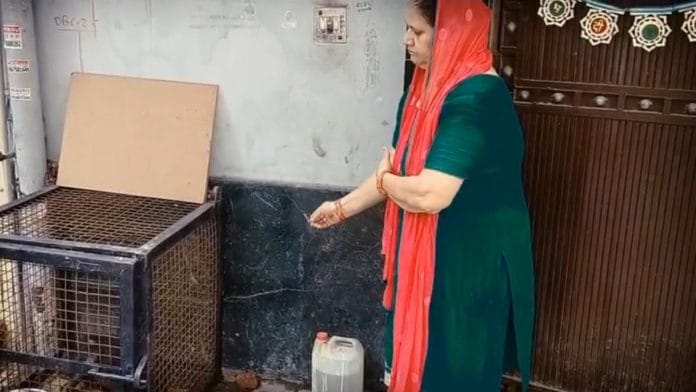



Religion, politics and pigs all came together in a Delhi neighbourhood recently, such that it would leave one scratching their head. According to the report, Hindu families in Tri Nagar—home to over 70 Muslim households—were worshipping pigs, often caged, alongside images of Varaha, the boar-headed Hindu deity.
Was it simply an act of devotion or a not-so-subtle political message to Muslim families? The debate is unfolding on social media.
Both sides, unsurprisingly, have their own accounts. The Hindu families maintain that it is an expression of belief. Residents from the Muslim community, however, allege that the act is provocative, pointing out that pigs are given Muslim names such as Sultan or Abdul.
It’s tragic that Varaha, whose story is about saving the earth and restoring cosmic order, is being turned into something ridiculously petty. A story that once spoke of saving the world is now being rewritten to draw lines within it. Religion can be a bridge based on our shared humanity, but it always ends up becoming a barrier.
Religion belongs in the spiritual domain, where it can guide one’s personal morals. When it takes a political shape, it becomes a question of how society should be organised: who fits within a space and who must be thrown out. That is the case of Delhi’s Tri Nagar.
Over a year ago, L&T chairman SN Subrahmanyan sparked controversy by suggesting a 90-hour work week.
“How long can you stare at your wife? How long can the wives stare at their husbands? Come on, get to the office and start working,” he said.
Perhaps Subrahmanyan captured an insight not understood at the time—a gruelling work week might be a better alternative to devoting this amount of time, energy, and effort into annoying your neighbours. One of the videos featured a woman sharing a plate of food with her pet pig. These scenes would make for a great Bollywood comedy, were there no darker forces at play.
Also read: Tamil Nadu’s elections are fought on delivery—ideology appears only when needed
A new symbol of hate
You may bring a pet into their life out of care, even out of devotion. But if the primary reason is to create discomfort for others, it should give you pause.
It’s a case of not being able to see the wood for the trees. When you spend so much effort on obsessing over others, it stops being about them entirely. Your decisions begin to be shaped by resentment and hostility.
Social media influencers and TV personalities who heavily generalise Muslims might find a certain comfort in the pig worship. It creates a space where they don’t have to word their hatred clearly, but can still signal it.
And that is what makes the episode more dangerous.
Openly calling for ‘genocide’ or marginalisation of a community is not acceptable anymore. But the sentiment does not disappear. It finds more socially acceptable ways to express itself. And sometimes, it begins to show up through small actions, such as caging up and worshipping an innocent animal.
Neither Delhi nor India are alone in their newfound love for pigs. Last month, MAGA supporters in New York organised a pig roast in front of Muslim mayor Zohran Mamdani’s office. But the funniest part about such incidents remains that they’re is based on a misunderstanding rooted in ignorance. Hindus and Christians can eat all the pork they want and keep pigs as pets—that does not bother Muslims. Pigs exist everywhere, including on the streets in many parts of India. Muslims see them, but they simply choose not to touch them. It is a personal religious practice.
The pig politicisation saga smuggles destructive communalism under the guise of spiritual practice. The veneer is especially thin in this particular instance, even if the provocation is not unique to Delhi or Hindus. It’s a well-practised strategy being deployed around the world. And for those of us who wish to see a harmonious, tolerant India, the four-legged pigs are not the real threat.
Amana Begam Ansari is a columnist, writer, and TV news panellist. She runs a weekly YouTube show called ‘India This Week by Amana and Khalid’. She tweets @Amana_Ansari. Views are personal.
(Edited by Prasanna Bachchhav)